Author: Alex

  • Restaurant Subleases Explained: Lower Costs and Maximize Space

    Restaurant Subleases Explained: Lower Costs and Maximize Space

    Many restaurant operators assume subleasing is too legally complex or financially risky to be worth pursuing. The reality is that a well-structured sublease can turn idle square footage into real rent relief, especially when occupancy costs are squeezing margins. Across the industry, rent alone can consume 6 to 12 percent of gross sales, and negotiating sublet rights upfront is one of the most underused tools operators have. This guide breaks down exactly what a restaurant sublease is, how it works, the pros and cons, and how to use it strategically to cut overhead and make your space work harder for your business.

    Table of Contents

    Key Takeaways

    Point Details
    Restaurant subleasing basics A restaurant sublease lets you rent out your space to another operator, with landlord consent, to offset costs.
    Financial benefits Subleasing can keep occupancy costs within the recommended 6-10% of sales and generate extra revenue.
    Major risks Despite cost savings, you remain liable if your subtenant defaults or goes bankrupt.
    Best negotiation tips Secure broad sublet rights and clarify all terms in your lease before committing to a sublease.

    What is a restaurant sublease?

    A restaurant sublease happens when the original tenant, called the sublandlord, rents all or part of their leased space to a third party, called the subtenant. The original landlord stays in the background. The subtenant gets the right to use the space, but their legal relationship is with the sublandlord, not with the landlord directly. This three-party structure is what operators often get confused about.

    Think of it like this: you signed a 10-year lease on a 3,000-square-foot restaurant. Business is slow on weekday mornings, so you rent the kitchen to a catering company from 6 a.m. to noon. You are now the sublandlord. The caterer is your subtenant. Your landlord is still your landlord, and your obligations under the master lease do not change.

    The sublease mechanics require the primary lease to permit subleasing, and the arrangement creates a direct landlord-tenant relationship between you and the subtenant, always subordinate to the master lease. That last part is critical: the master lease governs everything. If there is a conflict, the master lease wins.

    It is also important to understand the difference between a sublease and a license agreement. These two are often confused but they are legally very different. Understanding assignment vs. sublease is equally valuable context here.

    Feature Sublease License
    Possession Exclusive Non-exclusive
    Revocability Not easily revocable Can be revoked
    Tenant rights Strong, resembles a lease Minimal, permission-based
    Legal relationship Creates landlord-tenant relationship Does not
    Common use Ghost kitchens, shared dining rooms Pop-ups, event use

    Common real-world use cases for restaurant subleases include:

    • Ghost kitchens: Renting your licensed commercial kitchen to a delivery-only brand during off-hours
    • Shared dining rooms: Subleasing front-of-house space to a brunch operator while you only do dinner
    • Temporary concept testing: Letting a new operator trial your space before they commit to their own lease
    • Partial space monetization: Renting a storage area, private dining room, or event space to offset your base rent

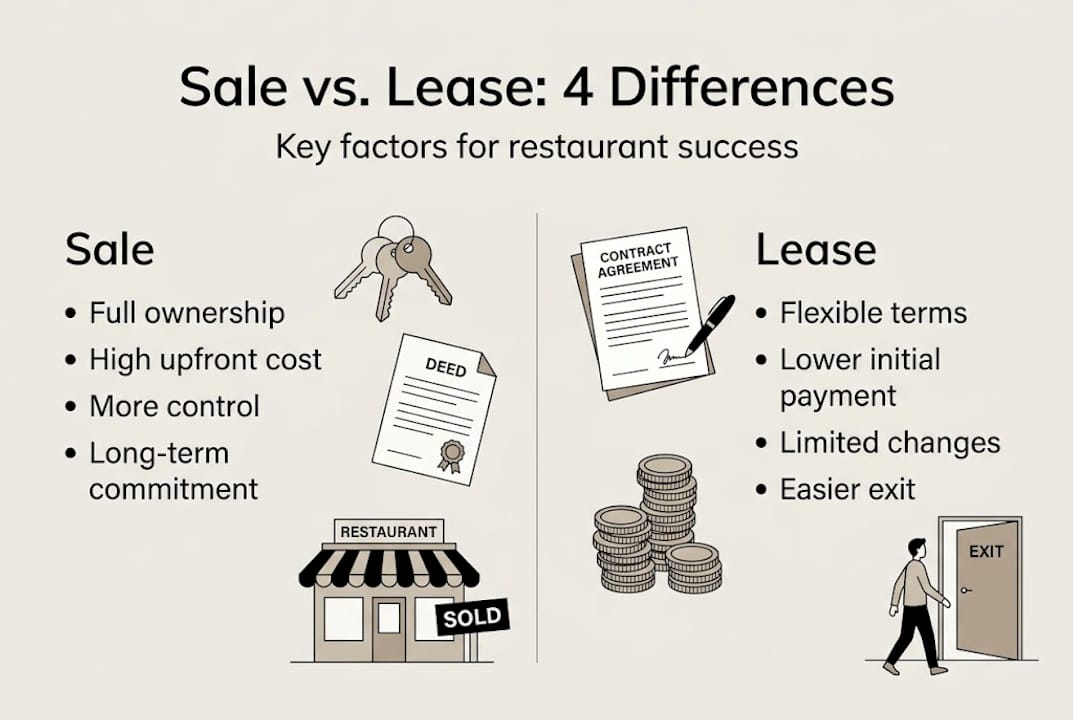
    Understanding whether your setup calls for a sublease versus another arrangement is foundational. Review sale vs. lease differences if you are also weighing whether to sell the business altogether.

    Why restaurant operators consider subleasing

    The math is simple. Empty space costs money. Even if nobody is cooking in your kitchen from 2 a.m. to 10 a.m., you are still paying rent on every square foot. Subleasing turns that dead time into income.

    Line cook working alone in empty morning kitchen

    Restaurant occupancy costs should fall within 6 to 10 percent of gross sales for most concepts, with fast casual running 5 to 8 percent, casual dining at 7 to 8 percent, and fine dining at 8 to 12 percent. If your current costs exceed those benchmarks, subleasing can be the fastest way to bring them back in line without renegotiating your entire lease.

    Restaurant type Target occupancy cost (% of sales)
    Fast casual 5 to 8%
    Casual dining 7 to 8%
    Fine dining 8 to 12%
    Quick service 4 to 6%

    Here is when subleasing makes the most financial sense:

    • Off-peak hours: You operate dinner only and want to recover daytime rent by subleasing kitchen access
    • Excess square footage: Your buildout includes more space than your current concept uses
    • Ghost kitchen model: You want to add a virtual brand without leasing a second location
    • Slow periods: Seasonal downturns where coverage from a subtenant stabilizes cash flow

    The complete workflow for subleasing your restaurant space walks through exactly how to find and vet subtenants, set terms, and execute the agreement.

    “Smart operators don’t wait until they’re struggling to think about subleasing. They negotiate the right to sublease on day one, before they ever need it.”

    Pro Tip: When negotiating your original lease, push for broad subletting rights with no requirement for landlord consent beyond written notice. This one clause can save you enormous stress and legal fees later.

    For a real-world example, check out this full restaurant sublease in Los Angeles currently active on Pepperlot. It gives you a feel for how these deals are structured and priced. If you want broader market context, the breakdown of LA restaurant leasing costs is worth reading before you set your sublease rate.

    Risks and challenges of subleasing your restaurant space

    Offloading space sounds great, but it carries risks you will want to anticipate before signing anything.

    The biggest one: you remain fully liable to your landlord even after you sublease. If your subtenant stops paying rent, you are still on the hook. Your subtenant’s failure becomes your problem. That ongoing liability exposure also extends to property damage, lease violations, and bankruptcy scenarios.

    Here are the key risks in order of how often they bite operators:

    1. Subtenant default: Your subtenant stops paying. You owe the landlord regardless.
    2. Buildout and TI costs: If the space needs upgrades for a subtenant, you may need to fund tenant improvement costs with no guarantee of long-term occupancy.
    3. Rent gap risk: You may need to sublease below your own rent rate to attract a tenant, especially in slow markets. That gap comes directly out of your pocket.
    4. Slow ramp-up time: Finding a qualified subtenant can take months. Many operators underestimate this timeline.
    5. Bankruptcy exposure: If your subtenant files for bankruptcy, lease rejection proceedings can leave you exposed to unpaid obligations.
    6. Operational conflict: Shared kitchens create friction around equipment, cleanliness standards, and scheduling.

    “The most dangerous assumption in restaurant subleasing is thinking you’ve offloaded the risk. You’ve shared the space, not the liability.”

    Pro Tip: Before you list your space, audit your existing lease carefully. Understand whether a full lease assignment would remove you from the picture entirely. Assignments transfer all obligations to the new tenant. Subleases do not. Review the challenges of leasing restaurant space and hidden buildout costs before you commit to a sublease structure.

    For some operators, especially those with failed locations, the cleaner move is lease termination or assignment. Subleasing feels like a solution but can extend financial exposure rather than end it.

    Best practices and negotiation tips for restaurant subleases

    For those set on subleasing, the difference between success and headaches lies in your negotiation strategy, starting long before you ever need to sublease.

    Infographic showing restaurant sublease benefits and risks

    The first move is securing broad sublet rights in your master lease from the start. Ghost kitchens and shared food-service spaces have normalized subleasing as a cost-cutting strategy, and most landlords in food-service markets will agree to reasonable subletting language if you ask early.

    Here is a checklist for what your sublease rights should include:

    • Landlord consent: Required, but must not be unreasonably withheld
    • Permitted use clarity: Sublease should specify what type of food business is allowed
    • Non-revocation protection: Landlord cannot pull consent without cause after the sublease is signed
    • Revenue-sharing or flat-rate terms: Define clearly whether rent is fixed or tied to subtenant sales
    • Exit clauses: What happens if your subtenant wants to leave early
    • Sublease term limits: Ideally shorter than your master lease term to retain flexibility

    Watch for these red flags in agreements:

    • Vague permitted use language that could create conflicts with your own operations
    • Landlord consent provisions that allow rejection for almost any reason
    • No tenant improvement allowance when the space clearly needs work
    • No free rent period for subtenant ramp-up, which makes it hard to attract quality operators

    Pro Tip: Consider offering new subtenants a modest free rent period of 30 to 60 days or a small TI contribution. The cost is usually less than two months of carrying the space empty.

    Know when to push for lease assignment vs. subleasing instead. For failed locations, experts prefer assignment because it releases you from ongoing liability. Subleases can be unfavorable at struggling locations due to high construction costs and slow market demand. Also read up on attracting serious restaurant tenants to understand what operators actually look for before they commit to a sublease.

    A fresh perspective: Why subleasing isn’t always the solution—what seasoned operators have learned

    Here is the uncomfortable truth most guides skip: subleasing is not a cure-all, and treating it like one is a common and costly mistake.

    Experienced operators know that lease termination is often preferable to subleasing for underperforming locations. Why? Because a sublease keeps you legally connected to the space and the subtenant. Every month your subtenant operates, you are still exposed. If they struggle, you inherit the problem.

    What first-timers miss most is the ramp-up reality. Finding a good subtenant for a restaurant space, especially one that needs buildout work, can take six months or more. During that window, you pay full rent with zero offset. By the time the subtenant is operational, you may have already absorbed the losses you were trying to avoid.

    The cleaner play, as seen through assignment vs. sublease realities, is to negotiate a full lease assignment when you want out, or to secure sublease rights proactively when you are growing and want optionality. Subleasing works best as a planned tool, not a reactive one. Operators who build it into their strategy from lease signing tend to come out ahead. Those who reach for it as a last resort often find it adds complexity without delivering the relief they expected.

    Ready to find or offer a restaurant sublease?

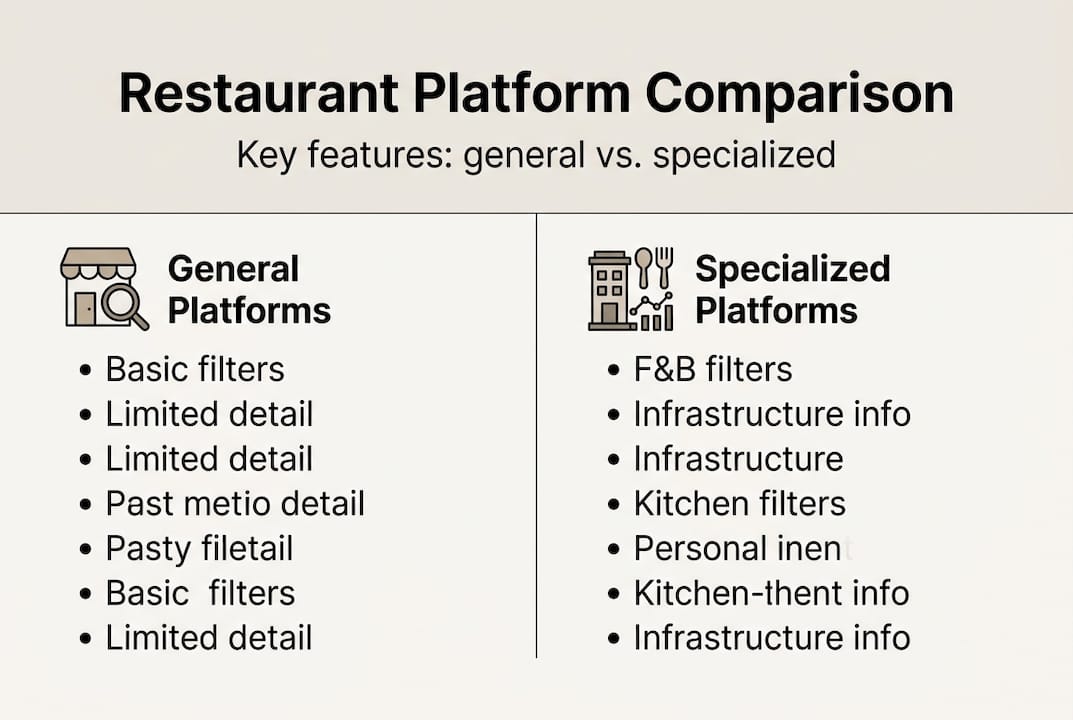
    If you are looking to sublease your space, list it, or find an existing restaurant already set up for your concept, Pepperlot is built specifically for this. Unlike generic commercial real estate platforms, every listing on Pepperlot includes restaurant-specific details like permits, seating capacity, kitchen infrastructure, and sublease terms.

    https://pepperlot.com

    Browse active listings like a restaurant for lease in Las Vegas, a restaurant for lease in San Francisco, or a fast casual sublease in New Jersey to see how operators across the country are structuring their deals. With over 500 active users including operators, landlords, and brokers, Pepperlot connects you to serious matches, not tire-kickers.

    Frequently asked questions

    Yes, most primary leases require landlord consent before subleasing is permitted. Always check your master lease before approaching potential subtenants.

    How does subleasing lower occupancy costs?

    By collecting rent from a subtenant, you offset your own rent payments and bring occupancy costs closer to the recommended 6 to 10 percent of gross sales benchmark.

    What’s the main difference between a sublease and a license?

    A sublease grants the subtenant exclusive possession of the space, while a license is non-exclusive and can typically be revoked at any time by the licensor.

    What risks remain if my subtenant defaults?

    You remain fully liable to your landlord for rent and all lease obligations if your subtenant defaults, meaning the master lease terms still apply to you regardless of the subtenant’s performance.

  • How to Lease Restaurant Space: Step-by-Step Guide

    How to Lease Restaurant Space: Step-by-Step Guide

    Two restaurants open in the same building, paying nearly identical rent. One thrives for a decade. The other closes in 18 months. The difference often comes down to a single document: the lease. A poorly structured lease can trap you in a space that kills your margins before you serve your first table. A well-negotiated one gives you breathing room to build something real. This guide walks you through every stage of the restaurant leasing process, from defining your requirements and researching locations to negotiating terms and completing due diligence, so you can make decisions with clarity and confidence.

    Table of Contents

    Key Takeaways

    Point Details
    Know your needs List your non-negotiable features and dealbreakers before touring restaurant spaces.
    Benchmark costs Keep total occupancy cost no higher than 10 percent of projected sales for a viable lease.
    Negotiate smart terms Seek key protections like rent abatement, TI allowance, and renewal options when you negotiate.
    Verify everything Do thorough due diligence and review all documents before signing to avoid costly surprises.

    Clarify your restaurant requirements and dealbreakers

    Before you visit a single space, you need a clear picture of what you actually need. Skipping this step is one of the most common and costly mistakes operators make. You end up falling in love with a location that can’t support your ventilation requirements or doesn’t have the electrical capacity for your kitchen equipment.

    The step-by-step leasing process starts with assessing your concept, ventilation needs, parking access, kitchen size, and utility capacity before you ever walk through a door. That sequence matters. Getting clear on your needs first filters out spaces that look great but won’t work operationally.

    Here are the core requirements to define before your search:

    • Concept fit: Does the space match your service style (fast casual, full service, bar, ghost kitchen)?
    • Kitchen infrastructure: Hood systems, grease traps, gas lines, and electrical capacity are expensive to add later.
    • Seating capacity: Does the floor plan support your revenue model?
    • Ventilation and HVAC: Inadequate systems are often non-negotiable to fix without major cost.
    • Parking and accessibility: Critically important for suburban concepts; less so for dense urban locations.
    • Visibility and foot traffic: Street-level exposure can make or break discovery-driven concepts.
    • Zoning and permitted uses: Confirm the space is legally approved for food service.

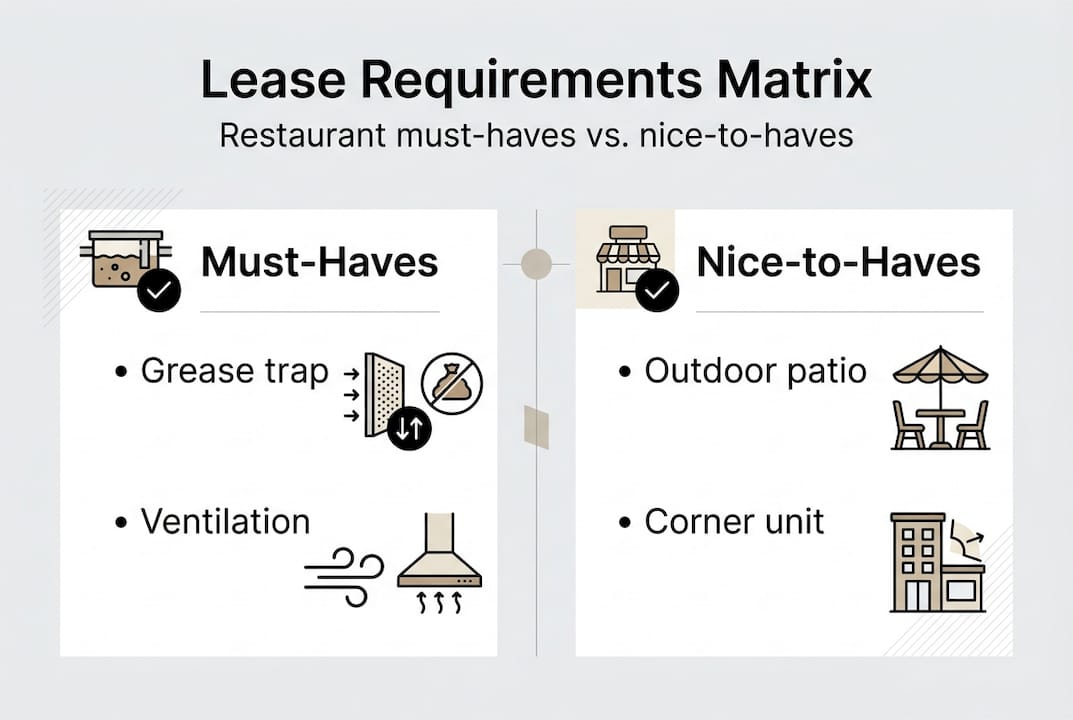
    Beyond that list, build a simple requirements matrix. Split your criteria into two columns: must-haves and nice-to-haves. This sounds basic, but it saves enormous time. When you’re evaluating six spaces simultaneously, a clear matrix stops emotion from overriding logic.

    Infographic contrasting must-have and nice-to-have features

    Requirement Must-Have Nice-to-Have
    Grease trap installed Yes
    Outdoor patio No Yes
    Private parking lot Depends on market
    Full hood system Yes
    Corner location No Yes
    1,500+ sq ft kitchen Yes

    Pro Tip: Before starting your search, complete a restaurant site evaluation checklist to turn your requirements into a structured scoring tool. It makes side-by-side comparisons far easier.

    Also revisit your buy vs. lease decision at this stage. Some operators assume leasing is always the right path, but the answer depends on your capital position and long-term plans.

    Research and compare ideal locations

    Once your requirements are locked in, you can start building a short-list of viable locations. This is where operators often move too fast, touring spaces before they understand the financial parameters they’re working within.

    Start with the numbers. Total occupancy costs — rent plus NNN (triple net fees covering taxes, insurance, and maintenance) — should fall between 6% and 10% of your projected gross sales. Base rent ranges from $10 to $150 per square foot annually depending on market. Buildout costs typically run $75 to $400 per square foot. Lease terms usually span 5 to 10 years. These benchmarks are your financial fence. Evaluate every space against them before you get attached.

    Here’s a practical sequence for comparing locations:

    1. Shortlist candidates based on your requirements matrix and preliminary rent data from your restaurant real estate guide.
    2. Visit each space during peak business hours to observe foot traffic, parking flow, and neighboring businesses.
    3. Run preliminary financials for each site: estimate your sales per square foot, apply the 6-10% occupancy benchmark, and confirm the math works before going deeper.

    Pro Tip: Build a simple spreadsheet with columns for each site and rows for rent per sq ft, estimated NNN, total occupancy cost, buildout estimate, lease term, and traffic notes. Plug in each location’s numbers and compare side by side without relying on memory or gut feeling.

    Here’s what a basic comparison might look like:

    Factor Space A (Downtown) Space B (Suburban strip)
    Base rent (per sq ft/yr) $85 $38
    Estimated NNN $18 $9
    Total occupancy cost $103/sq ft $47/sq ft
    Condition Move-in ready Needs full buildout
    Buildout estimate $50,000 $280,000
    Foot traffic (peak) High Moderate
    Lease term offered 5 years 10 years

    Space A costs more per foot but less upfront. Space B demands a longer commitment and higher buildout investment. Neither is automatically better. The right answer depends on your concept’s revenue model and your appetite for risk.

    Managers compare lists of restaurant spaces

    This is where deals are won or lost. Most operators go into lease negotiations focused only on rent. Experienced ones know the surrounding terms often matter just as much.

    Here are the key items to negotiate on every restaurant lease:

    • Rent abatement: Request 3 to 6 months of free or reduced rent during your buildout period. You’re not generating revenue yet, so you shouldn’t be paying full rent.
    • Tenant improvement (TI) allowance: Landlords typically offer $20 to $80 per square foot for buildout costs. On a 2,000 sq ft space, an $40/sq ft TI allowance means $80,000 from the landlord toward construction.
    • Exclusivity clause: Prevents the landlord from leasing to a direct competitor in the same building or center.
    • Assignment and sublease rights: Critical if your plans change. These rights let you transfer or sublease the space without full landlord control.
    • Renewal options: Lock in the right to renew at predetermined escalation rates (typically 2% to 3% annually).
    • CAM caps: Limit annual increases in common area maintenance fees to 3% to 5%.
    • Kick-out clause: Allows you to exit the lease early if sales fall below a defined threshold.

    “Project conservative sales when calculating your rent-to-sales ratio. Exceeding 10% occupancy cost is unsustainable long-term and the leading lease-related cause of restaurant failure.”

    Understand the sale vs. lease differences that affect how these terms are structured. And if you’re considering a space with an existing operator, learn how lease assignment works before assuming you can simply take it over.

    Pro Tip: Always ask for a cap on annual rent and CAM increases written directly into the lease. Without it, a landlord can raise costs significantly in years four or five, eroding margins you didn’t plan for.

    Due diligence and landlord priorities: What both sides must verify

    Good lease terms only protect you if the underlying facts are accurate. Due diligence is the verification step that most people rush, and the one that costs them the most when skipped.

    For tenants, here’s a core checklist of what to verify before signing:

    • Permitted use clause: Confirm the lease explicitly allows your type of food service operation.
    • Zoning and code compliance: Check with the local municipality that the space meets current health and fire codes.
    • Existing licenses and permits: Ask whether any existing food service or liquor licenses are transferable.
    • Utility history: Request prior year utility bills. Hidden HVAC inefficiencies or aging electrical systems can add thousands in monthly operating costs.
    • Infrastructure ownership: Clarify who owns fixed improvements like hood systems and grease traps if you ever vacate.
    • Operating restrictions: Look for hidden clauses around hours of operation, delivery access, or noise limitations.

    For landlords, the vetting process for restaurant tenants is more demanding than most other retail categories. Require strong financials and a detailed operating history. Ask for a written business plan and proof of concept. Name yourself as an additional insured on the tenant’s liability policy. Clarify upfront what happens to fixed infrastructure if the restaurant fails, because re-tenanting a restaurant space after failure carries unique physical and financial risks.

    Pro Tip: Review the hidden buildout costs that tend to surface during due diligence. If you’re evaluating a sublease, also understand the full subleasing process and how it differs from a direct lease.

    What most restaurant lease guides miss (and what actually works)

    Most leasing guides tell you to negotiate hard and read every clause. That’s true, but it misses the deeper point. The biggest mistakes we see aren’t about missing a clause. They’re about optimism.

    Operators build their rent-to-sales calculations on best-case projections. Then reality hits: slower-than-expected ramp, a tough first winter, a new competitor two blocks away. The lease was designed for the dream, not the business. Planning for lower sales than your optimistic model isn’t pessimism. It’s the thing that keeps you in business long enough to hit those numbers eventually.

    The same logic applies to TI allowances and free rent periods. A $100,000 TI allowance looks like a gift. But if it comes with a 12-year lease, 4% annual escalations, and no kick-out clause, you’ve traded flexibility for cash. Sometimes that trade makes sense. Often it doesn’t. Know what you’re giving up before you take the money.

    For landlords, the temptation is to chase popular F&B concepts because they drive traffic and improve property value. That’s real. But as the challenges of leasing restaurants show, strong F&B tenants also demand significantly more vetting and maintenance than other retail uses. A well-run regional operator with three locations is often a better bet than a first-time restaurateur with a viral concept and thin financials.

    “Strong F&B tenants boost traffic and property value, but they require thorough vetting due to higher failure rates and greater physical demands on the space.”

    Don’t let the excitement of a busy concept substitute for digging into the operator’s actual history.

    Find and lease great restaurant spaces with expert support

    You now have a practical framework for finding the right space, understanding the numbers, and negotiating terms that protect you on both sides of the deal. The next step is putting it into action.

    https://pepperlot.com

    Pepperlot connects operators and landlords through a marketplace built exclusively for restaurant real estate. Whether you’re looking for a turnkey opportunity like this Las Vegas restaurant for lease or a high-visibility San Francisco restaurant space, listings include the restaurant-specific details that actually matter: hood systems, grease traps, permits, and seating. Use Pepperlot’s location intelligence tools to analyze foot traffic, competition, and demographics before you commit.

    Frequently asked questions

    What should restaurant occupancy cost be as a percentage of sales?

    Total occupancy cost — rent plus NNN fees — should stay between 6% and 10% of gross sales. Exceeding 10% puts long-term sustainability at serious risk.

    What lease terms should I ask for as a restaurant tenant?

    Prioritize rent abatement during buildout, a tenant improvement allowance, renewal options, and capped increases on CAM fees. Also negotiate exclusivity and sublease rights to protect your flexibility.

    How can a landlord screen prospective restaurant tenants?

    Review the operator’s financials, track record, and business plan before anything else. Require proof of liability insurance with the landlord named as insured and confirm they have relevant operating experience.

    What is a tenant improvement allowance?

    A tenant improvement allowance is money the landlord contributes toward building out your space. It is typically negotiated as a per-square-foot dollar amount, ranging from $20 to $80 per square foot depending on the market and lease terms.

  • Choosing the right restaurant space: types and key factors

    Choosing the right restaurant space: types and key factors


    TL;DR:

    • Choosing the right restaurant space impacts costs, operations, and survival chances.
    • Second-generation spaces offer quick setup and cost savings but may require maintenance.
    • Alternative formats like food halls and ghost kitchens enable rapid testing with lower capital investment.

    Choosing a restaurant space is one of the most consequential decisions you’ll make as an operator. Get it right and you have a foundation built for growth. Get it wrong and you’re burning cash on a build-out that takes 18 months, fighting permits that don’t match your concept, or locked into a lease where foot traffic never materializes. The type of space you choose shapes your startup costs, your time to open, your daily operations, and ultimately your survival odds. This guide breaks down every major restaurant space type, from raw new builds to ghost kitchens, with clear comparisons and practical advice to help you choose with confidence.

    Table of Contents

    Key Takeaways

    Point Details
    Know your needs Match restaurant space size and layout to your dining concept and projected customer volume.
    Consider second-gen Second-generation spaces can save over $100,000 and months of buildout time.
    Alternative models Food halls and ghost kitchens offer low-commitment options ideal for pop-ups and delivery brands.
    Location is critical A poor location can cause failure even with the right space; analyze traffic, demographics, and saturation.

    How to evaluate restaurant space needs

    Before you tour a single property, you need to know exactly what you’re looking for. Too many operators fall in love with a space before they’ve done the math. Start with your concept and work backward.

    The first variable is size. Space sizes vary by concept: a small cafe runs 750 to 1,600 sq ft with 20 to 40 seats, a mid-size casual restaurant needs 1,600 to 3,200 sq ft for 50 to 100 seats, and a large full-service venue requires 3,200 to 6,500 sq ft for 100 or more seats. These aren’t arbitrary numbers. They reflect how much revenue you can realistically generate per square foot of rent you’re paying.

    The second variable is your kitchen-to-dining ratio. Fine dining runs a 2:1 ratio (30 to 33% kitchen), casual dining sits between 2:1 and 3:1 (25 to 33%), and quick-service operations run 3:1 to 4:1 (20 to 25%). If you’re opening a high-volume fast-casual concept and you’re looking at a space with a massive dining room and a cramped kitchen, that layout will fight you every single service.

    Beyond size and ratio, you need to assess these critical attributes before committing:

    • Zoning and permitted use: Confirm the space is zoned for food service. Some properties require a conditional use permit that can take months.
    • Existing infrastructure: Grease traps, hood systems, gas lines, and three-compartment sinks are expensive to install from scratch.
    • Occupancy load: Local fire codes set your legal capacity. This directly caps your revenue ceiling.
    • Parking and access: Especially important for suburban and family-dining concepts.
    • Foot traffic and demographics: Use location analysis to verify that your target customer actually passes by in meaningful numbers.

    Pro Tip: Model your revenue before signing anything. Multiply your projected covers per day by your average check size, then by your operating days per year. Compare that number against your total occupancy cost. If rent exceeds 8 to 10% of projected revenue, reconsider the space or renegotiate the terms.

    Understanding restaurant real estate basics early in your search saves you from chasing spaces that look great but don’t pencil out financially.

    New build-out restaurants: custom solutions with higher investment

    A new build-out means you’re starting with a raw shell or completely empty space and building every element of your restaurant from the ground up. No inherited layout. No previous operator’s quirks. Just blank walls and your vision.

    The upside is total control. You design the kitchen exactly how your chef needs it. You configure the dining room for your brand experience. You choose every material, every fixture, every flow. For experience-driven concepts, fine dining, or flagship locations where the environment IS the product, this level of customization is genuinely worth the premium.

    Here’s what that premium looks like:

    • Construction cost: Raw build-outs run $150,000 to $500,000+, or roughly $200 to $400 per square foot depending on market and finish level.
    • Timeline: Expect 12 to 18 months from lease signing to opening day, including permitting, design, and construction.
    • Sales benchmarks: Full-service restaurants need to hit $150 to $250 per square foot in annual sales to break even on a new build. Counter-service concepts need $200 to $300.
    • Permitting complexity: New builds trigger the full permitting gauntlet: zoning, building permits, fire inspections, health department sign-off, and ADA compliance reviews.

    The biggest risk operators underestimate is time. Every month of construction is a month of rent with zero revenue. If your build-out runs six months over schedule (common), that’s six additional months of carrying costs before you serve a single guest.

    Pro Tip: When negotiating a new build-out lease, push hard for a rent abatement period during construction. Landlords often grant three to six months of free rent on raw spaces. This can save tens of thousands of dollars and reduce your financial exposure significantly.

    Understanding build-out costs in detail before you commit will prevent the most common and painful financial surprises operators face.

    Second-generation restaurants: speed and savings

    A second-generation space is a previously operated restaurant that still has its core infrastructure intact: commercial kitchen, hood system, grease trap, bathrooms, and often basic equipment. Someone else already paid for the hard stuff. You’re stepping into a space that’s been purpose-built for food service.

    Chef checks equipment in older restaurant kitchen

    The financial case is compelling. Second-generation spaces save $100,000 or more in build-out costs and can cut your opening timeline from 18 months down to 60 days. In high-cost markets like New York City or California, where construction labor and materials are expensive, those savings can be the difference between a viable launch and an undercapitalized one.

    Here’s what to weigh when evaluating a second-gen space:

    • Layout fit: The previous operator’s kitchen layout may not match your workflow. A pizza concept taking over a sushi bar will likely need significant reconfiguration.
    • Deferred maintenance: Grease traps, hood systems, and HVAC units may be at end-of-life. Always get an independent inspection before signing.
    • Brand confusion: If the previous restaurant had a strong local identity, you may inherit their reputation, positive or negative.
    • Equipment condition: Included equipment is only valuable if it works and fits your menu.

    “The savings on a second-gen space are real, but so are the hidden costs. The operators who win are the ones who inspect thoroughly and negotiate a tenant improvement allowance to cover what needs updating.” — Restaurant real estate broker perspective

    Second-gen spaces are ideal for fast-launch concepts, quick-service operators, and multi-unit chains looking to scale quickly. They’re also a smart fit for operators who want to test a new market without a massive capital commitment. For a deeper look at second-generation spaces and how to evaluate them, the due diligence process matters as much as the deal itself.

    Pro Tip: Before you finalize any second-gen lease, hire a licensed contractor to walk the space and give you a written estimate of deferred maintenance. Use that number in your lease negotiation. Landlords often provide tenant improvement allowances to close deals.

    The conversions vs new builds debate ultimately comes down to your concept fit and capital position. Understanding both sides of that equation helps you negotiate from strength. And if you’re still deciding between owning vs. leasing, the second-gen market offers compelling options in both categories.

    Food halls, ghost kitchens, and alternative models

    Not every restaurant concept needs a traditional lease. The past decade has produced genuinely new operating formats that lower the barrier to entry and let operators test concepts with far less capital at risk.

    Food halls bring multiple food vendors under one roof with shared dining space. The foot traffic is built in, the infrastructure is managed by the operator, and the licensing structure is flexible. Instead of a traditional lease, most food hall arrangements use license agreements or revenue share models where vendors pay 8 to 12% of gross sales. That means lower fixed costs but a permanent cut of your revenue going to the hall operator.

    Ghost kitchens take the concept further. There’s no customer-facing space at all. You operate purely for delivery and pickup, sharing a commercial kitchen with other virtual brands. The setup cost is minimal, the speed to market is fast, and you can run multiple virtual concepts from a single kitchen.

    Here’s a direct comparison of all major space types:

    Space type Upfront cost Time to open Flexibility Branding control
    New build-out $150,000 to $500,000+ 12 to 18 months Low Full
    Second-generation $50,000 to $150,000 60 to 120 days Medium High
    Food hall $10,000 to $50,000 2 to 6 weeks High Limited
    Ghost kitchen $5,000 to $30,000 1 to 4 weeks Very high Minimal

    The tradeoffs are real. Food halls and ghost kitchens give you speed and low capital risk, but you sacrifice brand presence, community connection, and long-term equity. You’re also permanently sharing revenue with the platform operator.

    Pro Tip: Use a food hall or ghost kitchen as a proving ground, not a permanent home. If your concept generates strong sales in a shared environment, you have real data to bring to a landlord when negotiating a traditional lease.

    For operators curious about what a food hall space actually looks like in practice, seeing active listings gives you a concrete sense of what’s available in your target market.

    Comparing restaurant space types: decision guide

    With all four space types on the table, the question becomes: which one is right for you, right now? The answer depends on your business stage, capital position, concept type, and growth plan.

    60% of new restaurants fail within their first three years, and poor location selection is a leading factor. The space type you choose is inseparable from the location decision. A ghost kitchen in a delivery-dense urban neighborhood is a completely different bet than a new build-out in a suburban strip mall.

    Here’s a step-by-step process for matching space type to concept:

    1. Define your format and service model. Delivery-only, fast-casual, full-service, and fine dining each have different space requirements.
    2. Set your capital budget. Be honest about what you can actually spend, including a 20% contingency buffer.
    3. Establish your timeline. If you need to be open in 90 days, a new build is off the table.
    4. Analyze your target location. Use foot traffic data, demographic reports, and competition mapping to validate demand.
    5. Match space type to stage. First-time operators benefit from second-gen or food hall formats. Established multi-unit operators can absorb new build risk more easily.
    6. Filter by operational fit. A space that’s 80% right but opens on time beats a perfect space that opens 12 months late.

    For startups and first-time operators, second-gen spaces offer the best balance of speed, cost, and operational readiness. For franchises and multi-unit chains, new builds provide the brand consistency and layout control that scales. For pop-ups and delivery-only concepts, ghost kitchens and food halls are purpose-built solutions.

    Using data when evaluating restaurant location options gives you an objective filter that removes emotion from what is often an emotional decision.

    A restaurant real estate veteran’s perspective

    Here’s something most guides won’t tell you: the perfect restaurant space doesn’t exist. Every space is a set of trade-offs, and the operators who succeed are the ones who accept that reality early and make deliberate choices rather than chasing an ideal that keeps moving.

    We’ve seen operators burn through $400,000 on a custom new build for a concept that could have launched in a second-gen space for $80,000. The extra $320,000 didn’t buy them a better restaurant. It bought them a prettier one that ran out of runway before it found its audience.

    The most important question isn’t “Is this space perfect?” It’s “Does this space give my concept a real chance to succeed, and can I afford it without betting the entire business on the build?” A fast pivot into a second-gen space has saved more than a few operators who would have spent 18 months in construction limbo with a new build.

    Match your space type to your exit strategy too. If you’re building toward a sale or franchise expansion, the buying vs. leasing analysis changes significantly. Prioritize location fit and operational fundamentals. Amenities are nice. A viable business is necessary.

    Find your ideal restaurant space with Pepperlot

    Pepperlot is the only marketplace built specifically for restaurant real estate, covering every space type from turnkey full-service restaurants to ghost kitchens and food hall opportunities. Every listing includes the details that actually matter to operators: seating capacity, existing permits, grease trap status, hood systems, and patio access.

    https://pepperlot.com

    Whether you’re evaluating a restaurant space for sale or exploring ghost kitchen options for a delivery-first launch, Pepperlot’s active listings and location analysis tools give you the data you need to make a confident decision. Stop guessing on location and start validating with real market intelligence.

    Frequently asked questions

    What is a second-generation restaurant space?

    A second-generation space is a previously built-out restaurant with essential infrastructure already in place. These spaces save $100,000 or more in build-out costs and can cut opening timelines from 18 months to as few as 60 days.

    How much space do I need for my restaurant concept?

    It depends on your format. Cafes need 750 to 1,600 sq ft, casual restaurants require 1,600 to 3,200 sq ft, and large full-service venues need 3,200 to 6,500 sq ft, with sizing driven by seat count and kitchen ratio.

    What permits are required to open a restaurant?

    You’ll need zoning approval, a food facility or health permit, building and fire code compliance, a business license, and an alcohol license if applicable. Requirements vary by city and state, so confirm with your local planning department early.

    What are the main risks of building out a new restaurant space?

    New builds carry the highest financial risk due to construction costs of $150,000 to $500,000+, long timelines of 12 to 18 months, and frequent permitting delays that extend your pre-revenue carrying costs.

    Which space type is best for a pop-up or delivery-only concept?

    Food halls and ghost kitchens are the best fit for pop-ups and delivery-only brands. They use license agreements or revenue share models of 8 to 12% of gross sales, keeping upfront investment low and time to market fast.

  • Lease assignment guide: essential for restaurant operators

    Lease assignment guide: essential for restaurant operators


    TL;DR:

    • Lease assignment transfers all rights and obligations to a new tenant, unlike subleasing.
    • Landlord consent can slow or block assignment; standard is “not unreasonably withheld.”
    • Unreleased personal guarantees and change of control clauses can pose risks after assignment.

    Lease assignment is one of the most misunderstood concepts in restaurant real estate, and that gap in knowledge costs operators real money. Many restaurant deals collapse not because of price disagreements or poor foot traffic, but because the lease cannot be transferred to a buyer without triggering landlord interference or unexpected liability. If you are selling your restaurant, acquiring one, or simply planning your exit strategy, understanding how lease assignment works is not optional. This guide breaks down what lease assignment is, how the process unfolds step by step, what landlords actually look for, and how to protect yourself from the traps that catch even experienced operators off guard.

    Table of Contents

    Key Takeaways

    Point Details
    Lease assignment definition Assignment is the full legal transfer of your lease to another operator, who assumes all your rights and obligations.
    Process steps Assignment requires finding a qualified assignee, landlord consent, attorney-drafted paperwork, and proper notifications.
    Landlord consent Getting landlord approval depends on the assignee’s financials and lease terms—negotiation is key.
    Liability risks Unless released, the original restaurant tenant often remains liable after assignment—never assume you’re off the hook.
    Negotiation tips Define assignment rights, cap fees, and always negotiate before you sign—proactive terms save deals and protect you.

    What is lease assignment in commercial real estate?

    Let’s clear up the confusion right away. Lease assignment is the full transfer of a tenant’s rights and obligations under a commercial lease to a new tenant, called the assignee. The original tenant, called the assignor, hands over everything: the remaining lease term, the rent obligations, and all the conditions baked into the original agreement.

    This is fundamentally different from subleasing. With a sublease, you remain the primary tenant and essentially become a landlord to someone else. You collect rent from your subtenant and pass it to the landlord, but you stay on the hook for the entire lease. Understanding the assignment versus sublease distinction matters enormously because the financial exposure is completely different in each scenario.

    For restaurant operators, lease assignment is most relevant during ownership transitions. When you sell your restaurant as a going concern, the buyer needs to take over your space. That means assigning your lease. Without a clean assignment, there is no deal.

    Here is a side-by-side comparison to make the distinction concrete:

    Feature Lease assignment Sublease
    Who pays landlord? Assignee directly Original tenant
    Original tenant liability Usually remains (unless released) Always remains
    Lease term transferred Full remaining term Partial or full
    Landlord relationship Assignee becomes tenant Original tenant remains tenant
    Common use case Business sale Temporary vacancy

    One misconception trips up operators constantly: many assume that once they assign the lease, they are completely free. That is often not true. Unless the landlord formally releases you through a legal process called novation (a new agreement that substitutes the assignee as the sole responsible party), you may still be liable if the new tenant defaults.

    Industry insight: Many restaurant sellers discover post-closing that they are still exposed to lease liability for years after the sale. This is not a technicality. It is a real financial risk that can follow you long after you have moved on.

    If you are browsing restaurant lease opportunities, pay close attention to the assignment clause before you fall in love with a space. The full lease assignment process has several moving parts, and knowing them in advance puts you in a stronger position.

    Step-by-step: How lease assignment works for restaurant spaces

    The actual mechanics of assigning a restaurant lease follow a predictable sequence, though the timeline can stretch depending on how responsive the parties are. Here is what the process typically looks like:

    1. Review the assignment clause. Pull out your lease and find the section governing assignment. Does it require landlord consent? Is there a fee? Are there restrictions on the type of business that can take over? This clause controls everything.
    2. Identify a qualified assignee. Your buyer or incoming tenant needs to meet the landlord’s standards. That usually means solid financials, relevant restaurant experience, and a business concept compatible with the property.
    3. Submit a formal consent request. You formally notify the landlord in writing, providing the assignee’s financial statements, business plan, and any other documents the lease requires.
    4. Landlord review period. The landlord evaluates the assignee. This typically takes 10 to 30 days. Delays here are common, especially if the landlord requests additional documents.
    5. Execute the Assignment and Assumption Agreement. This is the core legal document. The assignee formally assumes all lease obligations. Both parties sign, and the landlord countersigns to confirm consent.
    6. Transfer the security deposit. Decide whether the assignee reimburses you for the deposit or whether the landlord holds a new deposit. Get this in writing.
    7. Notify all relevant stakeholders. Inform your vendors, insurers, and local licensing authorities about the change in tenancy.

    According to detailed lease assignment steps, the typical timeline is 30 days for a commercial lease assignment when all parties cooperate, with legal and administrative fees often ranging from $200 to $500.

    Pro Tip: Before you even list your restaurant for sale, confirm with an attorney whether your lease is assignable and under what conditions. Discovering a problematic assignment clause after you have a buyer lined up is one of the most stressful and deal-killing scenarios in restaurant real estate.

    For comparison, the subleasing workflow follows a slightly different path, but many of the same documentation requirements apply. The biggest delays in assignment typically come from incomplete financial submissions or landlords who take their time reviewing. Submit a complete package the first time and follow up proactively.

    Infographic shows lease assignment versus subleasing

    Landlord consent is where most restaurant lease assignments slow down or fall apart. Not all consent standards are created equal, and the language in your lease determines how much leverage the landlord actually has.

    There are three common consent standards you will encounter:

    • Sole discretion: The landlord can say no for any reason or no reason at all. This is the worst standard for tenants.
    • Reasonable consent: The landlord cannot withhold consent unreasonably. This is the most tenant-friendly standard and the one you should push for.
    • Permitted transfers: Certain transfers (to affiliates, parent companies, or related entities) are pre-approved without requiring consent. This is valuable for operators with multiple locations.

    As landlord consent standards vary widely, landlords typically assess the assignee’s financial strength, restaurant experience, concept compatibility, and projected sales volume relative to rent. A landlord running a curated food hall will scrutinize menu concept far more than a landlord with a standalone strip center.

    Landlord explains lease consent to tenant

    Here is a practical negotiation checklist for restaurant tenants:

    Negotiation point What to push for
    Consent standard “Not unreasonably withheld” language
    Assignment fees Cap at a fixed dollar amount
    Recapture rights Limit or eliminate landlord’s right to recapture
    Permitted transfers Include affiliates and related entities
    Review timeline Require landlord response within 20 to 30 days
    Release from liability Request novation or conditional release

    Pro Tip: Negotiate the assignment clause standards before you sign the original lease, not when you are trying to exit. Landlords are far more willing to agree to tenant-friendly assignment terms when they want to fill a space than when they hold all the leverage at renewal or sale time.

    Recapture rights deserve special attention. Some leases give the landlord the right to recapture the space (essentially terminate your lease and re-lease it directly) if you request assignment. This can completely undermine a restaurant sale. Know whether this clause exists in your lease before you start the process.

    Assignment traps, liabilities, and negotiation tips for restaurant operators

    Even when assignments proceed smoothly on the surface, hidden risks can surface months or years later. Here is where experienced operators get caught.

    Privity and personal guarantees. Many restaurant leases include personal guarantees, meaning you personally guaranteed the lease obligations. Assignment does not automatically release you from that guarantee. If the assignee defaults, the landlord can come after you personally. Push for a written release of your personal guarantee as part of the assignment approval.

    Change of control clauses. This is a trap that catches operators who sell their restaurant through a stock sale rather than an asset sale. If your restaurant operates as an LLC or corporation and you sell the ownership interests rather than the assets, some leases treat this as an assignment even though the legal entity holding the lease has not changed. Change of control provisions can trigger default or require landlord consent even when no formal assignment occurs.

    Landlord profit-sharing on lease premium. If your lease has below-market rent and you are assigning it to a buyer who values that favorable rate, the landlord may have the right to capture a portion of any premium paid for the lease. This directly reduces what you can charge a buyer for the goodwill tied to your lease terms.

    Key negotiation tips to protect yourself:

    • Request a full novation or written release from liability upon assignment
    • Cap any landlord assignment fees in the original lease
    • Negotiate to exclude affiliate and family transfers from consent requirements
    • Clarify whether stock sales trigger assignment provisions
    • Confirm what happens to the security deposit and whether it transfers

    The overlooked lever: Most operators focus on rent and term when negotiating a lease. The assignment clause is treated as boilerplate. It is not. That clause will determine whether your restaurant is sellable and at what price.

    For context on how assignment versus sublease provisions interact, and to understand the broader financial picture of your property decision, reviewing the restaurant sale versus lease comparison is worth your time. For negotiation benchmarks specific to restaurant leases, industry-focused resources can give you a realistic baseline for what is achievable in your market.

    Also, remember that original tenant liability may survive unless a novation is executed, which means your exposure does not automatically end at closing.

    A restaurateur’s perspective: What most lawyers miss about lease assignment

    Here is the uncomfortable truth: most attorneys handle lease assignment as a legal transaction. They check the boxes, draft the documents, and move on. What they often miss is the restaurant-specific reality that makes assignment uniquely high-stakes in this industry.

    A restaurant lease is not just a real estate agreement. It is tied to your liquor license, your health permits, your equipment financing, and your brand identity. When any of those elements are disrupted during an assignment, the deal can unravel in ways a standard commercial real estate attorney will not anticipate.

    Operators who have been through a restaurant sale often say the same thing: they wish they had negotiated the assignment clause before signing the original lease, not when they were desperate to exit. Prevention is not just cheaper. It is the difference between a clean sale and a deal that collapses at the finish line.

    The mindset shift that matters most? Stop treating your lease as a cost to manage and start treating it as an asset to protect. A well-structured, assignable lease with favorable terms adds real dollar value to your restaurant when it is time to sell. To learn more about lease assignment and how it interacts with sublease decisions, that resource is a strong starting point.

    Find your next restaurant space or get expert lease advice

    Navigating lease assignment is complex, but finding the right space or buyer does not have to be. Pepperlot is built specifically for restaurant operators, landlords, and brokers who need more than a generic real estate platform.

    https://pepperlot.com

    Whether you are looking for a full-service restaurant lease with favorable assignment terms already in place, exploring restaurant sale listings to find your next acquisition, or using location intelligence tools to evaluate a market before committing to a space, Pepperlot gives you the focused, industry-specific support that generic platforms simply cannot offer. Every listing includes restaurant-specific details that matter: permits, equipment, seating capacity, and lease terms.

    Frequently asked questions

    What is the difference between lease assignment and subleasing?

    Assignment transfers full remaining term and liability to a new tenant, while subleasing keeps the original tenant responsible and creates a secondary landlord-subtenant relationship between the original tenant and the new occupant.

    Can a landlord refuse to allow a lease assignment?

    Most leases require landlord consent, but refusal cannot usually be unreasonable if your lease includes a “not unreasonably withheld” standard. Always check what consent standard your specific lease uses.

    Does the original restaurant tenant remain liable after assignment?

    Unless specifically released through a novation agreement, the original tenant often remains liable for the lease even after a successful assignment is completed.

    What documents are needed for a lease assignment?

    You will need the original lease, an Assignment and Assumption Agreement, landlord consent and assignee financials, and any permits or licenses relevant to the restaurant operation being transferred.

    How long does a restaurant lease assignment typically take?

    When all parties respond promptly, a commercial lease assignment takes approximately 30 days from initial submission to executed agreement.

  • Top 6 Bizbuysell.com Alternatives 2026

    Top 6 Bizbuysell.com Alternatives 2026

    Looking for the right place to buy or sell a business can feel overwhelming with so many options out there. Each platform claims to be the solution you need but how do you know which one will really match your goals and budget. Some focus on simple listings and others bring advanced features to the table. You might find surprising benefits in spots you would not expect. Curious to see which sites stand out and what makes them different

    Table of Contents

    PepperLot

    Product Screenshot

    At a Glance

    PepperLot is the leading, restaurant-focused commercial real estate marketplace that connects operators, landlords, and brokers with curated restaurant spaces. It delivers fast, actionable site intelligence so you find lease or purchase opportunities with confidence and speed.

    Core Features

    PepperLot centers on data-driven location intelligence, offering tools that analyze local competition, demographics, and market demand. The platform lists curated listings for sale, lease, or sublease and supports asset and business sales as well as property transactions. It also highlights restaurant-specific details such as grease traps, permits, seating capacity, and outdoor patios.

    Pros

    • Specialized focus on restaurants: PepperLot concentrates solely on restaurant and F&B real estate, which gives you deeper, industry-specific data than general marketplaces.

    • Connects qualified participants efficiently: The platform brings together serious buyers, tenants, owners, and brokers so you spend less time chasing unqualified leads.

    • Hands-on location analysis: Built-in tools for competition mapping and demographic analysis let you compare sites objectively before visiting in person.

    • Targeted promotion for listings: Listings receive targeted social outreach to an audience directly relevant to restaurant landlords and operators.

    • Flexible transaction support: PepperLot handles multiple deal types including asset sales, business transfers, leases, and property sales to match varied deal structures.

    Who It’s For

    Restaurant operators seeking expansion, landlords hunting for credible tenants, and brokers wanting higher-quality leads will benefit most from PepperLot. If your primary objective is restaurant real estate rather than general commercial property, this platform aligns directly with your operational needs and decision criteria.

    Unique Value Proposition

    PepperLot sets the standard by combining a niche marketplace with rich, restaurant-centric intelligence. Where general CRE sites leave gaps, PepperLot supplies site-level restaurant metrics, listing fields for grease traps and seating, and marketing tuned to hospitality audiences. That makes it faster to screen feasibility, quantify demand, and present a professional package to landlords or buyers.

    The platform’s curated network of over 500 active users concentrates relevant deal flow and reduces noise. For brokers, that means higher lead conversion rates. For operators, that means fewer wasted site visits. For landlords, that means visibility to tenants who understand restaurant infrastructure.

    Real World Use Case

    A multiunit operator used PepperLot to map competing delivery zones and daytime foot traffic, filtered listings that included required hood and grease trap details, and then contacted the landlord directly through the platform. The operator signed a lease within six weeks after confirming seating and permit compatibility, saving months of legwork.

    Pricing

    Pricing is not specified on the website, which signals custom or subscription options based on user type and listing needs. Contact PepperLot for a tailored plan that fits your operator, landlord, or broker role.

    Website: https://pepperlot.com

    Flippa

    Product Screenshot

    At a Glance

    Flippa is a global online marketplace for buying and selling websites, ecommerce stores, mobile apps, and online businesses. It gives operators a wide pool of buyers and sellers while adding valuation and transaction support to reduce friction.

    Core Features

    Flippa lists assets across categories including websites, apps, domains, ecommerce stores, and SaaS products while offering business valuation tools and regional visibility. The platform also provides legal and escrow services and financing options to help close deals with more confidence.

    Pros

    • Large and diverse marketplace: The volume and variety of listings increase the odds of finding niche digital assets that match a restaurant brand or food service tech need.
    • Global reach: Access to international buyers and sellers opens options for cross border expansion or exit strategies for operators and brokers.
    • Comprehensive support services: Integrated legal, financing, and escrow support reduces steps and centralizes transaction coordination for busy owners.
    • Transparent listing details: Verified and detailed listings make initial screening faster and help you prioritize serious opportunities.
    • Valuation and deal sourcing tools: Built in valuations and sourcing assistance help you gauge market worth and find off market targets more efficiently.

    Cons

    • Marketplaces can be crowded and that competition may make standout listings harder to secure.
    • Quality of listings varies which forces buyers to perform careful due diligence beyond the platform summaries.
    • Fees and commissions may apply and those costs add to the purchase price for buyers or reduce net proceeds for sellers.
    • Some listings remain confidential which limits early stage due diligence until an NDA is in place.

    Who It’s For

    Flippa suits entrepreneurs, investors, and business owners who buy or sell digital businesses and assets. For restaurant operators and brokers it is useful when acquiring an ecommerce food brand, a delivery app, or a niche content site tied to your concept.

    Unique Value Proposition

    Flippa combines broad category coverage with transactional support and regional reach so buyers and sellers can match quickly and move a sale toward closing. The platform pairs market visibility with tools that help you evaluate and secure deals.

    Real World Use Case

    A restaurant group seeking a ready made online ordering platform uses Flippa to find a profitable takeaway app, runs the provided valuation, and uses escrow to complete the transfer while keeping service interruption to a minimum.

    Pricing

    Fee structure varies depending on listing type and transaction model and detailed pricing is available on the Flippa website. Expect listing, success, or service fees depending on the sale path and services chosen.

    Website: https://flippa.com

    Product Screenshot

    At a Glance

    Access Denied. The source returned an explicit message that no information could be retrieved, so this review cannot confirm any product capabilities for BizQuest. You should treat this as an incomplete data point and request alternate sources.

    Core Features

    The provided features array lists only the phrase No data available five times, which means no verifiable feature set can be described from the current source. Without feature details you cannot assess restaurant specific items like grease traps, seating capacity, or permit support.

    Pros

    • No verifiable strengths are listed because the source records No data available as the only entry for pros.

    • The dataset offers no documented benefits for landlords, brokers, or operators because every pros field contains No data available.

    • The absence of confirmed pros prevents objective comparison against restaurant‑focused platforms that supply site specific details.

    Cons

    • The introduction explicitly states Access Denied which prevents feature inspection and makes initial vetting impossible.

    • Pricing information is unavailable because the pricing field returns No data available, so you cannot budget or compare subscription models.

    • Use cases and ideal user profile are empty which means you cannot verify whether BizQuest supports specialized restaurant real estate needs.

    • Multiple core arrays contain only No data available which increases the risk of relying on incomplete or out of date information.

    Who It’s For

    Because the JSON returns only placeholders, this source cannot confirm an ideal user profile for BizQuest. Restaurant operators, landlords, and brokers should not assume suitability from this record alone and should request direct access or an alternate data feed.

    Unique Value Proposition

    No unique value proposition can be extracted from the supplied data. Every descriptive field is either blocked or labeled No data available, so the product proposition remains undefined in this source.

    Real World Use Case

    The dataset does not provide a real world use case. The single entry in realWorldUseCase is No data available, so this review cannot supply an actionable scenario showing how BizQuest serves restaurant transactions.

    Pricing

    Pricing is listed as No data available in the provided JSON, which prevents cost comparisons and financial planning for lease or purchase transactions.

    Website: https://www.bizquest.com

    Axial

    Product Screenshot

    At a Glance

    Axial is a private deal network focused on North American lower middle market companies, offering confidential deal sourcing and tailored matchings. It serves professionals who buy, sell, advise, or invest in companies and emphasizes privacy while connecting relevant deal partners.

    Core Features

    Axial provides private deal sourcing and marketing tools, confidential deal matching, and organized deal management and pipeline tools. The platform also highlights reputation through leaderboards and badges and offers market insights drawn from a broad member base across the US and Canada.

    Pros

    • Confidential transactions: The platform supports private and confidential deal flow so parties can explore opportunities without public exposure.
    • Targeted deal opportunities: Users receive highly targeted matches for lower middle market sectors, reducing time spent filtering irrelevant leads.
    • Strong member community: Axial brings together investors, acquirers, and advisors which increases the quantity and quality of meaningful introductions.
    • Deal management tools: Built in pipeline organization and communication features help teams track progress and keep conversations centralized.
    • Market data and insights: Members access industry data and deal tracking that inform sourcing decisions and negotiation strategy.

    Cons

    • Geographic and market focus is narrow: The platform is limited to North American lower middle market companies which restricts options for users targeting other regions or market segments.
    • Membership required for full access: Full use of the platform requires a membership request which adds an onboarding step before sourcing deals.
    • Learning curve for new users: The breadth of features can feel complex for first time users and may require time or help to adopt effectively.

    Who It’s For

    Axial fits professionals involved in buying, selling, advising, or investing in lower middle market companies in the US and Canada. This includes private equity firms, investment banks, M&A advisors, business owners, and family offices looking for curated, confidential opportunities.

    Unique Value Proposition

    Axial distinguishes itself with confidential, tailored matching and a concentrated member network for lower middle market deals. The combination of private sourcing, reputation displays, and deal management tools creates a single environment for sourcing, marketing, and executing transactions.

    Real World Use Case

    A private equity firm uses Axial to find acquisition targets that align with strict investment criteria while managing ongoing negotiations and building credibility among deal partners. The firm tracks pipeline activity and uses platform insights to prioritize high probability leads.

    Pricing

    Pricing information is not published on the site and interested users are prompted to request membership to learn about costs and access levels.

    Website: https://www.axial.com

    BusinessesForSale.com

    Product Screenshot

    At a Glance

    BusinessesForSale.com serves as a broad global marketplace connecting buyers and sellers across many sectors. It lists over 58,600 businesses in more than 130 countries and works well when you need scale and international exposure.

    Core Features

    The platform centers on a largest marketplace of listings and strong global reach across 130 plus countries. It also provides business guides, valuation tools, a dedicated resource center, franchise resales and a specialized M&A section for higher value deals.

    Pros

    • Extensive listings: The site hosts over 58,600 listings giving you broad choice across sectors and geographies.
    • Detailed learning resources: The platform supplies guides and valuation tools that help buyers and sellers prepare realistic offers.
    • M&A focus: A dedicated marketplace supports larger transactions and investor level deals that need extra exposure.
    • Franchise support: The site lists franchise opportunities and resales which helps operators scale or buy proven concepts.
    • User friendly search: Multiple search filters let you narrow by country sector and price range before you contact sellers.

    Cons

    • Privacy and tracking: The site uses cookie and tracking mechanisms that some users find intrusive and that can affect browsing comfort.
    • Limited listing detail: Many listings require login or direct contact to view full financials or property specifics which slows initial screening.
    • Information overload: The sheer volume of listings and resources can overwhelm newcomers who want a faster filtered shortlist.

    Who It’s For

    Business owners and brokers who need wide market exposure will get the most value here. Investors hunting cross border opportunities and franchise buyers looking for resale inventory also benefit from the scale and resources available.

    Unique Value Proposition

    The platform stands out by pairing sheer listing volume with tools that support deal readiness. If your goal is international reach and access to franchise and M&A opportunities you get both visibility and educational support in one place.

    Real World Use Case

    A small business owner in the UK lists a restaurant and reaches buyers in Europe and North America through targeted listing exposure. An investor uses the site to identify a high value acquisition in another country and connects with a broker to progress due diligence.

    Pricing

    Browsing is generally free and you can search listings without registering. Paid options exist for premium listings and advertising but exact fees are not specified on the public pages and require direct inquiry.

    Website

    Website: https://www.businessesforsale.com

    Takeaway
    If you need maximum listing exposure and tools for franchise or M&A deals choose BusinessesForSale.com, but plan for extra screening time and account creation to access full listing details.

    BizScout

    Product Screenshot

    At a Glance

    BizScout is a marketplace focused on buying and selling businesses that pairs active listings with tools to move deals from first contact to closing. The platform stands out for DealOS, an acquisition operating system that automates paperwork and reduces transactional friction.

    Core Features

    BizScout combines a marketplace for active listings, a step by step acquisition hub called DealOS, a verified buyer program, a personalized deal box with filters, and business calculators for investment and valuation analysis.

    Pros

    • Large active marketplace: The platform lists many businesses which increases the odds of finding a relevant opportunity in your target sector.

    • DealOS automates paperwork: The acquisition operating system moves users from NDA to closing with fewer manual steps and less admin work.

    • Verified buyer status speeds responses: Sellers and brokers respond faster to verified buyers which shortens the initial outreach timeline.

    • Tiered support options: Users can access mentorship and dedicated advisor support for more complex deals or when guidance is required.

    • Built in analysis tools: Business calculators help you test investment assumptions and check valuation compatibility before committing time to a deal.

    Cons

    • Limited feature detail in materials: The available content does not fully describe how advanced features compare or integrate with third party tools.

    • Higher tiers carry cost: Pro and Private Client levels require payment or application which raises the cost for access to premium capabilities.

    • Feature access varies by plan: Not all features are available to free users which can fragment the experience during market research.

    Who It’s For

    BizScout fits aspiring and active business buyers, investors, and brokers who need a centralized place to discover listings and manage deals. It also suits sellers who want a platform that supports verified buyer vetting and smoother closing workflows.

    Unique Value Proposition

    BizScout’s core strength lies in combining a searchable marketplace with a workflow engine that automates deal paperwork. The combination of DealOS, buyer verification, and built in calculators creates a single place to source, evaluate, and execute acquisitions.

    Real World Use Case

    A private equity firm uses BizScout to surface off market opportunities, confirm buyer credentials rapidly, and run acquisition tasks inside DealOS to take transactions from first contact through closing without switching between multiple systems.

    Pricing

    A Basic plan is free with limited features. The Pro plan is priced at $59 per month and unlocks additional tools. Higher level options such as Contrarian Academy and Private Client require application and likely involve additional fees.

    Website: https://www.bizscout.com

    Commercial Real Estate Marketplace Tools Comparison

    The table below provides a comprehensive overview of commercial real estate platforms specialized in restaurant spaces, digital businesses, and business general marketplaces. Compare features, pros, cons, and pricing.

    Platform Core Features Pros Cons Pricing
    PepperLot Data-driven location intelligence; targeted promotion; curated restaurant-focused listings Specialized restaurant focus; efficient qualified participant connections; flexible transaction support Pricing not specified Contact company for details
    Flippa Large pool of digital assets; valuation tools; transaction support Global reach; comprehensive support services; verified listing details; diversification opportunities Marketplace competition; varying listing quality; fees and commissions Fees vary; contact for details
    Axial Private deal network; targeted matching; confidential transaction capabilities Strong community membership; industry data insights; deal management tools Limited to North America; membership required Membership cost applies
    BusinessesForSale Extensive global marketplace over various industries; franchise opportunities International reach; resource guides; specialized sections for M&A deals Privacy concerns; information overload; account needed for detailed access Browsing is free; premium costs apply
    BizScout Active listings marketplace; step-by-step automated acquisition workflow via DealOS Automated paperwork process; built-in investment analysis; tiered user access; verified buyer program Limited feature details for free users; higher tiers require payment Free basic plan; $59 per month for pro

    Discover Smarter Restaurant Real Estate Solutions for 2026

    Navigating the right marketplace while searching for restaurant real estate can be overwhelming. The article highlights common challenges such as dealing with generic platforms that lack restaurant‑specific data and the difficulty finding curated listings that truly fit your operational needs. If you are tired of sifting through endless commercial listings without grease trap details, seating capacity, or permits mentioned, you are not alone.

    PepperLot offers a specialized solution focused exclusively on restaurant and food & beverage properties. With data-driven location intelligence, you gain clear insights on market demand, competition, and lease or purchase options tailored just for restaurants. Our platform connects you directly with verified landlords, operators, and brokers to streamline your search and reduce wasted time.

    https://pepperlot.com

    Ready to make smarter, faster decisions that fit your unique needs? Visit PepperLot today to explore curated restaurant spaces designed for the hospitality industry. Experience real estate listing innovation that puts your success first and transforms how you find your next site.

    Frequently Asked Questions

    What are the top alternatives to Bizbuysell.com for buying or selling businesses in 2026?

    Many alternatives to Bizbuysell.com are emerging for business transactions in 2026. Explore platforms that specialize in specific sectors or provide unique transaction tools to better match your needs.

    How can I evaluate which Bizbuysell.com alternative is best for my business needs?

    To find the best alternative, compare features, user experiences, and industry focus. Consider your specific requirements, such as specialization in retail or technology sectors, and run a side-by-side comparison to determine the best fit.

    What features should I look for in a Bizbuysell.com alternative?

    Look for platforms that offer strong user support, comprehensive listing details, and tools for valuation and negotiation. Prioritize marketplaces that have specific features catered to your industry for better transaction outcomes.

    How do I safely conduct transactions on a Bizbuysell.com alternative?

    Always ensure the platform offers secure payment and escrow services to protect your investment. Next, verify the legitimacy of listings and review user feedback to enhance transaction safety.

    What steps can I take to list my business on an alternative marketplace?

    To list your business, create detailed descriptions that highlight unique selling points. Clearly outline financials and operational details, then follow the platform’s listing process to ensure maximum visibility to potential buyers.

  • Second-gen restaurant spaces: open faster, spend less

    Second-gen restaurant spaces: open faster, spend less

    Restaurant failure rates are sobering: 26% close in year one, and the majority shut down within five years. Yet operators who choose second-generation restaurant spaces, properties previously used as restaurants with infrastructure already in place, consistently shorten their path to opening and reduce upfront costs. Whether you are an operator scouting your next location, a landlord trying to attract the right tenant, or a broker closing F&B deals, understanding how these spaces work gives you a measurable edge. This guide covers definitions, advantages, evaluation steps, and stakeholder-specific considerations so you can make smarter, faster decisions.

    Table of Contents

    Key Takeaways

    Point Details
    Speed to launch Second-generation spaces allow operators to open in weeks instead of many months, using existing infrastructure.
    Hidden savings Careful evaluation of infrastructure and upgrades can save tens of thousands in occupancy costs.
    Stakeholder due diligence Operators, landlords, and brokers should inspect, verify, and negotiate based on real conditions and risks.
    Conversion vs rebuild Not all spaces are a fit—sometimes starting fresh is the smarter long-term investment.

    What defines a second-generation restaurant space?

    A second-generation restaurant space, also called a 2G space or second-gen, is a commercial property that previously operated as a restaurant and still retains some or all of the specialized infrastructure that food service requires. Think of it as inheriting the bones of someone else’s kitchen.

    Second-generation restaurant spaces typically come with equipment and systems that would otherwise take months to source, permit, and install. These include:

    • Exhaust hoods and ventilation systems
    • Grease traps and interceptors
    • Commercial plumbing and gas lines
    • Three-compartment sinks and hand-washing stations
    • Walk-in coolers and freezers
    • Electrical panels sized for commercial kitchen loads

    A second-generation space retains key infrastructure like exhaust hoods, grease traps, and commercial plumbing that raw spaces simply do not have. This is what separates a 2G space from a first-generation or raw space, which is a blank commercial shell with standard office-grade utilities and no food service provisions.

    Contractor inspecting old kitchen plumbing

    The contrast matters enormously in practice. A raw space requires a full restaurant buildout: permits, demolition, rough-in plumbing, gas installation, ventilation design, and equipment procurement. That process is expensive and slow. A second-gen space skips most of those steps.

    Infographic comparing second-gen and raw restaurant spaces

    Here is a quick comparison of what each space type typically includes:

    Feature Second-gen space Raw/first-gen space
    Exhaust hood Usually present Not included
    Grease trap Usually present Not included
    Commercial plumbing Present Standard only
    Gas lines Present May not exist
    Walk-in cooler Often present Not included
    Permits/approvals Partially transferable Must start fresh

    Real-world examples are everywhere. A fast-casual taco concept takes over a shuttered pizza location and reuses the hood, gas lines, and prep area. A ghost kitchen operator leases a former diner and immediately begins production. In each case, the second-gen footprint accelerates the timeline and reduces the capital required to get the doors open.

    Advantages and challenges of second-generation spaces

    With a clear definition in hand, let’s look at why so many operators, landlords, and brokers favor second-generation spaces, along with the risks that come with them.

    The most cited advantage is speed. Opening time drops to 30 to 90 days with existing infrastructure, compared to up to 18 months for a new build. That gap is not just a scheduling convenience. Every month a restaurant is not open is a month of lost revenue against fixed lease obligations.

    Cost savings are the second major draw. Avoiding a full buildout can save hundreds of thousands of dollars depending on market and concept size. The benefits of buying restaurant space include leveraging existing infrastructure to preserve capital for operations, marketing, and staffing instead.

    “The fastest path to profitability is rarely the path with the most construction.”

    Key advantages at a glance:

    • Shorter time to open (weeks, not months)
    • Lower upfront capital requirements
    • Ready-to-use kitchen infrastructure
    • Easier permitting in some jurisdictions
    • Established utility connections

    Key challenges to watch:

    • Outdated or undersized equipment
    • Layout mismatched to your concept
    • Hidden liabilities like aging grease traps or failing refrigeration
    • Compliance gaps with current health and fire codes
    • Surprise repair costs once operations begin

    The hidden costs of restaurant conversions are real. Aged spaces or major layout changes can erode the cost advantage quickly, especially when a new concept requires a fundamentally different kitchen flow or seating configuration.

    Pro Tip: Before calculating your savings, get a licensed contractor to walk the space and itemize every system that needs repair or replacement. The gap between “infrastructure present” and “infrastructure functional” can be significant.

    Factor Advantage Risk
    Speed 30 to 90 day opening Rushed due diligence
    Cost Lower buildout spend Hidden repair costs
    Infrastructure Ready-to-use systems Outdated or mismatched
    Permits Partial transferability Compliance gaps

    Evaluating infrastructure and compatibility

    Understanding the benefits and potential challenges, a detailed evaluation decides whether a space is a true fit. This is where deals are won or lost, and where operators, landlords, and brokers need to be methodical.

    Key infrastructure to evaluate includes the hood system, grease traps, plumbing, refrigeration, and kitchen layout. Here is a practical step-by-step process:

    1. Hood system: Confirm the hood type (Type I for grease-laden vapor, Type II for heat and moisture), size, and last service date. Verify it meets current fire suppression code.
    2. Grease trap: Check capacity, condition, and pumping history. An undersized or neglected grease trap is a compliance liability and an expensive fix.
    3. Gas lines: Confirm BTU capacity matches your equipment needs. A bakery and a steakhouse have very different gas demands.
    4. Plumbing: Count and locate all floor drains, sinks, and connections. Verify water pressure and hot water capacity.
    5. Refrigeration: Test walk-in coolers and freezers for temperature consistency and compressor health. Older units may be inefficient or near end of life.
    6. Kitchen layout: Map the flow from receiving to prep to cook line to service. A layout designed for a different concept can create bottlenecks that hurt speed of service.
    7. Electrical panel: Confirm amperage supports your equipment list. Adding circuits is possible but adds cost and permitting time.
    8. Permits and certificates: Identify which permits are transferable and which require new applications. Health department approvals, certificate of occupancy, and fire inspections may all need updating.

    Operators should prioritize thorough due diligence on infrastructure match and condition before signing any lease or purchase agreement. A turnkey second-generation restaurant can look ready on the surface while hiding significant deferred maintenance underneath.

    Use a restaurant expansion checklist to make sure nothing is skipped during site visits. Compare the cost to upgrade or repair each system against any tenant improvement (TI) allowance the landlord is offering. If the TI does not cover the gap, that difference comes out of your opening budget.

    Pro Tip: Always request the maintenance logs and service records for major equipment. A grease trap that has never been pumped or a hood that has not been cleaned in two years tells you more about the space than any listing description.

    Stakeholder perspectives: Operators, landlords, and brokers

    Each stakeholder approaches second-generation spaces from a unique angle. Here is how their priorities and risks shape every deal.

    Operators need to focus on concept compatibility. A second-gen space that worked for a full-service Italian restaurant may not suit a high-volume quick-service concept without significant reconfiguration. Key operator priorities include:

    • Confirming infrastructure matches the menu and volume requirements
    • Calculating total occupancy cost including base rent, NNN charges, and estimated repairs
    • Negotiating TI allowances to offset upgrade costs
    • Securing enough free rent period to complete any necessary work before opening

    Landlords carry their own set of risks when leasing to restaurant tenants. Landlords should require detailed inspections, higher insurance, personal guarantees, and removal obligations to protect themselves if a new tenant fails. Grease damage, ventilation wear, and heavy utility use all accelerate property deterioration compared to standard commercial tenants.

    Landlords benefit from listing on specialized platforms like Pepperlot, where listings include restaurant-specific details like grease trap specs and seating capacity, attracting qualified operators rather than generic commercial inquiries. A restaurant space in Financial District markets very differently to a targeted F&B audience than it does on a general commercial real estate site.

    Brokers play a critical matchmaking role. The best brokers in F&B real estate go beyond square footage and lease rate. They evaluate whether a concept’s kitchen requirements align with the existing infrastructure, and they guide both sides through negotiations that account for repair responsibilities, TI structures, and removal clauses.

    A useful resource for brokers managing tenant transitions is the subleasing workflow, which outlines the steps for managing a space handoff cleanly.

    Statistic to keep in mind: With restaurant failure rates as high as they are, every stakeholder in a second-gen deal is managing risk, not just opportunity. Operators risk their capital, landlords risk their asset, and brokers risk their reputation. Diligence protects all three.

    The real-world wisdom most buyers miss about second-gen conversions

    Here is the part most articles skip. The narrative around second-generation spaces tends to be uniformly positive: save money, open faster, skip the buildout headaches. That is true, but only under the right conditions.

    Conversions work best for similar concepts in good condition, but a raze-and-rebuild is actually the smarter route for aged spaces or heavily customized layouts. The mistake many operators make is falling in love with the idea of savings before confirming whether those savings actually exist in a specific space.

    Flow inefficiencies are the most commonly missed liability. A kitchen designed for a different service model can cost you in labor and ticket times every single day, and those losses are invisible on a lease agreement. Second-generation space insights consistently point to layout compatibility as the factor most often underweighted during site selection.

    Our recommendation: always compare real, itemized costs against theoretical savings. Get two or three contractor bids. Talk to a health department inspector before you sign. The best second-gen deals are the ones where the infrastructure genuinely fits your concept, not the ones where you convince yourself it will work with a few adjustments.

    Explore available second-generation restaurant spaces

    Ready to put this knowledge to work? Pepperlot is built specifically for restaurant real estate, so every listing includes the details that actually matter to operators, landlords, and brokers: grease trap specs, hood types, seating capacity, and permit status.

    https://pepperlot.com

    Browse a Las Vegas restaurant for lease or explore a San Francisco second-generation space to see how detailed, restaurant-specific listings look in practice. Use Pepperlot’s location intelligence tools to analyze local competition, demographics, and market demand before committing to any site. Find, compare, and tour spaces that match your concept, not just your budget.

    Frequently asked questions

    What is a second-generation restaurant space?

    A second-generation restaurant space is a property formerly used as a restaurant, with key infrastructure already installed such as exhaust hoods, grease traps, and specialized plumbing. It differs from a raw space, which has none of those food service systems in place.

    How much faster can I open with a second-generation space?

    Operators can typically open in 30 to 90 days using a second-generation space, compared to up to 18 months for a new build from scratch.

    What should I check before signing a lease?

    Evaluate hood systems, grease traps, plumbing, gas lines, refrigeration performance, and kitchen layout to confirm compatibility with your concept and identify any infrastructure gaps before committing.

    Are second-generation spaces always better than new builds?

    Not always. Conversion is ideal for similar concepts with solid infrastructure, but aged or heavily customized spaces may make a new build more efficient and less risky overall.

    What documents and insurance do landlords need from tenants?

    Landlords should require detailed inspections, higher insurance coverage, and personal guarantees from tenants to minimize financial and property risk in the event of tenant failure.

  • Restaurant Lease Terms Explained: Secure Your Ideal Space

    Restaurant Lease Terms Explained: Secure Your Ideal Space

    Signing a restaurant lease without fully understanding its terms is one of the most expensive mistakes an operator can make. Many restaurateurs focus almost entirely on base rent, only to discover later that triple net charges, percentage rent clauses, and vague repair obligations quietly erode their margins. A single misread clause can cost tens of thousands of dollars over a five-year term. This guide breaks down every major lease concept you need to know, from lease structure to hidden costs to legal red flags, so you can walk into your next negotiation with clarity and confidence.

    Table of Contents

    Key Takeaways

    Point Details
    Know lease types Understanding gross, modified gross, and NNN leases will clarify both your costs and responsibilities.
    Negotiate wisely Standard leases can be improved with contingencies for buildout, permits, and renewal to protect your business.
    Watch for hidden costs Percentage rent and pass-throughs can significantly increase your rent—model all expenses before signing.
    Prioritize legal clarity Vague clauses on repairs or assignments can cost dearly; get every term defined.

    Understanding the main types of restaurant leases

    Every restaurant lease falls into one of three broad structures. Knowing which one you’re looking at changes everything about how you budget, negotiate, and plan for the future.

    Gross lease: You pay one flat monthly amount. The landlord covers most operating expenses including property taxes, insurance, and maintenance. It feels simple, but landlords price that simplicity into a higher base rent. You trade predictability for a premium.

    Triple net (NNN) lease: You pay base rent plus your proportional share of property taxes, building insurance, and common area maintenance (CAM). As triple net differences show, NNN favors landlords with stable income, while gross leases offer tenants simplicity at a higher base rent. Modified gross leases sit in between, offering flexibility through negotiated base year stops.

    Modified gross lease: A hybrid. Some expenses are covered by the landlord, others by you, and the split is negotiated. Watch for the “base year stop,” which is the expense level above which you start absorbing costs. If the base year is set low, your exposure grows fast.

    Here’s a quick comparison to keep these straight:

    Lease type Who pays operating costs Typical base rent Best for
    Gross Landlord Higher Tenants wanting simplicity
    NNN Tenant Lower Landlords wanting stability
    Modified gross Shared/negotiated Mid-range Both parties seeking flexibility

    Key things to watch in any lease structure:

    • CAM charges can include landscaping, parking lot repairs, and even management fees
    • Insurance pass-throughs vary widely depending on the building’s claims history
    • Property tax escalations in NNN leases can spike unexpectedly after reassessment
    • Administrative fees are sometimes added on top of CAM, often 10-15% of the CAM total

    If you’re exploring California restaurant leasing options, understanding which lease type dominates your target market gives you a real negotiating advantage before you ever sit across the table from a landlord.

    Typical lease lengths, renewals, and negotiation essentials

    Restaurant leases are long commitments. Unlike office or retail leases, food service operations require significant buildout investment, which means landlords expect longer terms and tenants need longer runways to recoup costs.

    Operator negotiates restaurant lease in coffee shop

    Lease terms typically run 5 to 10 years, often with two 5-year renewal options. That’s potentially 20 years tied to one location. The renewal option is not automatic. You usually must notify the landlord 6 to 12 months before the current term ends, and missing that window can cost you the right to renew entirely.

    Here’s what smart operators negotiate before signing:

    • Free rent period: Ask for 1 to 3 months of free rent during buildout. You’re not generating revenue while construction runs, so you shouldn’t be paying full rent either.
    • Tenant improvement (TI) allowance: The landlord contributes a dollar amount toward your buildout. This is standard in many markets and can offset significant startup costs.
    • Permit and license contingencies: If your health permit or liquor license is denied, you need an exit clause. Without it, you’re legally bound to a space you can’t legally operate.
    • Escalation caps: Rent increases annually in most leases. Negotiate a cap, typically 3% per year or CPI-linked, to prevent runaway increases in years 4 and 5.
    • Renewal rent terms: Some leases let the landlord set renewal rent at “market rate.” That’s vague. Push for a fixed percentage increase or a clearly defined formula.

    Pro Tip: Before signing, map out your rent obligations year by year including all escalations. If the number in year 8 makes your stomach drop, renegotiate now or walk away.

    Operators in competitive urban markets like those browsing San Francisco restaurant lease terms or exploring Pasadena lease renewal strategies often find that renewal provisions are where long-term value is won or lost. A great location with a bad renewal clause is a ticking clock.

    Percentage rent and hidden costs: What really impacts your bottom line

    Base rent is just the headline number. The real financial story lives in percentage rent clauses and the costs most operators don’t discover until after they’ve signed.

    Percentage rent means you pay base rent plus a percentage of your gross sales once those sales exceed a threshold called the breakpoint. As percentage rent basics explain, this share is often around 7% of gross sales above the breakpoint, which is common in retail and restaurant leases as a way for landlords to capture upside when your business performs well.

    There are two types of breakpoints:

    1. Natural breakpoint: Calculated by dividing your annual base rent by the percentage rate. If you pay $84,000 per year in base rent and the percentage is 7%, your natural breakpoint is $1,200,000 in annual gross sales.
    2. Artificial breakpoint: A number negotiated independently of the formula. This can be set higher (better for you) or lower (worse for you) than the natural breakpoint.

    Always run the math before agreeing to any percentage rent clause. A breakpoint set too low means you start sharing revenue with your landlord the moment you hit moderate success.

    Beyond percentage rent, watch for these hidden costs:

    1. Common area maintenance (CAM): Covers shared spaces like lobbies, parking, and hallways. Always request an itemized CAM breakdown.
    2. Marketing fund contributions: Some landlords in multi-tenant buildings require tenants to contribute to a shared marketing budget.
    3. Utility pass-throughs: In some NNN leases, water, trash, and HVAC costs are billed separately.
    4. Insurance requirements: Landlords often require specific coverage levels. If your current policy doesn’t qualify, your premiums go up.

    Pro Tip: Build a first-year financial model that includes base rent, estimated CAM, insurance, utilities, and a conservative percentage rent scenario. If the total exceeds 10% of your projected revenue, the location math may not work.

    For operators evaluating Oakland restaurant rent structures, running this full cost model before negotiating is what separates operators who thrive from those who scramble.

    Even a well-structured lease with fair rent can destroy your business if the legal language is sloppy or one-sided. These are the clauses that trip up even experienced operators.

    1. Vague repair and maintenance language: If the lease says you’re responsible for “all repairs,” that could include the HVAC system, the roof, or structural elements. Push for a clear division: tenant handles interior, landlord handles structural and major systems.
    2. Restrictive use clauses: Your lease defines what type of food business you can operate. If it says “casual dining,” you may not be able to pivot to fast casual or add a ghost kitchen without landlord approval.
    3. Exclusivity clauses (or the absence of them): An exclusivity clause prevents the landlord from leasing nearby space to a direct competitor. Without one, a competing concept can open next door.
    4. Assignment and subletting rights: If you sell your restaurant or need to exit the lease, can you transfer it to a buyer? Many leases require landlord approval, which can complicate or kill a sale.
    5. Personal guarantee scope: Landlords often require personal guarantees. Negotiate to limit the guarantee to 12 to 24 months of rent rather than the full lease term.

    “Contingencies for permits and liquor licenses are essential to avoid being locked into a costly lease without regulatory approval.”

    This is non-negotiable. If your permits fall through and you have no contingency clause, you’re paying rent on a space you legally cannot open. Operators in markets like Newport Beach where coastal permits add complexity know this risk firsthand.

    Always have a restaurant-experienced real estate attorney review your lease before signing. The cost is a few hundred to a few thousand dollars. The cost of not doing it can be catastrophic.

    Why lease education is your restaurant’s competitive edge

    Here’s a truth most guides skip: the operators who struggle most aren’t the ones with bad food or slow traffic. They’re the ones who signed leases they didn’t fully understand and spent years fighting terms they accepted without question.

    Lease literacy isn’t a legal skill. It’s a business skill. The most successful restaurateurs we see treat their lease the same way they treat their menu engineering or labor scheduling: as a dynamic tool that needs active management, not a static cost to be filed and forgotten.

    The uncomfortable reality is that most lease mistakes happen before opening day. Operators are excited, timelines are tight, and the pressure to sign feels enormous. That urgency is exactly when landlords hold the most leverage. Slowing down to understand every clause, every pass-through, and every renewal condition is where you reclaim that leverage.

    Base rent is not the most important number in your lease. The combination of escalations, CAM exposure, renewal conditions, and use restrictions will shape your profitability far more over a 10-year term. Operators who internalize this stop negotiating on rent alone and start negotiating on the full picture. That shift in thinking is what separates a lease that works for you from one that slowly works against you.

    How PepperLot simplifies your restaurant lease journey

    Understanding lease terms is the first step. Finding the right space with the right terms in the right market is where the real work begins.

    https://pepperlot.com

    PepperLot is built specifically for restaurant operators navigating exactly this process. Every listing on the platform includes restaurant-specific details like grease trap specs, seating capacity, existing permits, and equipment, so you’re comparing spaces on the factors that actually matter. The location intelligence tools let you analyze local competition, demographics, and market demand before you ever schedule a showing. Whether you’re searching for your first location or expanding to a second, browse San Francisco lease listings and dozens of other markets to find spaces that match your concept, your budget, and your lease requirements.

    Frequently asked questions

    What is the typical duration for a restaurant lease?

    Most restaurant leases run 5 to 10 years, often with options for two 5-year renewals. Missing the renewal notice window can forfeit that right entirely.

    How does percentage rent work in restaurant leases?

    You pay base rent plus a share, often around 7%, of gross sales above an agreed breakpoint. The breakpoint can be natural or artificially negotiated.

    What’s the difference between NNN, gross, and modified gross leases?

    NNN passes most operating costs to the tenant, gross is largely all-inclusive at a higher base rent, and modified gross is a negotiated hybrid with shared expense responsibilities.

    How can I negotiate better terms for my restaurant lease?

    Ask for free rent during buildout, include permit contingencies for licenses, cap annual escalations, and get renewal rent formulas defined in writing before signing.

    What red flags should I look for in a restaurant lease?

    Watch for vague repair obligations, missing exclusivity clauses, restricted assignment rights, and absent license contingencies that could trap you in a space you cannot legally operate.

  • Why specialized real estate platforms are essential for restaurants

    Why specialized real estate platforms are essential for restaurants

    Missing a single filter on a generic property site can cost a restaurant operator months of wasted showings, misdirected inquiries, and deals that fall apart at due diligence. General commercial real estate platforms were built for offices, warehouses, and retail strips, not for operators who need a Type II hood, a grease trap, and food-use zoning all in one space. This guide breaks down exactly why specialized platforms outperform broad search tools for restaurant buyers, landlords, and brokers, and shows you how to build a smarter search strategy that saves time, reduces friction, and puts the right parties in the same room faster.

    Table of Contents

    Key Takeaways

    Point Details
    Streamlined matches Specialized platforms match restaurants and landlords faster by filtering for unique requirements.
    Reduced search friction Food-use filters and intent visibility reduce wasted time and mismatches.
    Balanced platform strategy Combining niche and general real estate sites results in broad exposure and better outcomes.
    F&B-specific insights Industry-focused platforms offer analytics and features general sites lack.

    The common pain points of restaurant real estate searches

    Anyone who has tried to find a restaurant space on a generic commercial platform knows the frustration. You set a square footage range, pick a neighborhood, and get back a list of properties that includes a former dental office, a strip mall unit with no ventilation, and a warehouse with zero kitchen infrastructure. Every result requires manual investigation just to find out it was never designed for food service.

    The core problem is that generic property listings increase search friction for restaurants in ways that don’t affect other commercial tenants. A law firm can move into almost any office. A restaurant cannot move into almost any commercial space. The gap between “commercially zoned” and “ready for food service” is enormous, and general platforms rarely surface it.

    Here are the most common pain points operators, landlords, and brokers report:

    • No food-use zoning filters. A space may look perfect but sit in a zone that prohibits food preparation or requires expensive conditional use permits.
    • Missing infrastructure details. Listings rarely mention grease traps, gas line capacity, hood systems, or three-compartment sinks, all of which are non-negotiable for most food concepts.
    • No turnkey readiness indicator. Operators need to know if a space is a cold dark shell or a fully equipped kitchen. Generic platforms treat both identically.
    • Unqualified inquiries for landlords. When a restaurant space is listed on a general site, landlords field calls from retail tenants, storage users, and curious browsers who have no intention of running a food business.
    • Broker time waste. Brokers spend hours pre-qualifying leads that a specialized filter could have screened in seconds.

    “Finding a restaurant space on a general platform is like searching for a commercial baking ingredient in a grocery store that doesn’t label its aisles. Everything is technically there, but nothing is where you need it.”

    The lack of competitive restaurant listings on general platforms also means landlords miss the chance to attract the most qualified operators. When critical details are absent, serious buyers move on and less-qualified prospects fill the void. Specialized restaurant-only listing platforms were built specifically to close this gap.

    How specialized platforms solve these problems

    Specialized platforms flip the script. Instead of forcing restaurant professionals to work around a tool designed for everyone, they build the tool around the restaurant industry’s actual needs.

    The most immediate improvement is filtering. On a platform built for F&B real estate, you can search by grease trap presence, hood type, seating capacity, outdoor patio availability, and existing permits. That one change eliminates the majority of irrelevant results before you ever open a listing.

    Landlord reviews tenant profiles at desk

    For landlords, the advantage is equally significant. A tenant demand-driven marketplace makes tenant intent visible and reduces leasing timelines by surfacing operators who are actively searching for spaces that match specific criteria. A landlord with a turnkey sushi restaurant space doesn’t need to hear from a prospective nail salon. Specialized platforms filter that noise out automatically.

    Here’s a direct comparison of what you get:

    Feature General platform Specialized F&B platform
    Food-use zoning filter Rarely available Standard
    Kitchen infrastructure details Not included Required field
    Cuisine-type matching Not available Available
    Tenant intent visibility None Built-in
    Qualified lead quality Low High
    Listing turnaround time Standard Faster with niche audience

    The PepperLot restaurant marketplace is a strong example of this model in action. Listings include grease trap status, permit history, seating capacity, and equipment details as standard fields, not optional add-ons. The platform also surfaces benefits for property owners by connecting them directly with operators who are searching for exactly what they have to offer.

    Pro Tip: When listing a restaurant space, include every infrastructure detail you have, even if it seems minor. Operators searching on specialized platforms filter by those exact details, and a complete listing can double your qualified inquiries.

    Specialized vs. general real estate platforms: What’s the real difference?

    The difference between specialized and general platforms goes beyond filters. It shows up in deal speed, user satisfaction, and the quality of every interaction from first search to signed lease.

    Infographic comparing restaurant real estate platforms

    Specialized platforms can reduce search friction and shorten timelines for food businesses by ensuring that every listing, every user, and every tool on the platform speaks the same industry language. When a broker searches for a full-service restaurant space with a Type I hood and a beer and wine license, they don’t want to explain what those terms mean to the platform. They want results.

    Here’s how the user experience breaks down by role:

    User type General platform experience Specialized platform experience
    Operator/buyer Filters too broad, results irrelevant Precise filters, relevant results fast
    Landlord High volume, low quality leads Fewer but far more qualified inquiries
    Broker Manual pre-qualification required Platform does initial screening
    Seller Limited F&B-specific exposure Targeted audience of serious buyers

    Beyond the table, the communication tools on specialized platforms are also better calibrated. Messaging threads stay focused on deal-relevant details like lease terms, equipment value, and permit transfers rather than generic property questions. This makes the path from inquiry to offer significantly shorter.

    For operators focused on finding the right restaurant space, the platform choice is not a minor logistical detail. It directly affects how long the search takes, how many dead ends you hit, and ultimately whether you secure the right location before a competitor does.

    Key outcomes where specialized platforms consistently outperform general ones:

    • Faster time from listing to qualified inquiry
    • Higher conversion rate from inquiry to showing
    • Better match between tenant concept and space design
    • Lower vacancy periods for landlords with F&B-specific properties
    • Reduced legal and due diligence surprises because critical details are disclosed upfront

    Potential drawbacks of niche platforms (and how to manage them)

    Specialized platforms are not perfect for every situation. It’s worth being honest about the scenarios where a niche focus can create limitations.

    The most common issue is a narrower total inventory. If you’re in a smaller market or searching for a space that could work for either retail or food service, a specialized platform may show fewer options than a broad commercial site. A niche-only approach may reduce dealflow if your needs expand beyond the platform’s defined scope.

    Here’s how to manage this intelligently:

    1. Define your must-haves first. Before choosing a platform, list the non-negotiable features your space needs. If all of them are F&B-specific, a specialized platform is your primary tool.
    2. Use specialized platforms as your lead channel. Start your search on a niche platform to find the best-matched options, then supplement with broader searches only if inventory is thin.
    3. Don’t abandon general platforms entirely. Some landlords with great restaurant spaces still list only on general sites. A hybrid approach ensures you don’t miss those opportunities.
    4. Check platform activity levels. A specialized platform with low user activity may not serve you better than a busy general site. Look for platforms with an active, verified user base.
    5. Reassess as your concept evolves. If your restaurant concept pivots to a ghost kitchen or food hall model, your platform strategy should shift accordingly.

    The goal is not platform loyalty. It’s deal quality. Use the tools that match your actual search criteria at each stage of your process.

    Pro Tip: Bookmark restaurant real estate tips from specialized platforms even when you’re browsing general sites. The frameworks they provide for evaluating spaces apply regardless of where you find the listing.

    What the industry misses about specialized platforms

    Most conversations about specialized platforms focus on features. Better filters, smarter matching, faster leads. Those things matter, but they miss the deeper point.

    Specialized platforms change the quality of information in a deal, not just the speed of finding it. When a landlord knows that an operator is searching specifically for a 1,800 square foot full-service space with an existing Type I hood in a high foot-traffic corridor, the entire negotiation changes. Both sides arrive at the table with context. That context reduces misunderstandings, compresses timelines, and builds trust before the first handshake.

    General platforms can’t replicate this because they were never designed to capture F&B-specific intent. They see a tenant looking for commercial space. Specialized platforms see a pizza operator who needs a gas line, a grease trap, and parking for delivery drivers.

    Market shifts reinforce this point. As ghost kitchens, food halls, and hybrid dining concepts reshape the industry, the property requirements for food businesses are becoming more varied and more technical. A platform that doesn’t speak that language will fall further behind. The specialized platform benefits are not static. They compound as the industry gets more complex.

    A hybrid strategy still makes sense in thin markets. But for any serious restaurant operator, landlord, or broker, a specialized platform should be the first call, not the fallback.

    Discover purpose-built spaces for your restaurant

    You now have a clear picture of why platform choice matters in restaurant real estate. The next step is putting that knowledge to work with a tool built specifically for this industry.

    https://pepperlot.com

    PepperLot gives you access to listings that include every detail a food business actually needs to evaluate a space. Browse a food business for sale in Inglewood, CA, or explore a San Francisco restaurant lease with full infrastructure details already disclosed. Use advanced location insights to analyze foot traffic, local competition, and demographic demand before you commit. With over 500 active operators, landlords, and brokers on the platform, your next qualified match is closer than you think.

    Frequently asked questions

    What are the key features restaurant buyers should look for on a specialized platform?

    Look for food-use zoning filters, kitchen infrastructure fields like grease traps and hood systems, and tools that match spaces by cuisine type or operational model. These specialized platform features directly streamline restaurant property matches and cut out irrelevant results.

    How do specialized real estate platforms reduce search time for landlords?

    By surfacing tenant intent and demand for specific restaurant properties, these platforms help landlords connect with qualified leads faster and avoid wasted showings from unqualified prospects.

    Are there risks to only using niche platforms for restaurant real estate deals?

    Yes. A niche-only approach can limit your exposure to broader market inventory, especially in smaller cities, so combining specialized and general search tools gives you the best coverage.

    Which specialized features do platforms like PepperLot and Sytes offer that general sites miss?

    Platforms like PepperLot and Sytes offer F&B-specific filters and analytics, including tenant intent data, turnkey kitchen matching, and infrastructure details that general commercial platforms never capture.

  • Top benefits of buying restaurant space for growth

    Top benefits of buying restaurant space for growth

    Location can determine whether a restaurant thrives or barely survives. But beyond choosing the right neighborhood, there’s a deeper decision most operators face early: should you buy the space or lease it? This choice shapes your cash flow, your creative freedom, and your long-term wealth. Leasing offers flexibility, but buying puts you in the driver’s seat in ways that compound over time. In this article, we break down the real advantages of purchasing restaurant space, from tax savings to equity growth, so you can evaluate what makes sense for your specific situation and goals.

    Table of Contents

    Key Takeaways

    Point Details
    Customization freedom Ownership lets you tailor your restaurant space to match your exact vision without landlord restrictions.
    Tax and cash flow benefits Buying enables valuable tax deductions and accelerated depreciation, boosting profits in early years.
    Stability and equity growth Owning gives you long-term security and builds asset value that can support future expansion.
    Informed decision-making Evaluate buying versus leasing based on business goals, location, and available capital to ensure the best fit.

    Maximized control and customization

    When you own your restaurant space, you answer to one person: yourself. That kind of freedom is hard to put a price on, especially in an industry where your physical environment is part of your brand.

    Leasing means working within someone else’s rules. Want to knock out a wall to expand your kitchen? You need approval. Want to install a custom ventilation system or upgrade your grease trap? You’re negotiating with a landlord who may not share your urgency or vision. Ownership eliminates that friction entirely. As full control over customizations confirms, owning gives you the freedom to redesign interiors, restructure kitchen layouts, and modify operations without waiting on anyone.

    Here’s what that looks like in practice:

    • Kitchen layout redesign: Move prep stations, add a second oven line, or expand cold storage without approval delays.
    • Interior branding: Build the exact ambiance your concept demands, from lighting to flooring to acoustic panels.
    • Operating hours: Open at 6 a.m. or close at 2 a.m. No lease clauses restricting your schedule.
    • Outdoor expansion: Add a patio, install a pergola, or create a takeout window without landlord sign-off.
    • Technology upgrades: Wire the space for your POS system, security cameras, or kitchen display screens your way.

    This level of adaptability matters more than most operators realize. Restaurant concepts evolve. Menus change. Customer expectations shift. When you own the space, you can respond to those shifts immediately, not six weeks after a landlord review.

    Operators exploring options in high-demand markets like leasing in Anaheim or leasing in California often find that leasing is the faster entry point, but ownership becomes the smarter long-term play once a concept is proven.

    “The best restaurant spaces aren’t just found, they’re built. Ownership gives you the canvas to build exactly what your brand needs.”

    Pro Tip: When designing your owned space, build in adaptable infrastructure from day one. Oversized electrical panels, extra plumbing rough-ins, and modular kitchen layouts cost a fraction upfront compared to retrofitting later.

    Tax advantages and accelerated depreciation

    Buying restaurant space isn’t just a real estate move. It’s a tax strategy. The financial benefits available to property owners can dramatically change your annual bottom line.

    Here are the core tax advantages owners unlock:

    1. Mortgage interest deduction: Interest paid on your commercial mortgage is generally deductible, reducing taxable income every year.
    2. Property tax deduction: Annual property taxes paid on your restaurant space are deductible as a business expense.
    3. Standard depreciation: The IRS allows you to depreciate commercial real estate over 39 years, creating a consistent annual deduction.
    4. Cost segregation studies: This is where things get powerful. A cost segregation study reclassifies parts of your building into shorter depreciation categories, typically 5 or 15 years instead of 39.
    5. Bonus depreciation: In many cases, reclassified assets qualify for 60 to 100 percent bonus depreciation in the first year, creating a massive immediate deduction.

    The numbers are striking. First-year savings of $142k to $615k are achievable on restaurant properties valued between $1 million and $9 million when cost segregation is applied correctly. That’s not a marginal benefit. That’s capital you can reinvest into staffing, marketing, or a second location.

    Property value Estimated first-year tax savings
    $1,000,000 ~$142,000
    $3,000,000 ~$280,000
    $6,000,000 ~$450,000
    $9,000,000 ~$615,000

    The accelerated depreciation methodology works by reclassifying assets like flooring, lighting, and specialized equipment to 5 or 15-year depreciation lives instead of the standard 39-year commercial building schedule. For restaurant owners, this is particularly effective because so much of a restaurant buildout involves personal property and land improvements.

    Operators considering ownership in markets like leasing in Pasadena should factor these tax benefits into their total return calculation before assuming leasing is the more affordable option.

    Pro Tip: Hire a tax advisor who specializes in commercial real estate or the restaurant industry before closing on a property. A cost segregation study typically costs $5,000 to $15,000 but can generate tens of thousands in first-year savings.

    Long-term stability and equity growth

    One of the most underappreciated risks in the restaurant industry is losing your location. A landlord decides not to renew. Rent doubles at renewal. The building gets sold to a developer. Any of these scenarios can end a thriving restaurant overnight, regardless of how strong your brand is.

    Ownership removes that risk entirely. You control the asset. No one can price you out or force you to relocate.

    Beyond security, ownership builds equity. Every mortgage payment increases your stake in a tangible asset. Over time, that asset typically appreciates, especially in urban and suburban markets with strong food and beverage demand.

    Restaurant owner outside her brick storefront

    Here’s a side-by-side look at how buying and leasing compare on long-term financial stability:

    Factor Buying Leasing
    Monthly cost predictability Fixed mortgage payment Variable rent increases
    Asset appreciation Yes, equity grows over time No, payments build no equity
    Location security Permanent Subject to landlord decisions
    Capital requirement High upfront Lower upfront
    Flexibility to relocate Low High

    Equity also becomes a financing tool. Once you’ve built meaningful equity in your property, you can use it to secure loans for expansion, renovations, or even a second location. It’s a compounding advantage that leasing simply cannot replicate.

    “Owning your restaurant space turns a fixed operating cost into a wealth-building asset. Every year you operate, you’re building something that belongs to you.”

    That said, leasing enables prime locations that may be unaffordable to purchase outright, and it preserves capital for operations. For operators in high-cost markets like leasing in Long Beach, leasing may be the only viable entry point. The key is knowing which stage of growth you’re in.

    • Early-stage operators: Leasing preserves cash for concept development and marketing.
    • Established operators: Buying locks in costs and starts building equity.
    • Multi-unit operators: Owning flagship locations while leasing secondary sites can balance stability and flexibility.

    Strategic decision factors: Buying vs. leasing

    There’s no universal answer to whether buying or leasing is right for your restaurant. The right choice depends on your financial position, your concept’s maturity, and your long-term goals.

    Leasing makes sense when:

    • You’re launching a new concept and need flexibility to pivot or relocate.
    • The ideal location is in a high-cost market where purchase prices are prohibitive.
    • You need to preserve capital for operations, staffing, or inventory.
    • Your business model depends on being in a specific high-traffic area you cannot afford to buy.

    Buying makes sense when:

    • Your concept is proven and you’re committed to a specific market long-term.
    • You have the capital or financing for a down payment without straining operations.
    • You want to eliminate rent risk and build equity simultaneously.
    • You’re in a market where property values are expected to appreciate.

    Here’s a quick comparison to help frame the decision:

    Decision factor Buying Leasing
    Upfront capital needed High Low
    Long-term cost control Strong Weak
    Location flexibility Low High
    Tax advantages Significant Minimal
    Equity building Yes No
    Risk of displacement None High

    As buying excels in equity, tax, and stability for the right operator profile, the decision really comes down to timing and capital readiness. Operators exploring competitive markets like leasing in San Francisco or leasing in Los Angeles often find that leasing is the practical starting point, with ownership as the long-term target.

    The smartest operators we see use leasing strategically in the early years, then transition to ownership once their brand has traction and their financials can support it.

    Our perspective: How owners can make the right investment decision

    Here’s the uncomfortable truth the industry rarely says out loud: having the capital to buy doesn’t automatically mean you should.

    We’ve seen operators lock up their liquidity in a property purchase, then struggle to fund a menu refresh, a marketing push, or a key hire. The building appreciates, but the business stagnates. That’s not a win.

    Conventional wisdom treats buying as the obvious upgrade from leasing. But smart acquisition timing matters more than the act of buying itself. The right question isn’t “Can I afford to buy?” It’s “Does buying this space now accelerate my business, or does it constrain it?”

    Market cycles matter too. Buying at peak valuations in a cooling market can erode the equity advantage you’re counting on. Operators in markets like leasing in Oakland know that timing and local market conditions shape the real return on a purchase.

    Our hard-won lesson: buy when the space serves your growth, not just your ego. Ownership is powerful, but only when it’s aligned with where your business is headed, not where you wish it was.

    PepperLot: Your gateway to prime restaurant investments

    If you’re ready to move from evaluating options to taking action, PepperLot restaurant marketplace gives you a focused, intelligent starting point. Unlike generic commercial real estate platforms, Pepperlot is built exclusively for restaurant and food and beverage real estate, so every listing includes the details that actually matter to operators: grease traps, permits, seating capacity, kitchen specs, and more.

    https://pepperlot.com

    Whether you’re looking to purchase a space, explore lease opportunities, or list a property you’re ready to exit, Pepperlot connects you with serious buyers, qualified tenants, and experienced brokers. Check out active opportunities like selling restaurants in Oakland to see what’s available in your target market. With over 500 active users and data-driven location tools, Pepperlot helps you make smarter decisions faster.

    Frequently asked questions

    What are the main tax benefits of buying restaurant space?

    Owners can deduct mortgage interest, property taxes, and depreciation for substantial annual savings. With cost segregation, first-year savings can reach $142,000 to $615,000 depending on property value.

    How does cost segregation work for restaurant owners?

    Cost segregation reclassifies assets like flooring and lighting to 5 or 15-year depreciation schedules instead of the standard 39-year commercial building timeline, accelerating deductions and boosting early cash flow significantly.

    Is buying always better than leasing restaurant space?

    Not always. Buying excels in equity and stability, while leasing offers access to prime locations with lower upfront investment and greater flexibility to relocate or scale.

    What are the risks of owning restaurant space?

    Ownership requires significant upfront capital, reduces your ability to relocate quickly, and exposes you to market downturns that can affect property values and equity. It also ties up liquidity that might be better used in operations during early growth stages.

    Article generated by BabyLoveGrowth

  • Step-by-step workflow for subleasing your restaurant space

    Step-by-step workflow for subleasing your restaurant space

    Empty restaurant space costs you money every single day. Rent, utilities, and insurance keep running whether your dining room is full or completely dark. For operators facing a downturn, a temporary closure, or a strategic pivot, subleasing that space can be the difference between surviving and folding. But subleasing a restaurant is not like subleasing a generic office. You’re dealing with grease traps, health permits, liquor licenses, and a landlord who has every reason to be cautious. This guide walks you through a clear, step-by-step workflow so you can reduce your exposure, find the right subtenant, and protect your bottom line.

    Table of Contents

    Key Takeaways

    Point Details
    Check lease and readiness Evaluate your lease for subletting rights and make sure you have landlord approval and necessary permits.
    Engage landlord early Collaborating with your landlord at the start can prevent surprises and speed up subleasing approval.
    Screen subtenants rigorously Carefully vet subtenants for financial and operational capability to protect your interests.
    Monitor compliance post-deal Stay on top of legal, regulatory, and payment compliance after subleasing to avoid unexpected liabilities.

    Assessing your readiness for subleasing

    Once you’ve recognized the need to sublease, your first move should be assessing your lease and operational readiness. This step alone can save you weeks of wasted effort.

    Start with your lease document. Does it explicitly allow subleasing? Many restaurant leases include a clause requiring landlord consent, and some outright prohibit it. If your lease is silent on the matter, that’s not a green light. It means you need to ask. Skipping this step is the fastest way to trigger a default.

    Beyond lease language, check these critical prerequisites before moving forward:

    • Landlord consent clause: Confirm whether consent is required and what the approval standard is (reasonable vs. absolute discretion)
    • Remaining lease term: Most subtenants want at least 12 to 24 months of runway
    • Current permits: Health department certificates, food handler licenses, and certificate of occupancy must be active
    • Competitive rent: If your rent is above market, finding a subtenant willing to absorb it will be harder
    • Equipment condition: Subtenants will inspect every piece of kitchen equipment

    Subleasing may come with hidden obstacles such as high buildout costs, required tenant improvement allowances, regulatory hurdles, and lease term limits. Knowing this upfront prevents costly surprises.

    Infographic summarizing subleasing workflow

    Readiness factor What to check Risk if skipped
    Sublease rights Lease clause language Lease default
    Landlord consent Required approval process Deal blocked
    Permit status Active licenses on file Legal liability
    Rent vs. market Comparable listings nearby Subtenant rejection
    Equipment condition Walk-through inspection Deal renegotiation

    Operators exploring subleasing processes in San Francisco or restaurant leasing in California broadly will find that local regulations add another layer to this checklist. Even steps for subleasing in Roseville differ from larger metro markets.

    Pro Tip: Pull your lease and read the assignment and subletting section out loud. If it’s confusing, hire a restaurant-focused real estate attorney for a one-hour review. It’s worth every dollar.

    Once you’re ready internally, your next hurdle is communicating and negotiating with the landlord. This is where many operators stumble by moving too fast or too informally.

    Landlords in the food and beverage sector are often wary of subleases. They worry about an unknown operator damaging the space, falling behind on rent, or creating health code violations that reflect poorly on the property. Your job is to reframe subleasing as a shared risk-reduction strategy, not just your escape hatch.

    Follow these steps to engage your landlord effectively:

    1. Request a meeting before sending any formal notice. A face-to-face conversation builds goodwill and surfaces concerns early.
    2. Prepare a financial package. Bring your current rent payment history, a business summary, and a profile of your ideal subtenant.
    3. Propose subtenant criteria together. Letting the landlord co-define standards makes them a partner, not an obstacle.
    4. Discuss key deal points upfront. These include tenant improvement (TI) allowances, any free rent period, and what happens if the subtenant defaults.
    5. Document everything in writing. A tri-party agreement signed by you, the subtenant, and the landlord is the cleanest structure.

    “Success hinges on early landlord engagement and data-driven negotiations.”

    Come to the table with market data. Show your landlord comparable rents in the area, vacancy rates, and the demand for food-ready spaces. This positions you as a credible partner, not a desperate tenant trying to offload a problem.

    Using a marketplace for restaurant real estate can help you pull this data quickly and present it professionally. Landlords respond better when you speak their language.

    Pro Tip: Never approach your landlord with a specific subtenant already locked in. It signals that you’ve bypassed their input and will put them on the defensive immediately.

    Vetting and negotiating with subtenants

    With landlord alignment, it’s time to find and negotiate with a qualified subtenant. This is the most operationally complex part of the process.

    Negotiation between restaurant operators

    Not every interested party is a good fit. Screen candidates across three dimensions: food-use compatibility, financial strength, and operational readiness. A subtenant who can’t pass a health inspection or doesn’t have working capital for the first 90 days is a liability, not a solution.

    Here’s a step-by-step screening process:

    1. Confirm food-use intent. Will they use the existing kitchen setup, or do they need major modifications?
    2. Request financial statements. Two years of tax returns or bank statements are a reasonable ask.
    3. Check references. Talk to prior landlords. Ask about payment history and how they left the space.
    4. Verify licenses. Confirm they can obtain the necessary permits for their concept in your jurisdiction.
    5. Assess operational timeline. How quickly can they open? A ready-to-operate subtenant dramatically reduces your rent gap.

    Subtenants may demand TI allowances or free rent, and they pose bankruptcy and liability risk for the primary tenant. Build these scenarios into your negotiation from the start.

    Structure Best for Key risk
    Sublease Short-term relief, partial exit You stay liable for master lease
    Assignment Full exit, long-term solution Requires landlord approval
    Tri-party replacement Clean break, new direct lease Landlord must accept new tenant

    When negotiating terms, pay close attention to liability and risk in Anaheim subleasing and review occupancy cost benchmarks in Oakland to understand what rent levels are realistic in your market.

    Pro Tip: Prioritize subtenants who already operate a similar concept. They require fewer modifications, move faster, and carry less operational risk than first-time restaurateurs.

    Managing the sublease: Compliance, pitfalls, and monitoring

    Now that you’ve inked your sublease deal, consistent management is the key to long-term stability. Signing the agreement is not the finish line.

    Your legal exposure doesn’t disappear once a subtenant moves in. As the master tenant, you remain responsible for rent payments to the landlord if the subtenant defaults. You’re also on the hook for any permit violations or unapproved physical changes to the space.

    Here’s what to monitor on an ongoing basis:

    • Rent payments: Confirm the subtenant pays on time every month. Set up a 5-day grace period with automatic notice triggers.
    • Permit renewals: Track expiration dates for health permits, food handler certifications, and business licenses.
    • Insurance certificates: Require the subtenant to name you as an additional insured and provide updated certificates annually.
    • Space condition: Conduct quarterly walk-throughs. Document everything with photos.
    • Unapproved modifications: Any structural or equipment changes require your written consent and likely the landlord’s as well.

    “Ongoing liability remains with the master tenant even after subleasing; regulatory and financial compliance must be continuously monitored.”

    On the financial side, track your subtenant’s sales-to-rent ratio. Occupancy costs typically range from 6% to 10% of sales for quick-service restaurants. If your subtenant’s ratio climbs above that band, they may be heading toward default.

    Operators managing subleases in restaurant leasing in Los Angeles and leasing trends in San Diego should pay extra attention to local health department inspection cycles, which can create compliance windows that catch unprepared subtenants off guard.

    Alternatives to subleasing: Weighing your exit options

    Subleasing isn’t always the smartest option. Sometimes, cleaner or faster exits exist, and knowing the difference can save you months of complexity.

    Tri-party deals or lease termination with a replacement tenant often present fewer obstacles and a cleaner exit for restaurant owners than traditional subleasing. In a tri-party deal, the landlord, you, and the incoming tenant all sign a new agreement. You walk away. The new tenant takes over directly.

    Option Best scenario Liability outcome
    Sublease Short-term gap, partial relief You remain on master lease
    Lease assignment Full exit with landlord consent Liability transfers to assignee
    Tri-party replacement Landlord prefers new tenant You are fully released
    Lease termination Market favors landlord Possible buyout cost

    Key factors that should drive your decision:

    • Time remaining on lease: More than 3 years left? Assignment or tri-party may be worth the effort.
    • Market demand: In a hot market, landlords are more willing to accept a new direct tenant.
    • Your business goals: If you’re closing permanently, a clean exit beats an ongoing sublease obligation.
    • Subtenant quality: A strong operator may qualify for a direct lease, making tri-party the better path.

    Exploring restaurant leasing alternatives in Sacramento shows how local market conditions shape which option makes the most financial sense.

    Perspective: Why most subleases fail—and what the best operators do differently

    Most sublease failures trace back to two root causes: weak subtenant vetting and poor landlord communication. Operators rush the process because the financial pressure is immediate, and that urgency leads to shortcuts that create bigger problems down the road.

    The hidden cost nobody talks about is deferred maintenance. A subtenant who inherits a space with aging HVAC, a failing grease trap, or outdated wiring will either demand rent concessions or walk away mid-lease. That’s a gap you’ll pay for.

    The best operators treat subleasing as a strategic transaction, not a fire drill. They use location data in restaurant subleasing to benchmark rents, assess competition, and identify the subtenant profile most likely to succeed in that specific space. They also plan proactively, building sublease flexibility into lease renewals before they ever need it.

    Operational transparency is the other differentiator. Sharing your sales history, foot traffic data, and equipment records with prospective subtenants builds trust and speeds up due diligence. It signals that you’re a serious operator, not someone trying to offload a problem. That reputation matters when the landlord is evaluating whether to approve your deal.

    Next steps: Get expert help and unlock your restaurant’s potential

    Putting all these best practices into action is much easier when you have the right tools and partners behind you.

    https://pepperlot.com

    The Pepperlot marketplace is built specifically for restaurant real estate, connecting operators, landlords, and brokers around curated sublease and lease listings that include the details that actually matter: grease traps, permits, seating capacity, and kitchen specs. You’re not sifting through generic commercial listings hoping something fits. Every listing is food-service ready. Pepperlot also offers location intelligence tools that let you analyze local competition, demographics, and market demand so you can price your sublease competitively and attract the right subtenant faster. With over 500 active users in the network, your listing gets in front of serious, qualified operators from day one.

    Frequently asked questions

    What documents do I need to sublease my restaurant space?

    You’ll need your original lease, written landlord consent, a sublease agreement draft, active business licenses, and proof of current permit compliance. Confirm sublease rights and gather all documentation before approaching any prospective subtenant.

    Is subleasing always better than lease assignment?

    Not always. While subleasing offers flexibility, assignments or tri-party deals can provide a cleaner break and significantly less ongoing liability for the outgoing tenant.

    What are typical occupancy costs for subletting a restaurant?

    For quick-service restaurants, occupancy costs typically range from 6% to 10% of sales, though actual rates vary by market, concept type, and lease structure.

    What risks remain after subleasing my space?

    You stay liable for all master lease obligations, including rent and property condition, so you must actively monitor subtenant performance and regulatory compliance throughout the sublease term.

    Article generated by BabyLoveGrowth