
Empty restaurant space costs you money every single day. Rent, utilities, and insurance keep running whether your dining room is full or completely dark. For operators facing a downturn, a temporary closure, or a strategic pivot, subleasing that space can be the difference between surviving and folding. But subleasing a restaurant is not like subleasing a generic office. You’re dealing with grease traps, health permits, liquor licenses, and a landlord who has every reason to be cautious. This guide walks you through a clear, step-by-step workflow so you can reduce your exposure, find the right subtenant, and protect your bottom line.
Table of Contents
- Assessing your readiness for subleasing
- Engaging the landlord: Securing consent and setting expectations
- Vetting and negotiating with subtenants
- Managing the sublease: Compliance, pitfalls, and monitoring
- Alternatives to subleasing: Weighing your exit options
- Perspective: Why most subleases fail—and what the best operators do differently
- Next steps: Get expert help and unlock your restaurant’s potential
- Frequently asked questions
Key Takeaways
| Point | Details |
|---|---|
| Check lease and readiness | Evaluate your lease for subletting rights and make sure you have landlord approval and necessary permits. |
| Engage landlord early | Collaborating with your landlord at the start can prevent surprises and speed up subleasing approval. |
| Screen subtenants rigorously | Carefully vet subtenants for financial and operational capability to protect your interests. |
| Monitor compliance post-deal | Stay on top of legal, regulatory, and payment compliance after subleasing to avoid unexpected liabilities. |
Assessing your readiness for subleasing
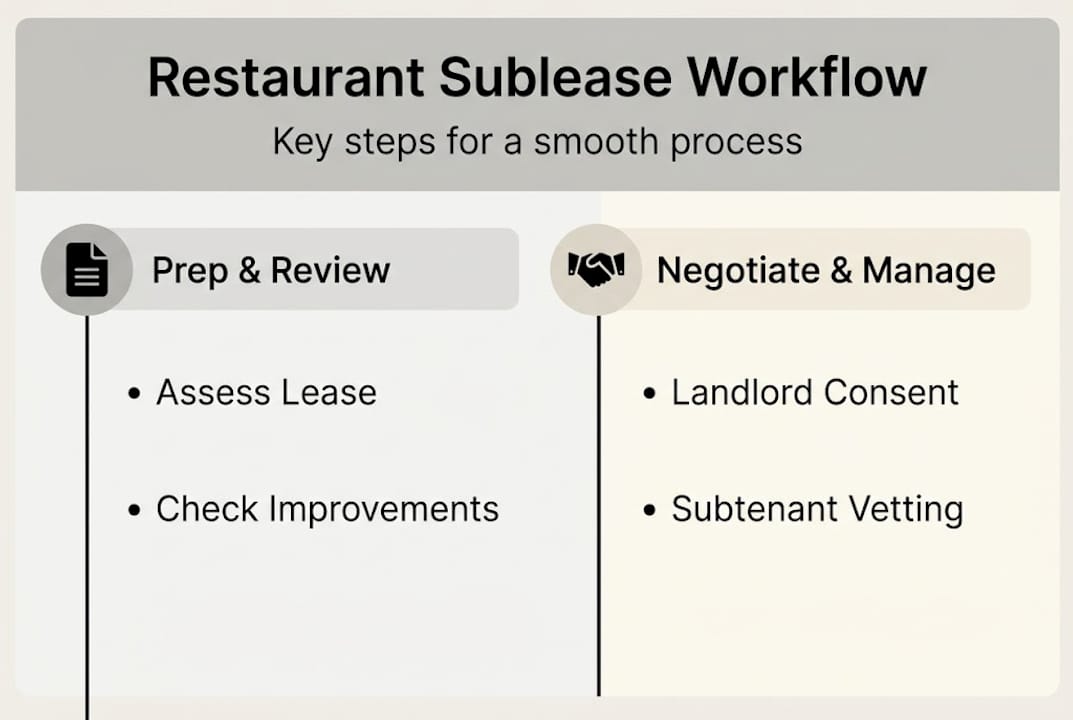
Once you’ve recognized the need to sublease, your first move should be assessing your lease and operational readiness. This step alone can save you weeks of wasted effort.
Start with your lease document. Does it explicitly allow subleasing? Many restaurant leases include a clause requiring landlord consent, and some outright prohibit it. If your lease is silent on the matter, that’s not a green light. It means you need to ask. Skipping this step is the fastest way to trigger a default.
Beyond lease language, check these critical prerequisites before moving forward:
- Landlord consent clause: Confirm whether consent is required and what the approval standard is (reasonable vs. absolute discretion)
- Remaining lease term: Most subtenants want at least 12 to 24 months of runway
- Current permits: Health department certificates, food handler licenses, and certificate of occupancy must be active
- Competitive rent: If your rent is above market, finding a subtenant willing to absorb it will be harder
- Equipment condition: Subtenants will inspect every piece of kitchen equipment
Subleasing may come with hidden obstacles such as high buildout costs, required tenant improvement allowances, regulatory hurdles, and lease term limits. Knowing this upfront prevents costly surprises.
| Readiness factor | What to check | Risk if skipped |
|---|---|---|
| Sublease rights | Lease clause language | Lease default |
| Landlord consent | Required approval process | Deal blocked |
| Permit status | Active licenses on file | Legal liability |
| Rent vs. market | Comparable listings nearby | Subtenant rejection |
| Equipment condition | Walk-through inspection | Deal renegotiation |
Operators exploring subleasing processes in San Francisco or restaurant leasing in California broadly will find that local regulations add another layer to this checklist. Even steps for subleasing in Roseville differ from larger metro markets.
Pro Tip: Pull your lease and read the assignment and subletting section out loud. If it’s confusing, hire a restaurant-focused real estate attorney for a one-hour review. It’s worth every dollar.
Engaging the landlord: Securing consent and setting expectations
Once you’re ready internally, your next hurdle is communicating and negotiating with the landlord. This is where many operators stumble by moving too fast or too informally.
Landlords in the food and beverage sector are often wary of subleases. They worry about an unknown operator damaging the space, falling behind on rent, or creating health code violations that reflect poorly on the property. Your job is to reframe subleasing as a shared risk-reduction strategy, not just your escape hatch.
Follow these steps to engage your landlord effectively:
- Request a meeting before sending any formal notice. A face-to-face conversation builds goodwill and surfaces concerns early.
- Prepare a financial package. Bring your current rent payment history, a business summary, and a profile of your ideal subtenant.
- Propose subtenant criteria together. Letting the landlord co-define standards makes them a partner, not an obstacle.
- Discuss key deal points upfront. These include tenant improvement (TI) allowances, any free rent period, and what happens if the subtenant defaults.
- Document everything in writing. A tri-party agreement signed by you, the subtenant, and the landlord is the cleanest structure.
“Success hinges on early landlord engagement and data-driven negotiations.”
Come to the table with market data. Show your landlord comparable rents in the area, vacancy rates, and the demand for food-ready spaces. This positions you as a credible partner, not a desperate tenant trying to offload a problem.
Using a marketplace for restaurant real estate can help you pull this data quickly and present it professionally. Landlords respond better when you speak their language.
Pro Tip: Never approach your landlord with a specific subtenant already locked in. It signals that you’ve bypassed their input and will put them on the defensive immediately.
Vetting and negotiating with subtenants
With landlord alignment, it’s time to find and negotiate with a qualified subtenant. This is the most operationally complex part of the process.

Not every interested party is a good fit. Screen candidates across three dimensions: food-use compatibility, financial strength, and operational readiness. A subtenant who can’t pass a health inspection or doesn’t have working capital for the first 90 days is a liability, not a solution.
Here’s a step-by-step screening process:
- Confirm food-use intent. Will they use the existing kitchen setup, or do they need major modifications?
- Request financial statements. Two years of tax returns or bank statements are a reasonable ask.
- Check references. Talk to prior landlords. Ask about payment history and how they left the space.
- Verify licenses. Confirm they can obtain the necessary permits for their concept in your jurisdiction.
- Assess operational timeline. How quickly can they open? A ready-to-operate subtenant dramatically reduces your rent gap.
Subtenants may demand TI allowances or free rent, and they pose bankruptcy and liability risk for the primary tenant. Build these scenarios into your negotiation from the start.
| Structure | Best for | Key risk |
|---|---|---|
| Sublease | Short-term relief, partial exit | You stay liable for master lease |
| Assignment | Full exit, long-term solution | Requires landlord approval |
| Tri-party replacement | Clean break, new direct lease | Landlord must accept new tenant |
When negotiating terms, pay close attention to liability and risk in Anaheim subleasing and review occupancy cost benchmarks in Oakland to understand what rent levels are realistic in your market.
Pro Tip: Prioritize subtenants who already operate a similar concept. They require fewer modifications, move faster, and carry less operational risk than first-time restaurateurs.
Managing the sublease: Compliance, pitfalls, and monitoring
Now that you’ve inked your sublease deal, consistent management is the key to long-term stability. Signing the agreement is not the finish line.
Your legal exposure doesn’t disappear once a subtenant moves in. As the master tenant, you remain responsible for rent payments to the landlord if the subtenant defaults. You’re also on the hook for any permit violations or unapproved physical changes to the space.
Here’s what to monitor on an ongoing basis:
- Rent payments: Confirm the subtenant pays on time every month. Set up a 5-day grace period with automatic notice triggers.
- Permit renewals: Track expiration dates for health permits, food handler certifications, and business licenses.
- Insurance certificates: Require the subtenant to name you as an additional insured and provide updated certificates annually.
- Space condition: Conduct quarterly walk-throughs. Document everything with photos.
- Unapproved modifications: Any structural or equipment changes require your written consent and likely the landlord’s as well.
“Ongoing liability remains with the master tenant even after subleasing; regulatory and financial compliance must be continuously monitored.”
On the financial side, track your subtenant’s sales-to-rent ratio. Occupancy costs typically range from 6% to 10% of sales for quick-service restaurants. If your subtenant’s ratio climbs above that band, they may be heading toward default.
Operators managing subleases in restaurant leasing in Los Angeles and leasing trends in San Diego should pay extra attention to local health department inspection cycles, which can create compliance windows that catch unprepared subtenants off guard.
Alternatives to subleasing: Weighing your exit options
Subleasing isn’t always the smartest option. Sometimes, cleaner or faster exits exist, and knowing the difference can save you months of complexity.
Tri-party deals or lease termination with a replacement tenant often present fewer obstacles and a cleaner exit for restaurant owners than traditional subleasing. In a tri-party deal, the landlord, you, and the incoming tenant all sign a new agreement. You walk away. The new tenant takes over directly.
| Option | Best scenario | Liability outcome |
|---|---|---|
| Sublease | Short-term gap, partial relief | You remain on master lease |
| Lease assignment | Full exit with landlord consent | Liability transfers to assignee |
| Tri-party replacement | Landlord prefers new tenant | You are fully released |
| Lease termination | Market favors landlord | Possible buyout cost |
Key factors that should drive your decision:
- Time remaining on lease: More than 3 years left? Assignment or tri-party may be worth the effort.
- Market demand: In a hot market, landlords are more willing to accept a new direct tenant.
- Your business goals: If you’re closing permanently, a clean exit beats an ongoing sublease obligation.
- Subtenant quality: A strong operator may qualify for a direct lease, making tri-party the better path.
Exploring restaurant leasing alternatives in Sacramento shows how local market conditions shape which option makes the most financial sense.
Perspective: Why most subleases fail—and what the best operators do differently
Most sublease failures trace back to two root causes: weak subtenant vetting and poor landlord communication. Operators rush the process because the financial pressure is immediate, and that urgency leads to shortcuts that create bigger problems down the road.
The hidden cost nobody talks about is deferred maintenance. A subtenant who inherits a space with aging HVAC, a failing grease trap, or outdated wiring will either demand rent concessions or walk away mid-lease. That’s a gap you’ll pay for.
The best operators treat subleasing as a strategic transaction, not a fire drill. They use location data in restaurant subleasing to benchmark rents, assess competition, and identify the subtenant profile most likely to succeed in that specific space. They also plan proactively, building sublease flexibility into lease renewals before they ever need it.
Operational transparency is the other differentiator. Sharing your sales history, foot traffic data, and equipment records with prospective subtenants builds trust and speeds up due diligence. It signals that you’re a serious operator, not someone trying to offload a problem. That reputation matters when the landlord is evaluating whether to approve your deal.
Next steps: Get expert help and unlock your restaurant’s potential
Putting all these best practices into action is much easier when you have the right tools and partners behind you.
The Pepperlot marketplace is built specifically for restaurant real estate, connecting operators, landlords, and brokers around curated sublease and lease listings that include the details that actually matter: grease traps, permits, seating capacity, and kitchen specs. You’re not sifting through generic commercial listings hoping something fits. Every listing is food-service ready. Pepperlot also offers location intelligence tools that let you analyze local competition, demographics, and market demand so you can price your sublease competitively and attract the right subtenant faster. With over 500 active users in the network, your listing gets in front of serious, qualified operators from day one.
Frequently asked questions
What documents do I need to sublease my restaurant space?
You’ll need your original lease, written landlord consent, a sublease agreement draft, active business licenses, and proof of current permit compliance. Confirm sublease rights and gather all documentation before approaching any prospective subtenant.
Is subleasing always better than lease assignment?
Not always. While subleasing offers flexibility, assignments or tri-party deals can provide a cleaner break and significantly less ongoing liability for the outgoing tenant.
What are typical occupancy costs for subletting a restaurant?
For quick-service restaurants, occupancy costs typically range from 6% to 10% of sales, though actual rates vary by market, concept type, and lease structure.
What risks remain after subleasing my space?
You stay liable for all master lease obligations, including rent and property condition, so you must actively monitor subtenant performance and regulatory compliance throughout the sublease term.
Leave a Reply