
TL;DR:
- Lease assignment transfers all rights and obligations to a new tenant, unlike subleasing.
- Landlord consent can slow or block assignment; standard is “not unreasonably withheld.”
- Unreleased personal guarantees and change of control clauses can pose risks after assignment.
Lease assignment is one of the most misunderstood concepts in restaurant real estate, and that gap in knowledge costs operators real money. Many restaurant deals collapse not because of price disagreements or poor foot traffic, but because the lease cannot be transferred to a buyer without triggering landlord interference or unexpected liability. If you are selling your restaurant, acquiring one, or simply planning your exit strategy, understanding how lease assignment works is not optional. This guide breaks down what lease assignment is, how the process unfolds step by step, what landlords actually look for, and how to protect yourself from the traps that catch even experienced operators off guard.
Table of Contents
- What is lease assignment in commercial real estate?
- Step-by-step: How lease assignment works for restaurant spaces
- Landlord consent: What actually matters and how to negotiate
- Assignment traps, liabilities, and negotiation tips for restaurant operators
- A restaurateur’s perspective: What most lawyers miss about lease assignment
- Find your next restaurant space or get expert lease advice
- Frequently asked questions
Key Takeaways
| Point | Details |
|---|---|
| Lease assignment definition | Assignment is the full legal transfer of your lease to another operator, who assumes all your rights and obligations. |
| Process steps | Assignment requires finding a qualified assignee, landlord consent, attorney-drafted paperwork, and proper notifications. |
| Landlord consent | Getting landlord approval depends on the assignee’s financials and lease terms—negotiation is key. |
| Liability risks | Unless released, the original restaurant tenant often remains liable after assignment—never assume you’re off the hook. |
| Negotiation tips | Define assignment rights, cap fees, and always negotiate before you sign—proactive terms save deals and protect you. |
What is lease assignment in commercial real estate?
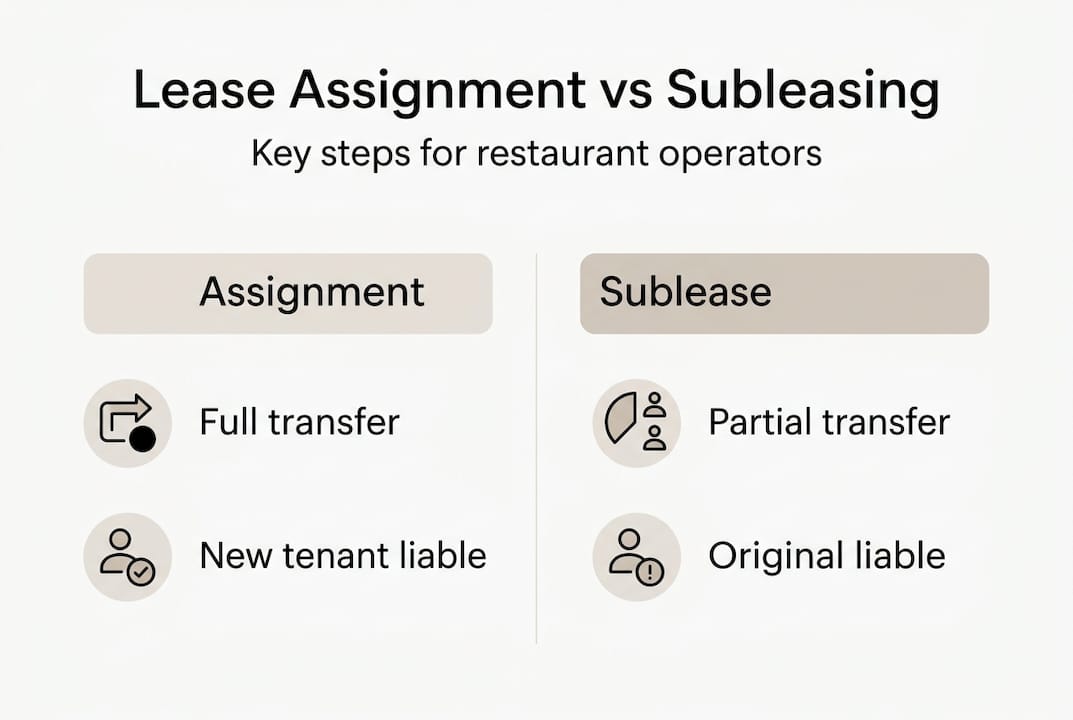
Let’s clear up the confusion right away. Lease assignment is the full transfer of a tenant’s rights and obligations under a commercial lease to a new tenant, called the assignee. The original tenant, called the assignor, hands over everything: the remaining lease term, the rent obligations, and all the conditions baked into the original agreement.
This is fundamentally different from subleasing. With a sublease, you remain the primary tenant and essentially become a landlord to someone else. You collect rent from your subtenant and pass it to the landlord, but you stay on the hook for the entire lease. Understanding the assignment versus sublease distinction matters enormously because the financial exposure is completely different in each scenario.
For restaurant operators, lease assignment is most relevant during ownership transitions. When you sell your restaurant as a going concern, the buyer needs to take over your space. That means assigning your lease. Without a clean assignment, there is no deal.
Here is a side-by-side comparison to make the distinction concrete:
| Feature | Lease assignment | Sublease |
|---|---|---|
| Who pays landlord? | Assignee directly | Original tenant |
| Original tenant liability | Usually remains (unless released) | Always remains |
| Lease term transferred | Full remaining term | Partial or full |
| Landlord relationship | Assignee becomes tenant | Original tenant remains tenant |
| Common use case | Business sale | Temporary vacancy |
One misconception trips up operators constantly: many assume that once they assign the lease, they are completely free. That is often not true. Unless the landlord formally releases you through a legal process called novation (a new agreement that substitutes the assignee as the sole responsible party), you may still be liable if the new tenant defaults.
Industry insight: Many restaurant sellers discover post-closing that they are still exposed to lease liability for years after the sale. This is not a technicality. It is a real financial risk that can follow you long after you have moved on.
If you are browsing restaurant lease opportunities, pay close attention to the assignment clause before you fall in love with a space. The full lease assignment process has several moving parts, and knowing them in advance puts you in a stronger position.
Step-by-step: How lease assignment works for restaurant spaces
The actual mechanics of assigning a restaurant lease follow a predictable sequence, though the timeline can stretch depending on how responsive the parties are. Here is what the process typically looks like:
- Review the assignment clause. Pull out your lease and find the section governing assignment. Does it require landlord consent? Is there a fee? Are there restrictions on the type of business that can take over? This clause controls everything.
- Identify a qualified assignee. Your buyer or incoming tenant needs to meet the landlord’s standards. That usually means solid financials, relevant restaurant experience, and a business concept compatible with the property.
- Submit a formal consent request. You formally notify the landlord in writing, providing the assignee’s financial statements, business plan, and any other documents the lease requires.
- Landlord review period. The landlord evaluates the assignee. This typically takes 10 to 30 days. Delays here are common, especially if the landlord requests additional documents.
- Execute the Assignment and Assumption Agreement. This is the core legal document. The assignee formally assumes all lease obligations. Both parties sign, and the landlord countersigns to confirm consent.
- Transfer the security deposit. Decide whether the assignee reimburses you for the deposit or whether the landlord holds a new deposit. Get this in writing.
- Notify all relevant stakeholders. Inform your vendors, insurers, and local licensing authorities about the change in tenancy.
According to detailed lease assignment steps, the typical timeline is 30 days for a commercial lease assignment when all parties cooperate, with legal and administrative fees often ranging from $200 to $500.
Pro Tip: Before you even list your restaurant for sale, confirm with an attorney whether your lease is assignable and under what conditions. Discovering a problematic assignment clause after you have a buyer lined up is one of the most stressful and deal-killing scenarios in restaurant real estate.
For comparison, the subleasing workflow follows a slightly different path, but many of the same documentation requirements apply. The biggest delays in assignment typically come from incomplete financial submissions or landlords who take their time reviewing. Submit a complete package the first time and follow up proactively.
Landlord consent: What actually matters and how to negotiate
Landlord consent is where most restaurant lease assignments slow down or fall apart. Not all consent standards are created equal, and the language in your lease determines how much leverage the landlord actually has.
There are three common consent standards you will encounter:
- Sole discretion: The landlord can say no for any reason or no reason at all. This is the worst standard for tenants.
- Reasonable consent: The landlord cannot withhold consent unreasonably. This is the most tenant-friendly standard and the one you should push for.
- Permitted transfers: Certain transfers (to affiliates, parent companies, or related entities) are pre-approved without requiring consent. This is valuable for operators with multiple locations.
As landlord consent standards vary widely, landlords typically assess the assignee’s financial strength, restaurant experience, concept compatibility, and projected sales volume relative to rent. A landlord running a curated food hall will scrutinize menu concept far more than a landlord with a standalone strip center.

Here is a practical negotiation checklist for restaurant tenants:
| Negotiation point | What to push for |
|---|---|
| Consent standard | “Not unreasonably withheld” language |
| Assignment fees | Cap at a fixed dollar amount |
| Recapture rights | Limit or eliminate landlord’s right to recapture |
| Permitted transfers | Include affiliates and related entities |
| Review timeline | Require landlord response within 20 to 30 days |
| Release from liability | Request novation or conditional release |
Pro Tip: Negotiate the assignment clause standards before you sign the original lease, not when you are trying to exit. Landlords are far more willing to agree to tenant-friendly assignment terms when they want to fill a space than when they hold all the leverage at renewal or sale time.
Recapture rights deserve special attention. Some leases give the landlord the right to recapture the space (essentially terminate your lease and re-lease it directly) if you request assignment. This can completely undermine a restaurant sale. Know whether this clause exists in your lease before you start the process.
Assignment traps, liabilities, and negotiation tips for restaurant operators
Even when assignments proceed smoothly on the surface, hidden risks can surface months or years later. Here is where experienced operators get caught.
Privity and personal guarantees. Many restaurant leases include personal guarantees, meaning you personally guaranteed the lease obligations. Assignment does not automatically release you from that guarantee. If the assignee defaults, the landlord can come after you personally. Push for a written release of your personal guarantee as part of the assignment approval.
Change of control clauses. This is a trap that catches operators who sell their restaurant through a stock sale rather than an asset sale. If your restaurant operates as an LLC or corporation and you sell the ownership interests rather than the assets, some leases treat this as an assignment even though the legal entity holding the lease has not changed. Change of control provisions can trigger default or require landlord consent even when no formal assignment occurs.
Landlord profit-sharing on lease premium. If your lease has below-market rent and you are assigning it to a buyer who values that favorable rate, the landlord may have the right to capture a portion of any premium paid for the lease. This directly reduces what you can charge a buyer for the goodwill tied to your lease terms.
Key negotiation tips to protect yourself:
- Request a full novation or written release from liability upon assignment
- Cap any landlord assignment fees in the original lease
- Negotiate to exclude affiliate and family transfers from consent requirements
- Clarify whether stock sales trigger assignment provisions
- Confirm what happens to the security deposit and whether it transfers
The overlooked lever: Most operators focus on rent and term when negotiating a lease. The assignment clause is treated as boilerplate. It is not. That clause will determine whether your restaurant is sellable and at what price.
For context on how assignment versus sublease provisions interact, and to understand the broader financial picture of your property decision, reviewing the restaurant sale versus lease comparison is worth your time. For negotiation benchmarks specific to restaurant leases, industry-focused resources can give you a realistic baseline for what is achievable in your market.
Also, remember that original tenant liability may survive unless a novation is executed, which means your exposure does not automatically end at closing.
A restaurateur’s perspective: What most lawyers miss about lease assignment
Here is the uncomfortable truth: most attorneys handle lease assignment as a legal transaction. They check the boxes, draft the documents, and move on. What they often miss is the restaurant-specific reality that makes assignment uniquely high-stakes in this industry.
A restaurant lease is not just a real estate agreement. It is tied to your liquor license, your health permits, your equipment financing, and your brand identity. When any of those elements are disrupted during an assignment, the deal can unravel in ways a standard commercial real estate attorney will not anticipate.
Operators who have been through a restaurant sale often say the same thing: they wish they had negotiated the assignment clause before signing the original lease, not when they were desperate to exit. Prevention is not just cheaper. It is the difference between a clean sale and a deal that collapses at the finish line.
The mindset shift that matters most? Stop treating your lease as a cost to manage and start treating it as an asset to protect. A well-structured, assignable lease with favorable terms adds real dollar value to your restaurant when it is time to sell. To learn more about lease assignment and how it interacts with sublease decisions, that resource is a strong starting point.
Find your next restaurant space or get expert lease advice
Navigating lease assignment is complex, but finding the right space or buyer does not have to be. Pepperlot is built specifically for restaurant operators, landlords, and brokers who need more than a generic real estate platform.

Whether you are looking for a full-service restaurant lease with favorable assignment terms already in place, exploring restaurant sale listings to find your next acquisition, or using location intelligence tools to evaluate a market before committing to a space, Pepperlot gives you the focused, industry-specific support that generic platforms simply cannot offer. Every listing includes restaurant-specific details that matter: permits, equipment, seating capacity, and lease terms.
Frequently asked questions
What is the difference between lease assignment and subleasing?
Assignment transfers full remaining term and liability to a new tenant, while subleasing keeps the original tenant responsible and creates a secondary landlord-subtenant relationship between the original tenant and the new occupant.
Can a landlord refuse to allow a lease assignment?
Most leases require landlord consent, but refusal cannot usually be unreasonable if your lease includes a “not unreasonably withheld” standard. Always check what consent standard your specific lease uses.
Does the original restaurant tenant remain liable after assignment?
Unless specifically released through a novation agreement, the original tenant often remains liable for the lease even after a successful assignment is completed.
What documents are needed for a lease assignment?
You will need the original lease, an Assignment and Assumption Agreement, landlord consent and assignee financials, and any permits or licenses relevant to the restaurant operation being transferred.
How long does a restaurant lease assignment typically take?
When all parties respond promptly, a commercial lease assignment takes approximately 30 days from initial submission to executed agreement.
Recommended
- Restaurant Lease Assignment vs Sublease Explained | PepperLot Blog
- Step-by-step workflow for subleasing your restaurant space
- Restaurant sale vs. lease: 4 key differences for success
- Restaurant Lease Terms Explained: Secure Your Ideal Space
- Qu’est-ce que le PPC pour restaurants ? Guide pratique pour propriétaires | Sorbey Blog | Sorbey
Leave a Reply