
TL;DR:
- Overlooked lease clauses can lead to substantial costs for restaurant operators before opening, especially restrictions on menu changes and exclusivity. Securing broad use language, exclusive use protections, favorable lease terms, and reasonable assignment rights are critical for long-term profitability. Most operators neglect these provisions, risking their investment by accepting landlord-favorable terms without negotiation.
One overlooked lease clause can cost you six figures before you serve your first plate. Restaurant operators who focus exclusively on base rent often discover too late that restrictions on menu changes, competitor proximity, or exit options have quietly boxed them in. The lease you sign today will govern every pivot, renovation, and sale you attempt for the next 10 to 20 years. This guide breaks down the clauses that matter most, what they actually mean for your bottom line, and how to negotiate like someone who has read every line.
Table of Contents
- Why restaurant leases are different: Unique pitfalls and opportunities
- Key restaurant-specific lease clauses to focus on
- Comparison: Clause types, costs, and negotiation leverage
- Advanced issues: Edge cases, loopholes, and must-have addenda
- What most operators overlook: Lease clauses that make or break restaurant deals
- Find and negotiate restaurant-ready leases with Pepperlot
- Frequently asked questions
Key Takeaways
| Point | Details |
|---|---|
| Exclusive use protection | Negotiate for exclusive use to guard against direct competitors in your building. |
| Tenant improvement range | Expect TI allowances between $20–$150/SF and always secure reimbursement terms. |
| Assignment clause flexibility | Clarify assignment rights to allow future sales and avoid transfer penalties. |
| Triple Net (NNN) risks | NNN leases shift most costs to tenants, so negotiate caps and fair audits. |
| Watch for edge cases | Review language around ownership change and use to prevent hidden risks. |
Why restaurant leases are different: Unique pitfalls and opportunities
A standard commercial lease was designed with office tenants or retail boutiques in mind. Restaurants are a different animal entirely. You are committing hundreds of thousands of dollars to build out a space with industrial ventilation, grease traps, specialized plumbing, and custom kitchen infrastructure. If the lease falls apart two years in, you cannot simply pack up your desk and find a new spot. You lose the build-out, the permits, sometimes the equipment.
Restaurants also live and die by foot traffic patterns, neighboring businesses, and the competitive landscape within a quarter mile. That makes understanding restaurant lease terms not just a legal exercise but a strategic one.
Here is what makes restaurant leases uniquely risky compared to other commercial tenancies:
- Use clause restrictions can prevent you from adding a happy hour, launching a brunch menu, or pivoting to a ghost kitchen model without landlord approval.
- Operating hour requirements may force you to stay open even during slow seasons, burning labor costs to satisfy lease language.
- Buildout dependencies mean your ability to open at all is tied to landlord delivery timelines and improvement allowance terms.
- Foot traffic dependencies make exclusivity more than a courtesy. It is a competitive survival tool.
“Exclusive use clauses prevent landlords from leasing to direct competitors in the same property, crucial for niche concepts like taco or pizza restaurants.”
When you operate a ramen shop or a craft cocktail bar, having a nearly identical concept open two doors down is not just annoying. It can cut your revenue by 20 to 30 percent overnight. Standard leases rarely include exclusivity protections unless you fight for them.

Key restaurant-specific lease clauses to focus on
Most restaurant operators know to ask about rent and lease term length. Fewer dig into the clauses that actually determine whether the deal is profitable or painful. Here are the provisions that deserve your full attention before you sign anything.
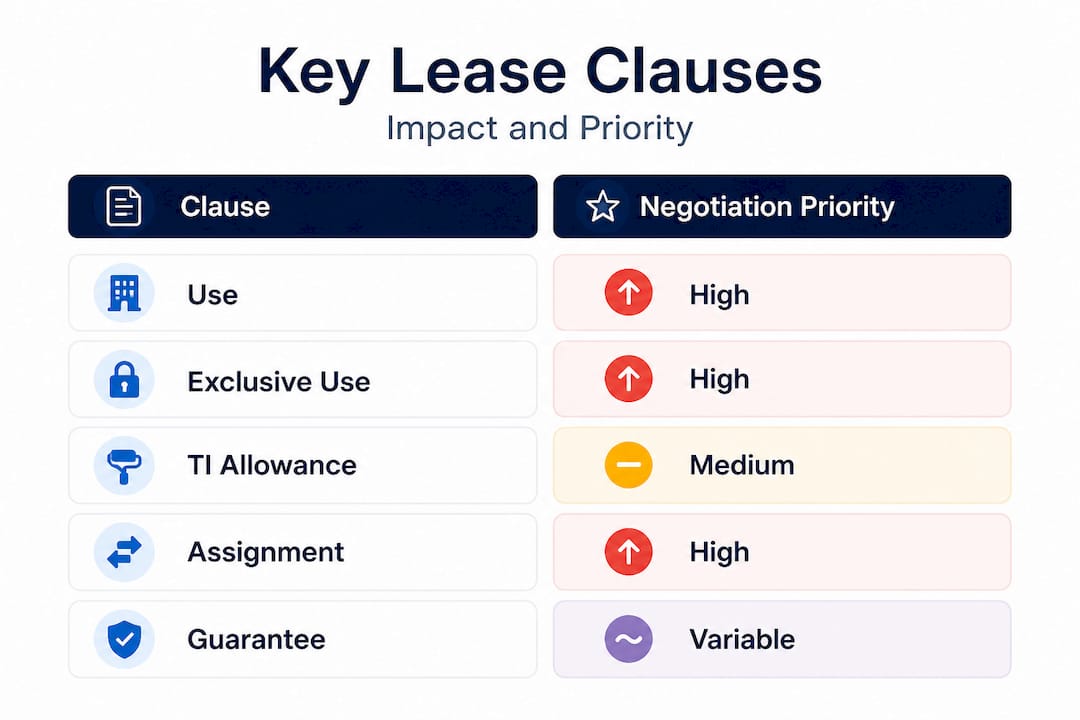
1. Use clause
The use clause defines what you are legally allowed to do in the space. Narrow use clauses say something like “full-service Italian restaurant only.” Broader language like “food and beverage establishment” gives you room to evolve. Always push for the broadest definition the landlord will accept. Negotiate specific carve-outs if necessary, such as the right to add retail merchandise, meal kits, or catering services.
2. Exclusive use clause
This clause prevents the landlord from renting adjacent or nearby units to a direct competitor. If you run a pizza concept without this protection, nothing stops your landlord from signing another pizza chain one floor above you. Exclusive use provisions are especially critical in mixed-use developments and food halls.
3. Tenant improvement (TI) allowance
This is landlord money applied to your build-out costs. TI allowances typically range $20 to $150 per square foot, with the high end reflecting markets like New York City or San Francisco. For a 2,000 square foot restaurant, that is anywhere from $40,000 to $300,000 in landlord-funded build-out assistance. Negotiate free rent during the construction period as well. You should not be paying rent on a space you cannot yet operate.
4. Assignment and subletting rights
These clauses determine what happens when you want to sell your restaurant or bring in a new investor. Without favorable assignment terms, you may need landlord consent for any transfer, which gives the landlord enormous leverage. The full restaurant lease steps always include reviewing assignment language carefully. Negotiate for “reasonable consent” language and cap any transfer fees.
5. Personal guarantee
Most landlords require the operator to personally guarantee the lease. This means your personal assets are on the line if the business fails. Push back with a burn-off provision (the guarantee reduces over time), a good-guy clause (limits liability if you vacate and notify the landlord promptly), or a time-limited guarantee of three to five years rather than the full lease term.
| Clause | Financial impact | Negotiation priority |
|---|---|---|
| Use clause | Medium to high | Negotiate broad language |
| Exclusive use | High for niche concepts | Demand specific competitor carve-outs |
| TI allowance | $40k to $300k+ | Get free rent during build-out |
| Assignment rights | High at exit | Require reasonable consent standard |
| Personal guarantee | Full lease liability | Negotiate burn-off or good-guy clause |
Pro Tip: Always request a detailed build-out schedule in writing and tie rent commencement to your certificate of occupancy, not the landlord’s projected delivery date. Delays are common, and you should not pay rent until you can legally open.
Comparison: Clause types, costs, and negotiation leverage
Understanding individual clauses is one thing. Seeing how they interact with your lease structure is another. The type of lease you sign shapes who absorbs cost increases over time.
In a gross lease, you pay a single flat rent and the landlord covers operating expenses like taxes, insurance, and maintenance. Predictable, but the base rent is usually higher to compensate. In a triple net (NNN) lease, you pay a lower base rent plus your proportionate share of property taxes, insurance, and common area maintenance (CAM). NNN leases benefit landlords by shifting cost risk to tenants, who gain more control but face unpredictable escalations. For restaurant operators, NNN leases require careful negotiation of expense caps, audit rights, and exclusions for major capital items like roof replacement.
One expensive edge case worth knowing: black iron exhaust systems. In dense urban markets like New York City, installing a compliant exhaust system can cost $50,000 to $150,000 if the existing infrastructure is missing. Many operators discover this after signing. Always inspect what infrastructure exists and get a landlord commitment in writing about who bears that cost.
Rent abatement is another protection worth fighting for. If the landlord delivers the space late, you should receive free rent for every day of delay. This is not standard language. You need to negotiate it in, particularly for complex restaurant build-outs that may take four to eight months.
For restaurant triple net lease insights, the difference between capped and uncapped CAM charges can mean thousands of dollars per year in unpredictable costs. Always ask for a CAM cap of 3 to 5 percent annually and exclude management fees from the CAM reconciliation.
Advanced issues: Edge cases, loopholes, and must-have addenda
Once you have handled the standard clauses, there is a second layer of risk that catches even experienced operators off guard. These edge cases are where deals quietly fall apart years after signing.
Change of control triggers. Many leases define an assignment as any transfer of more than 50 percent of the ownership entity. That means if you sell your restaurant through a stock sale or bring in a private equity partner who takes a majority stake, you may have triggered an assignment clause requiring landlord consent. M&A transactions and stock sales can technically constitute a change of ownership even if the restaurant operation stays identical. Negotiate explicit carve-outs for internal restructuring and financing rounds.
Sole discretion approval language. Watch for clauses that allow the landlord to approve or deny assignment requests “in their sole and absolute discretion.” That language gives the landlord a veto over any sale, regardless of how qualified the buyer is. Push for “reasonable consent, not to be unreasonably withheld or delayed” as the standard. This one phrase change can mean the difference between a clean sale and a stalled deal.
Overly narrow use clauses. A clause that limits you to “a sit-down seafood restaurant with table service” sounds specific enough at signing. Two years later, when you want to add a bar program or convert part of the space to a fast-casual counter, that language blocks you. Narrow use clauses hinder pivots in ways that can be financially devastating, particularly when consumer preferences shift or your original concept underperforms. Negotiate broad use language upfront and add specific operational carve-outs.
Transfer premiums. Some leases require tenants to share a percentage of any profit made on a lease assignment or sublease. These transfer premiums can reach up to 50 percent of assignment proceeds, gutting the value of selling your restaurant. Cap or eliminate this provision wherever possible.
Additional edge cases to address in your lease addenda:
- Force majeure clauses that explicitly cover pandemics, government shutdowns, and supply chain disruptions as grounds for rent abatement or lease suspension
- Renovation carve-outs from continuous operation requirements so you can close for remodeling without triggering a default
- Signage rights locked in writing, including illuminated exterior signage and the right to maintain them if the building changes management
- Right of first refusal on adjacent spaces if you plan to expand
Pro Tip: Hire a restaurant-focused real estate attorney, not a general commercial attorney, to review your lease. Restaurant-specific pitfalls like assignment edge cases for restaurateurs require someone who has seen these clauses fail in practice, not just in theory. The $2,000 to $5,000 in legal fees is trivial compared to what a bad clause can cost over a 10-year lease.
For a clear breakdown of how assignment and sublease differences affect your exit strategy, it is worth reviewing both options before you negotiate the lease.
What most operators overlook: Lease clauses that make or break restaurant deals
Here is a perspective that most guides will not tell you directly: the operators who get hurt the most are not the ones who negotiate bad rent. They are the ones who negotiate nothing else.
After working closely with restaurant operators across dozens of markets, the pattern is clear. A new restaurateur spends weeks negotiating the base rent down by two dollars per square foot and then signs the rest of the lease as-is. That two dollars per square foot savings is $4,000 per year on a 2,000 square foot space. Meanwhile, a missing exclusive use clause lets a competitor open next door. An inflexible use clause blocks an alcohol license expansion. A personal guarantee with no burn-off leaves them personally exposed for the full 15-year term.
The math is not close. Expert lease negotiation tips consistently point to exclusive use, assignment flexibility, and use clause breadth as the terms that most directly affect long-term profitability and exit value. Base rent is visible and feels controllable. These other clauses are invisible until they bite.
The most successful operators we see treat the lease not as a hurdle to clear before opening, but as the foundational document that defines their operating ceiling. They ask: “What happens if I want to sell in five years? What happens if I want to add a second concept in this same space? What if I need to close for three months to renovate?” Every one of those scenarios has a corresponding lease clause. Either you negotiated it in your favor, or you did not.
The uncomfortable truth is that most landlords send a lease that is written entirely in their favor. Accepting it without pushback is not a sign of goodwill. It is a negotiating mistake that compounds for the entire lease term.
Find and negotiate restaurant-ready leases with Pepperlot
Knowing which clauses to fight for is half the battle. Finding spaces where the landlord is already familiar with restaurant requirements is the other half.
Pepperlot is built specifically for restaurant operators navigating exactly this process. Every listing on the platform includes restaurant-relevant details like grease trap status, existing permits, hood systems, seating capacity, and build-out condition, so you are not discovering deal-breakers after an offer. Browse restaurant space for sale or explore full restaurant lease listings to find spaces already configured for food service. Use Pepperlot’s location analysis tools to evaluate foot traffic, competition density, and demographic fit before you ever sit down with a landlord. Smarter sourcing leads to stronger negotiating positions.
Frequently asked questions
What is an exclusive use clause, and why does it matter for restaurants?
An exclusive use clause prevents your landlord from leasing nearby space to a direct competitor, protecting your customer base and revenue. This is especially critical for niche concepts like taco restaurants or craft breweries where a similar concept nearby can directly cannibalize sales.
What are typical tenant improvement (TI) allowance amounts for restaurant leases?
Restaurant TI allowances typically range from $20 to $150 per square foot depending on the market and build-out complexity, so always negotiate free rent during construction to protect your cash flow.
How can restaurant operators avoid expensive assignment clause pitfalls?
Negotiate for reasonable landlord consent standards, eliminate or cap transfer premiums, and explicitly carve out M&A and ownership restructuring scenarios so a business sale does not trigger a default.
What does a “burn-off” provision mean in personal guarantees?
A burn-off provision means your personal guarantee liability reduces incrementally over time or after hitting certain performance benchmarks, limiting how long your personal assets remain at risk.
Leave a Reply