
TL;DR:
- Understanding key restaurant infrastructure terms before signing leases is crucial to ensure successful project completion and timely opening. Familiarity with concepts like BOH, FOH, HVAC, and TI allowances enables operators to accurately budget, negotiate, and avoid costly build-out mistakes. Proper knowledge prevents delays caused by ambiguous lease clauses and unanticipated infrastructure costs, safeguarding operational efficiency and financial stability.
Most restaurant operators learn infrastructure terminology the hard way, deep into a lease negotiation or mid-build-out when a contractor asks whether you want a Type I or Type II hood and the wrong answer costs $20,000. Understanding restaurant infrastructure key terms before you sign anything is not just helpful, it is the difference between a project that opens on time and one that burns through your reserve capital waiting on permits. This guide gives you the working vocabulary to walk into property negotiations, contractor conversations, and health inspections with genuine confidence.

Table of Contents
- Defining key restaurant infrastructure terms every operator should know
- Understanding tenant improvement (TI) allowances and build-out costs
- Key spatial infrastructure terms in kitchen and dining layouts
- Infrastructure terms related to compliance, safety, and operational efficiency
- The hidden truths restaurant operators rarely hear about infrastructure terms and build-outs
- Find your ideal restaurant space with Pepperlot
- Frequently asked questions
Key Takeaways
| Point | Details |
|---|---|
| Master essential terms | Knowing infrastructure key terms like BOH, FOH, HVAC, and TI allowance is critical for confident restaurant setup decisions. |
| Plan for TI delays | Tenant improvement reimbursements require upfront cash and can take 30-90 days, so plan finances to avoid cash flow issues. |
| Balance space wisely | Allocate about 60% of your space to dining and 40% to kitchen areas for efficient operation and guest comfort. |
| Comply with layouts | Kitchen aisle widths and equipment clearances must follow code to prevent delays and maintain efficiency. |
| Clarify lease roles | Explicitly define landlord and tenant responsibilities for permits and approvals to avoid costly build-out delays. |
Defining key restaurant infrastructure terms every operator should know
The hospitality industry has its own dialect, and key restaurant infrastructure terms are the foundation of that language. Before you evaluate a single listing or review a lease, these are the terms that will shape every conversation you have.
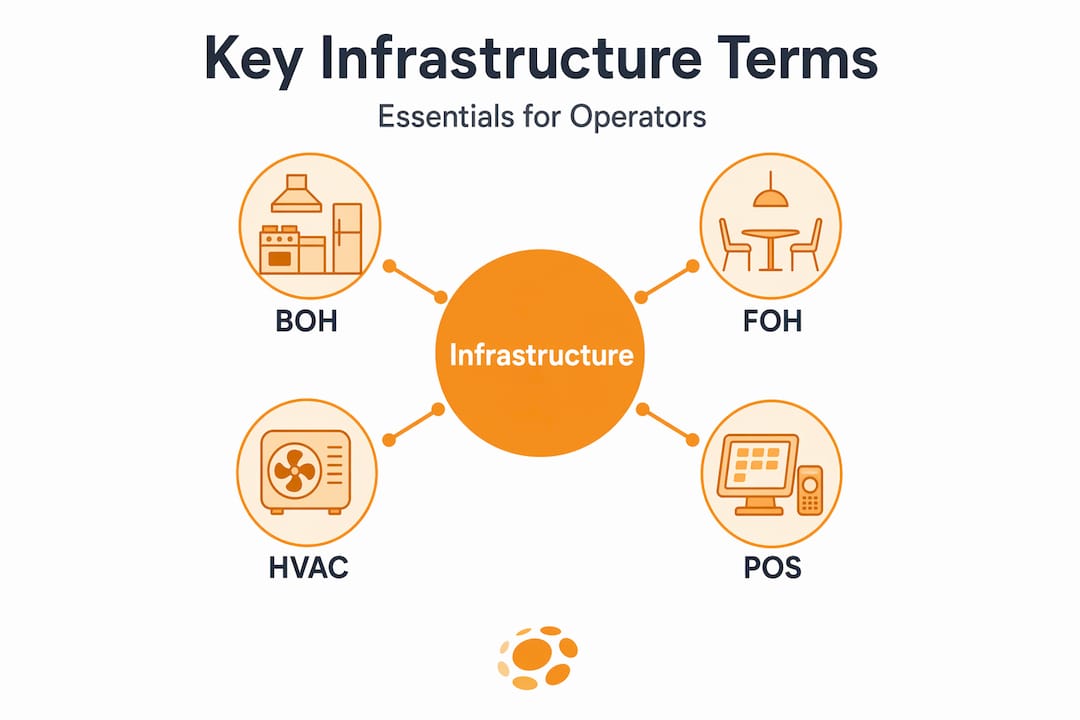
BOH vs. FOH. Back-of-house (BOH) refers to all kitchen, prep, storage, and staff areas that guests never see. Front-of-house (FOH) covers everything the guest experiences: the dining room, bar, waiting area, and restrooms. This distinction matters enormously in lease negotiations because landlords often measure “usable square footage” differently from how you will actually deploy that space. A space advertised as 2,000 square feet may leave you with only 800 square feet of practical BOH if the layout is inefficient.
HVAC. Heating, ventilation, and air conditioning systems do double duty in restaurants. They regulate guest comfort in the dining room and, critically, control heat and grease-laden air exhaust from the kitchen. QSR Pro’s glossary defines HVAC as part of the core infrastructure every operator must understand, noting that commercial kitchen ventilation requirements differ significantly from standard HVAC installations. Make sure your lease specifies who owns, maintains, and is financially responsible for the HVAC system.
POS systems. A point-of-sale (POS) system is your transaction hub, handling orders, payments, inventory tracking, and reporting. From an infrastructure standpoint, POS systems require dedicated electrical circuits, reliable internet connections, and sometimes structured cabling built into the space. If you are leasing a second-generation restaurant space, confirm whether existing data and electrical infrastructure supports your POS choice or whether you will need to rewire.
Plumbing, electrical, and fire suppression. These three are the non-negotiables of food service infrastructure. Plumbing in a restaurant context means not just water lines but also grease traps, floor drains, and three-compartment sinks required by health codes. Electrical systems must handle high-load commercial equipment like fryers, ovens, and refrigeration. Fire suppression, specifically a wet chemical suppression system above cooking equipment, is required by most fire codes and must be inspected and certified before opening.
Tenant improvement allowance (TI). A TI allowance is a landlord contribution toward your restaurant build-out definitions and construction costs. More on this in the next section, but it is essential to understand that TI is not cash in hand. It is a reimbursement, and the mechanics of how you access it will directly affect your cash flow during the build.
Here is a quick-reference list of the most commonly misunderstood terms:
- Shell space: A bare, unfinished space with no plumbing, electrical, or HVAC beyond the basics. Requires full build-out investment.
- Second-generation (2G) space: A previously occupied restaurant space with existing infrastructure still in place.
- Certificate of Occupancy (CO): The official permit confirming the space meets code requirements and is legally occupiable.
- Grease trap: An interceptor device that prevents fats, oils, and grease from entering municipal sewer lines.
- Type I hood: A grease and heat-rated exhaust hood required above fryers, griddles, and open-flame equipment.
- Type II hood: A lighter-duty condensate and heat hood used above dishwashers or low-heat equipment.
Understanding tenant improvement (TI) allowances and build-out costs
TI allowances are one of the most financially loaded terms in restaurant leasing, and most first-time operators misread how they work until it is too late. A landlord offering a $100-per-square-foot TI on a 2,000-square-foot space sounds like $200,000 in free money. It is not. Tenant improvement allowance details show these are structured as reimbursements, meaning you spend the money first and wait 30 to 90 days after inspections to get paid back.
TI allowances typically range from $50 to $150 per square foot depending on the market and landlord negotiating position. In high-cost markets like New York City, that range barely covers MEP work (mechanical, electrical, and plumbing) on a shell space. Always model your build-out budget assuming the TI reimbursement arrives 60 days after your last inspection, not the day you open.
The cost picture gets more specific when you factor in the type of space you are working with. Restaurant build-outs cost between $150 and $400 or more per square foot and typically take 4 to 9 months from planning to opening. Shell spaces sit at the top of that range because every system must be installed from scratch. Second-generation restaurant spaces can save 30 to 50 percent on build-out costs if the existing infrastructure aligns with your concept.
Key factors that drive build-out cost variation:
- Space condition: Shell vs. warm shell vs. second-generation
- Concept complexity: A quick-service counter operation costs far less than a full-service kitchen with multiple cooking zones
- Local labor rates: Construction costs in urban markets can run 40 percent higher than suburban equivalents
- Permit fees and timelines: Some municipalities charge significant plan-check fees and take 8 to 12 weeks to process restaurant permits
- Equipment specifications: Custom millwork, walk-in cooler sizing, and hood configurations all drive cost
Pro Tip: Before signing a lease, get a licensed contractor to walk the space and give you a rough scope estimate. Even a ballpark number based on your concept will reveal whether the landlord’s TI offer is meaningful or symbolic. Many operators skip this step and discover the gap only after they are committed.
Understanding TI allowances and build-out budgeting also means knowing what is and is not typically covered. Landlords often exclude furniture, fixtures, and equipment (FF&E) from TI eligibility. Your hood system, walk-in cooler, and POS hardware may need to come entirely out of your own capital.
Key spatial infrastructure terms in kitchen and dining layouts
Restaurant layout guidelines are built on ratios, measurements, and clearances that feed directly into your operational efficiency and regulatory compliance. Get these wrong in the design phase and you pay for it every service, either in staff collisions, health code violations, or sluggish ticket times.
The standard dining-to-kitchen space ratio used in layout planning allocates 60% to dining areas and 40% to kitchen, prep, and storage. That 40% BOH allocation must accommodate cooking lines, cold storage, dry storage, a dishwashing station, and staff circulation. It is a tighter constraint than it looks on a floor plan.
Seating allocation follows a similar precision. Seating density averages 1.5 to 2 square meters per guest, with fine dining on the higher end and casual dining closer to the lower end. Calculate this against your total dining square footage to project your maximum covers and, by extension, your revenue capacity.
| Space type | Recommended ratio | Notes |
|---|---|---|
| Dining area | 60% of total floor area | Includes bar, waiting, and restrooms |
| Kitchen + prep + storage | 40% of total floor area | BOH must accommodate all operational functions |
| Seating density | 1.5 to 2 sq meters per guest | Varies by concept and local fire code |
| Single-cook aisle width | 42 inches minimum | Per NFPA/FDA standards |
| Multi-cook aisle width | 48 inches minimum | For 2+ cooks working simultaneously |
| Equipment front clearance | 36 inches minimum | Required in front of ranges and high-heat equipment |
Kitchen design terminology around aisle widths is directly tied to safety compliance. Minimum aisle widths are 42 inches for a single cook station and 48 inches for lines with two or more cooks. Front-of-equipment clearances must be at least 36 inches to meet NFPA and FDA Food Code requirements. These are not suggestions. Violations during a health inspection can result in forced closures.
Pro Tip: When reviewing a floor plan for a restaurant layout example, physically mark out aisle widths on paper using the actual equipment dimensions from your supplier. Many design errors only become visible when real equipment footprints are overlaid on the architectural drawing.
Infrastructure terms related to compliance, safety, and operational efficiency
Compliance is where restaurant operational terms get legally and financially serious. The permitting structure in a restaurant lease can make or break your opening timeline, and most operators do not scrutinize this section of their lease nearly enough.
NYC leases must specify permitting responsibilities explicitly. Landlords typically handle base building permits and the certificate of occupancy. Tenants handle permits for any alterations, including electrical upgrades, plumbing modifications, and hood installations. The dangerous gray area sits in venting approvals, exterior penetrations, and any work that touches the building’s base systems. Ambiguity here has delayed restaurant openings by months.
Here is how permitting responsibilities typically break down in a standard build-out:
- Landlord submits plans and receives base building permit approval
- Tenant hires licensed architect to file alteration plans
- Tenant pulls separate trade permits for electrical, plumbing, and mechanical work
- Fire suppression contractor files hood and suppression system permit independently
- Health department conducts pre-opening inspection and issues operating permit
- Fire marshal approves suppression system before final sign-off
On the food safety side, HACCP (Hazard Analysis and Critical Control Points) compliance requires temperature monitoring throughout your cold chain. Food temperatures outside 40°F to 140°F for more than two hours create an unsafe zone for bacterial growth, and manual temperature logging fails consistently in operations with multiple locations or high staff turnover. Automated digital logging systems solve this, but they require infrastructure: connected probes, a reliable network, and a data management system.
“Permitting responsibilities must be explicitly stated in the lease because gray areas around venting approvals have delayed restaurant openings by months in markets like New York City.” — DHC Legal, 2026
Key compliance terms to know before signing any lease:
- Certificate of Occupancy (CO): Confirms the space legally meets building code for the intended use
- Health operating permit: Issued by the local health department after a pre-opening inspection
- HACCP plan: A written food safety management program documenting hazard controls at critical production points
- Permitting and compliance responsibilities: The lease clause defining who files and pays for each permit category
- ADA compliance: Accessibility requirements for dining, restrooms, and pathways that affect your floor plan
The hidden truths restaurant operators rarely hear about infrastructure terms and build-outs
Here is what years of watching restaurant deals succeed and fail teaches you. The operators who get into trouble are rarely the ones who made bad concept decisions. They are the ones who trusted informal understandings on paper-thin lease language and assumed the TI allowance would cover more than it did.
The cash flow trap in TI reimbursements is real and underappreciated. TI reimbursements require lien waivers and take 30 to 90 days to process, meaning you must fund the entire build-out from your own pocket first. Many startup operators drain their reserves during construction and arrive at opening week without working capital. The solution is bridge financing secured before you break ground, not after you realize you need it.
Second-generation spaces are often pitched as cost-savers, and they can be. But “existing restaurant infrastructure” is not a guarantee of compatible infrastructure. A previous tenant running a fast-casual concept may have a hood sized for a lower BTU load than your menu requires. Their grease trap may be undersized for your fry volume. Their walk-in cooler may sit in a location that creates an impossible traffic pattern for your kitchen concept. Always commission an infrastructure assessment before assuming 2G savings apply to your build.
BOH aisle widths must meet 48 to 60 inches for back-to-back station layouts per FDA codes. This is the dimension that kitchen designers compress first when operators push for more equipment. The result is a kitchen that looks functional on a drawing but generates constant staff collisions and, eventually, OSHA exposure. Test the layout with mock traffic before your common build-out pitfalls become permanent ones. Mark out the footprint with tape on the floor, walk your team through a service rush, and find the chokepoints before concrete is poured.
The lease clause that most operators overlook is the one governing venting and exhaust penetrations. This matters because your hood system exhaust must exit through the roof or exterior wall, and if the building’s ownership structure or co-tenancy restrictions create ambiguity about who approves those penetrations, your permit can sit in limbo for months. Get that clause explicit, in writing, before you sign.
Find your ideal restaurant space with Pepperlot
Now that you have the vocabulary to evaluate restaurant spaces like an operator who has done it before, the next step is applying that knowledge to a real property search.
Pepperlot is built exclusively for restaurant real estate, so every listing includes the infrastructure details that actually matter to you: grease trap presence, seating capacity, hood type, outdoor patio availability, and permit history. You will not waste time calling a broker to find out whether a space has a working fire suppression system. Browse full restaurant for lease options or explore restaurant spaces for sale with complete infrastructure disclosures, real market data, and listings curated for serious operators who know what they are looking for.
Frequently asked questions
What is a tenant improvement allowance in restaurant leases?
A tenant improvement allowance is a landlord’s financial contribution toward build-out costs, structured as a reimbursement after work completion. TI allowances typically range from $50 to $150 per square foot, with tenants fronting costs and waiting 30 to 90 days for payback after inspections pass.
How much space should be allocated to kitchen versus dining areas?
Operators should allocate roughly 40% of total floor area to kitchen, prep, and storage, and 60% to dining. Unilever Food Solutions’ layout guide supports this ratio as the baseline for balancing operational capacity with guest experience.
What aisle widths are required in commercial kitchen layouts?
Minimum aisle widths are 42 inches for single-cook stations and 48 inches where two or more cooks work simultaneously, with at least 36 inches of clearance in front of ranges to meet NFPA and FDA Food Code requirements.
Who is typically responsible for permits in a restaurant build-out lease?
Landlords generally handle base building permits and the certificate of occupancy, while tenants manage alteration permits for electrical, plumbing, and mechanical work. NYC lease guidance makes clear that venting approvals and similar gray areas must be explicitly assigned in the lease to avoid months-long delays.
Why is understanding restaurant infrastructure terms important?
Mastering these terms lets you evaluate leases accurately, budget build-outs realistically, and negotiate from a position of knowledge rather than assumption, preventing the costly surprises that derail most first-time restaurant openings.
Leave a Reply