
Two restaurants open in the same building, paying nearly identical rent. One thrives for a decade. The other closes in 18 months. The difference often comes down to a single document: the lease. A poorly structured lease can trap you in a space that kills your margins before you serve your first table. A well-negotiated one gives you breathing room to build something real. This guide walks you through every stage of the restaurant leasing process, from defining your requirements and researching locations to negotiating terms and completing due diligence, so you can make decisions with clarity and confidence.
Table of Contents
- Clarify your restaurant requirements and dealbreakers
- Research and compare ideal locations
- Navigate negotiations: Terms, allowances, and protections
- Due diligence and landlord priorities: What both sides must verify
- What most restaurant lease guides miss (and what actually works)
- Find and lease great restaurant spaces with expert support
- Frequently asked questions
Key Takeaways
| Point | Details |
|---|---|
| Know your needs | List your non-negotiable features and dealbreakers before touring restaurant spaces. |
| Benchmark costs | Keep total occupancy cost no higher than 10 percent of projected sales for a viable lease. |
| Negotiate smart terms | Seek key protections like rent abatement, TI allowance, and renewal options when you negotiate. |
| Verify everything | Do thorough due diligence and review all documents before signing to avoid costly surprises. |
Clarify your restaurant requirements and dealbreakers
Before you visit a single space, you need a clear picture of what you actually need. Skipping this step is one of the most common and costly mistakes operators make. You end up falling in love with a location that can’t support your ventilation requirements or doesn’t have the electrical capacity for your kitchen equipment.
The step-by-step leasing process starts with assessing your concept, ventilation needs, parking access, kitchen size, and utility capacity before you ever walk through a door. That sequence matters. Getting clear on your needs first filters out spaces that look great but won’t work operationally.
Here are the core requirements to define before your search:
- Concept fit: Does the space match your service style (fast casual, full service, bar, ghost kitchen)?
- Kitchen infrastructure: Hood systems, grease traps, gas lines, and electrical capacity are expensive to add later.
- Seating capacity: Does the floor plan support your revenue model?
- Ventilation and HVAC: Inadequate systems are often non-negotiable to fix without major cost.
- Parking and accessibility: Critically important for suburban concepts; less so for dense urban locations.
- Visibility and foot traffic: Street-level exposure can make or break discovery-driven concepts.
- Zoning and permitted uses: Confirm the space is legally approved for food service.
Beyond that list, build a simple requirements matrix. Split your criteria into two columns: must-haves and nice-to-haves. This sounds basic, but it saves enormous time. When you’re evaluating six spaces simultaneously, a clear matrix stops emotion from overriding logic.
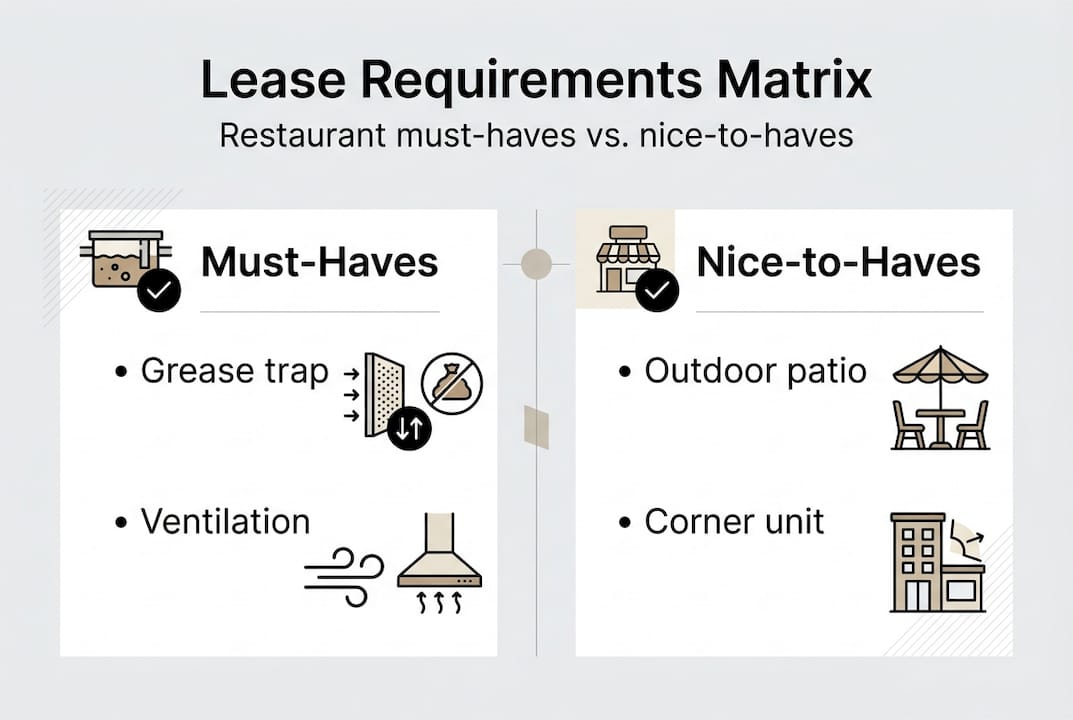
| Requirement | Must-Have | Nice-to-Have |
|---|---|---|
| Grease trap installed | Yes | , |
| Outdoor patio | No | Yes |
| Private parking lot | Depends on market | , |
| Full hood system | Yes | , |
| Corner location | No | Yes |
| 1,500+ sq ft kitchen | Yes | , |
Pro Tip: Before starting your search, complete a restaurant site evaluation checklist to turn your requirements into a structured scoring tool. It makes side-by-side comparisons far easier.
Also revisit your buy vs. lease decision at this stage. Some operators assume leasing is always the right path, but the answer depends on your capital position and long-term plans.
Research and compare ideal locations
Once your requirements are locked in, you can start building a short-list of viable locations. This is where operators often move too fast, touring spaces before they understand the financial parameters they’re working within.
Start with the numbers. Total occupancy costs, rent plus NNN (triple net fees covering taxes, insurance, and maintenance), should fall between 6% and 10% of your projected gross sales. Base rent ranges from $10 to $150 per square foot annually depending on market. Buildout costs typically run $75 to $400 per square foot. Lease terms usually span 5 to 10 years. These benchmarks are your financial fence. Evaluate every space against them before you get attached.
Here’s a practical sequence for comparing locations:
- Shortlist candidates based on your requirements matrix and preliminary rent data from your restaurant real estate guide.
- Visit each space during peak business hours to observe foot traffic, parking flow, and neighboring businesses.
- Run preliminary financials for each site: estimate your sales per square foot, apply the 6-10% occupancy benchmark, and confirm the math works before going deeper.
Pro Tip: Build a simple spreadsheet with columns for each site and rows for rent per sq ft, estimated NNN, total occupancy cost, buildout estimate, lease term, and traffic notes. Plug in each location’s numbers and compare side by side without relying on memory or gut feeling.
Here’s what a basic comparison might look like:
| Factor | Space A (Downtown) | Space B (Suburban strip) |
|---|---|---|
| Base rent (per sq ft/yr) | $85 | $38 |
| Estimated NNN | $18 | $9 |
| Total occupancy cost | $103/sq ft | $47/sq ft |
| Condition | Move-in ready | Needs full buildout |
| Buildout estimate | $50,000 | $280,000 |
| Foot traffic (peak) | High | Moderate |
| Lease term offered | 5 years | 10 years |
Space A costs more per foot but less upfront. Space B demands a longer commitment and higher buildout investment. Neither is automatically better. The right answer depends on your concept’s revenue model and your appetite for risk.

Navigate negotiations: Terms, allowances, and protections
This is where deals are won or lost. Most operators go into lease negotiations focused only on rent. Experienced ones know the surrounding terms often matter just as much.
Here are the key items to negotiate on every restaurant lease:
- Rent abatement: Request 3 to 6 months of free or reduced rent during your buildout period. You’re not generating revenue yet, so you shouldn’t be paying full rent.
- Tenant improvement (TI) allowance: Landlords typically offer $20 to $80 per square foot for buildout costs. On a 2,000 sq ft space, an $40/sq ft TI allowance means $80,000 from the landlord toward construction.
- Exclusivity clause: Prevents the landlord from leasing to a direct competitor in the same building or center.
- Assignment and sublease rights: Critical if your plans change. These rights let you transfer or sublease the space without full landlord control.
- Renewal options: Lock in the right to renew at predetermined escalation rates (typically 2% to 3% annually).
- CAM caps: Limit annual increases in common area maintenance fees to 3% to 5%.
- Kick-out clause: Allows you to exit the lease early if sales fall below a defined threshold.
“Project conservative sales when calculating your rent-to-sales ratio. Exceeding 10% occupancy cost is unsustainable long-term and the leading lease-related cause of restaurant failure.”
Understand the sale vs. lease differences that affect how these terms are structured. And if you’re considering a space with an existing operator, learn how lease assignment works before assuming you can simply take it over.
Pro Tip: Always ask for a cap on annual rent and CAM increases written directly into the lease. Without it, a landlord can raise costs significantly in years four or five, eroding margins you didn’t plan for.
Due diligence and landlord priorities: What both sides must verify
Good lease terms only protect you if the underlying facts are accurate. Due diligence is the verification step that most people rush, and the one that costs them the most when skipped.
For tenants, here’s a core checklist of what to verify before signing:
- Permitted use clause: Confirm the lease explicitly allows your type of food service operation.
- Zoning and code compliance: Check with the local municipality that the space meets current health and fire codes.
- Existing licenses and permits: Ask whether any existing food service or liquor licenses are transferable.
- Utility history: Request prior year utility bills. Hidden HVAC inefficiencies or aging electrical systems can add thousands in monthly operating costs.
- Infrastructure ownership: Clarify who owns fixed improvements like hood systems and grease traps if you ever vacate.
- Operating restrictions: Look for hidden clauses around hours of operation, delivery access, or noise limitations.
For landlords, the vetting process for restaurant tenants is more demanding than most other retail categories. Require strong financials and a detailed operating history. Ask for a written business plan and proof of concept. Name yourself as an additional insured on the tenant’s liability policy. Clarify upfront what happens to fixed infrastructure if the restaurant fails, because re-tenanting a restaurant space after failure carries unique physical and financial risks.
Pro Tip: Review the hidden buildout costs that tend to surface during due diligence. If you’re evaluating a sublease, also understand the full subleasing process and how it differs from a direct lease.
What most restaurant lease guides miss (and what actually works)
Most leasing guides tell you to negotiate hard and read every clause. That’s true, but it misses the deeper point. The biggest mistakes we see aren’t about missing a clause. They’re about optimism.
Operators build their rent-to-sales calculations on best-case projections. Then reality hits: slower-than-expected ramp, a tough first winter, a new competitor two blocks away. The lease was designed for the dream, not the business. Planning for lower sales than your optimistic model isn’t pessimism. It’s the thing that keeps you in business long enough to hit those numbers eventually.
The same logic applies to TI allowances and free rent periods. A $100,000 TI allowance looks like a gift. But if it comes with a 12-year lease, 4% annual escalations, and no kick-out clause, you’ve traded flexibility for cash. Sometimes that trade makes sense. Often it doesn’t. Know what you’re giving up before you take the money.
For landlords, the temptation is to chase popular F&B concepts because they drive traffic and improve property value. That’s real. But as the challenges of leasing restaurants show, strong F&B tenants also demand significantly more vetting and maintenance than other retail uses. A well-run regional operator with three locations is often a better bet than a first-time restaurateur with a viral concept and thin financials.
“Strong F&B tenants boost traffic and property value, but they require thorough vetting due to higher failure rates and greater physical demands on the space.”
Don’t let the excitement of a busy concept substitute for digging into the operator’s actual history.
Find and lease great restaurant spaces with expert support
You now have a practical framework for finding the right space, understanding the numbers, and negotiating terms that protect you on both sides of the deal. The next step is putting it into action.
Pepperlot connects operators and landlords through a marketplace built exclusively for restaurant real estate. Whether you’re looking for a turnkey opportunity like this Las Vegas restaurant for lease or a high-visibility San Francisco restaurant space, listings include the restaurant-specific details that actually matter: hood systems, grease traps, permits, and seating. Use Pepperlot’s location intelligence tools to analyze foot traffic, competition, and demographics before you commit.
Frequently asked questions
What should restaurant occupancy cost be as a percentage of sales?
Total occupancy cost, rent plus NNN fees, should stay between 6% and 10% of gross sales. Exceeding 10% puts long-term sustainability at serious risk.
What lease terms should I ask for as a restaurant tenant?
Prioritize rent abatement during buildout, a tenant improvement allowance, renewal options, and capped increases on CAM fees. Also negotiate exclusivity and sublease rights to protect your flexibility.
How can a landlord screen prospective restaurant tenants?
Review the operator’s financials, track record, and business plan before anything else. Require proof of liability insurance with the landlord named as insured and confirm they have relevant operating experience.
What is a tenant improvement allowance?
A tenant improvement allowance is money the landlord contributes toward building out your space. It is typically negotiated as a per-square-foot dollar amount, ranging from $20 to $80 per square foot depending on the market and lease terms.
Recommended
- Step-by-step workflow for subleasing your restaurant space
- Restaurant Real Estate 101: How to Find, Lease, or Buy the Right Space for Your Concept | PepperLot Blog
- How to Buy a Restaurant: A Step-by-Step Guide for First-Time Buyers | PepperLot Blog
- Should You Buy A Restaurant Or Lease A New Space? | PepperLot Blog
- Eco-vriendelijke horeca: zo maak je jouw zaak stap voor stap duurzaam
Browse restaurant space for lease on PepperLot.
Leave a Reply