TL;DR:
- A restaurant asset sale involves transferring specific assets like equipment, goodwill, and permits, not the legal entity.
- The process includes financial review, lease and license transfer, and navigating landlord and regulatory approvals.
- Lease assignments and liquor license transfers are complex, often causing delays and requiring careful planning.
Buying or selling a restaurant feels like a real estate deal on the surface, but strip away that assumption and you’ll find a layered transaction that touches legal liability, regulatory approvals, equipment ownership, and years of built-up goodwill. Most first-time buyers assume they’re simply picking up keys and a menu. What they’re actually acquiring is a carefully negotiated bundle of assets, each with its own transfer requirements, valuation method, and timeline. Understanding how a restaurant asset sale actually works protects both sides from costly surprises and positions everyone at the table to negotiate with confidence.
Table of Contents
- What is a restaurant asset sale?
- Core steps in a restaurant asset sale
- Landlord consent and lease assignment: Non-negotiable hurdles
- Liquor license and permits: Timeline and transfer challenges
- Asset sale vs stock sale: Key differences for restaurant owners
- The hidden complexities most guides skip
- Find your opportunity or buyer on Pepperlot
- Frequently asked questions
Key Takeaways
| Point | Details |
|---|---|
| Asset sales protect buyers | A restaurant asset sale limits buyer liabilities and can provide tax advantages. |
| Landlord consent is critical | A lease transfer must get landlord approval, and new terms may be introduced. |
| Licenses take time to transfer | Liquor licenses and health permits often require regulatory reviews and have variable timelines. |
| Stock sales are rare | Few restaurant buyers take the risk of a stock sale, making asset deals the industry norm. |
| Preparation is everything | Accurate financial records, asset lists, and clear agreements reduce drama and delays at closing. |
What is a restaurant asset sale?
A restaurant asset sale is a transaction where the buyer purchases specific business assets from the seller, rather than acquiring ownership of the legal entity that owns those assets. This is a critical distinction. The seller’s corporation or LLC typically stays intact; only the agreed-upon contents of the business change hands.
In a typical restaurant deal, the assets being sold include:
- Kitchen and front-of-house equipment (ranges, refrigerators, hood systems, POS terminals, furniture)
- Inventory on hand at closing (food, beverages, supplies)
- Goodwill (the brand reputation, customer base, and operational identity)
- Leasehold improvements (build-outs that are attached to the space)
- Transferable licenses and permits (health permits, food handler certifications, and sometimes liquor licenses)
- Recipes, trade names, and proprietary systems if negotiated into the agreement
What does not transfer in an asset sale? The seller’s prior tax liabilities, unpaid vendor debts, and any pending litigation stay with the original legal entity. This is the core reason most buyers strongly prefer asset sales when buying a restaurant. You get the business without inheriting its ghosts.
From the seller’s side, a stock sale is often more attractive from a tax standpoint, because proceeds may qualify for more favorable capital gains treatment. However, as noted in asset sale vs stock sale analysis, buyers prefer asset sales for liability protection and tax benefits while sellers favor stock sales for capital gains, though stock sales are far less common in restaurants due to buyer risk aversion. In practice, the buyer’s preference almost always wins in restaurant deals.
Pro Tip: Before any negotiation begins, request a full itemized asset list from the seller. Vague descriptions like “all kitchen equipment” lead to disputes at closing. You want make, model, age, and condition for every major item.
Core steps in a restaurant asset sale
Building on what an asset sale includes, the next question is how to actually execute one without it unraveling. The process involves more moving parts than most buyers expect, and skipping even one step can delay or kill the deal.
Here is the typical sequence:
- Compile financial documentation. Sellers should prepare two to three years of profit and loss statements, tax returns, and a current equipment list. Buyers use these to validate the purchase price and secure financing.
- Conduct due diligence. Buyers review leases, vendor contracts, existing permits, and any pending violations. This is where hidden liabilities surface.
- Negotiate and draft the Asset Purchase Agreement (APA). The APA spells out exactly what is being sold, at what price, and under what terms.
- Complete IRS Form 8594 for price allocation. Both parties must agree on how the total purchase price is allocated across asset categories (equipment, goodwill, inventory, etc.), which affects each party’s tax treatment.
- Obtain landlord consent for lease assignment. Without this, the deal cannot close if the restaurant is in a leased space.
- Transfer licenses and permits. Health permits, food handler licenses, and liquor licenses each have their own regulatory process.
- Open escrow and close. Escrow handles the exchange of funds and documents, often holding contingency amounts until specific conditions are met.
According to a restaurant M&A legal guide, the key process steps include preparing two to three years of financials, negotiating the APA with IRS Form 8594 price allocation, obtaining landlord consent for lease assignment, transferring licenses, and closing with escrow for contingencies. Each of these steps intersects with the others, meaning a delay in one can push back the entire timeline.

| Step | Typical Timeline | Key Document |
|---|---|---|
| Financial prep and due diligence | 2 to 4 weeks | P&L statements, tax returns |
| APA negotiation | 2 to 6 weeks | Asset Purchase Agreement |
| Landlord consent | 2 to 8 weeks | Lease assignment application |
| License transfer | 2 to 16 weeks | Liquor license, health permit |
| Escrow and closing | 1 to 2 weeks | Escrow instructions |
Total deal timelines often land between 60 and 180 days, depending on regulatory complexity. Sellers who want a smooth selling process should begin documentation preparation months before listing. Buyers following a step-by-step restaurant buying approach will avoid the all-too-common mistake of treating deal signing as deal closing.
Pro Tip: Start the license transfer and landlord consent processes simultaneously, not sequentially. These are often the two longest steps, and running them in parallel can shave weeks off the total timeline.
Landlord consent and lease assignment: Non-negotiable hurdles
After outlining the main sale steps, it is worth zooming in on the part that stalls the most transactions: the lease. In most restaurant deals, the space itself is leased, not owned. That means the buyer needs to step into the seller’s shoes as the tenant. But that’s not automatic.
“Landlords must approve lease assignments; even stock sales may trigger change-of-control clauses requiring consent. Landlords may demand new guarantees, higher deposits, or rent adjustments.”
The landlord’s leverage in this situation is real. They are legally entitled to vet the incoming tenant just as they would a new applicant. Common demands include:
- Personal guarantees from the buyer or their principals
- Increased security deposits, sometimes one to three months of additional rent
- Rent escalations tied to the assignment approval
- Changes to permitted use clauses in the lease
- Review of the buyer’s financials and restaurant operating experience
The difference between lease assignment and sublease matters here. In a full assignment, the original tenant is released from future obligations (subject to the landlord’s agreement). In a sublease, the original tenant often remains on the hook. Most buyers want a clean assignment, but sellers may resist if the landlord requires them to remain as guarantor.
Buyers and sellers should both review the lease assignment essentials before entering negotiations with a landlord. Knowing what a landlord can and cannot require under local law makes for a much stronger conversation. Lease terms, remaining duration, and any personal guarantee provisions all affect how motivated a landlord will be to cooperate quickly.
If the landlord denies the assignment entirely, the deal generally falls apart unless the buyer can negotiate directly for a new lease. That scenario resets the timeline and sometimes the economics of the transaction.
Liquor license and permits: Timeline and transfer challenges
Having addressed the lease, we turn to the other major variable: liquor licenses and operating permits. For restaurants with a full liquor license, the transfer process is often the longest single step in the entire asset sale.
Liquor license approvals typically require 30 to 120 days of separate regulatory review, and in some jurisdictions they cannot be pledged as loan collateral or transferred at all under certain conditions. This creates a real operational problem: the seller wants to stop running the business, but the buyer cannot legally serve alcohol until the license clears.
Common workarounds include:
- Interim management agreements: The seller continues to operate the restaurant on paper while the buyer manages day-to-day operations under contract, pending license approval.
- Escrow holds: A portion of the purchase price is held in escrow until the liquor license successfully transfers.
- Separate closings: The asset sale closes first for all non-liquor assets, and the liquor license transfer completes in a secondary closing.
Not all permits transfer automatically either. Health department permits, certificate of occupancy, food handler certifications, and fire suppression system inspections may all need to be reapplied for under the buyer’s name. Buyers interested in properties with transferable permits already in place can save significant time and money.
| License or permit | Typical transfer time | Transferable? |
|---|---|---|
| Liquor license | 30 to 120 days | Often yes, with approval |
| Health permit | 1 to 4 weeks | Often no, must reapply |
| Food handler certifications | 1 to 2 weeks | No, individual-based |
| Fire and hood inspection | 1 to 3 weeks | Inspection required |
| Certificate of occupancy | 2 to 6 weeks | Depends on jurisdiction |
Asset sale vs stock sale: Key differences for restaurant owners
To bring everything into focus, we break down the practical difference between an asset sale and a stock sale in a restaurant context.
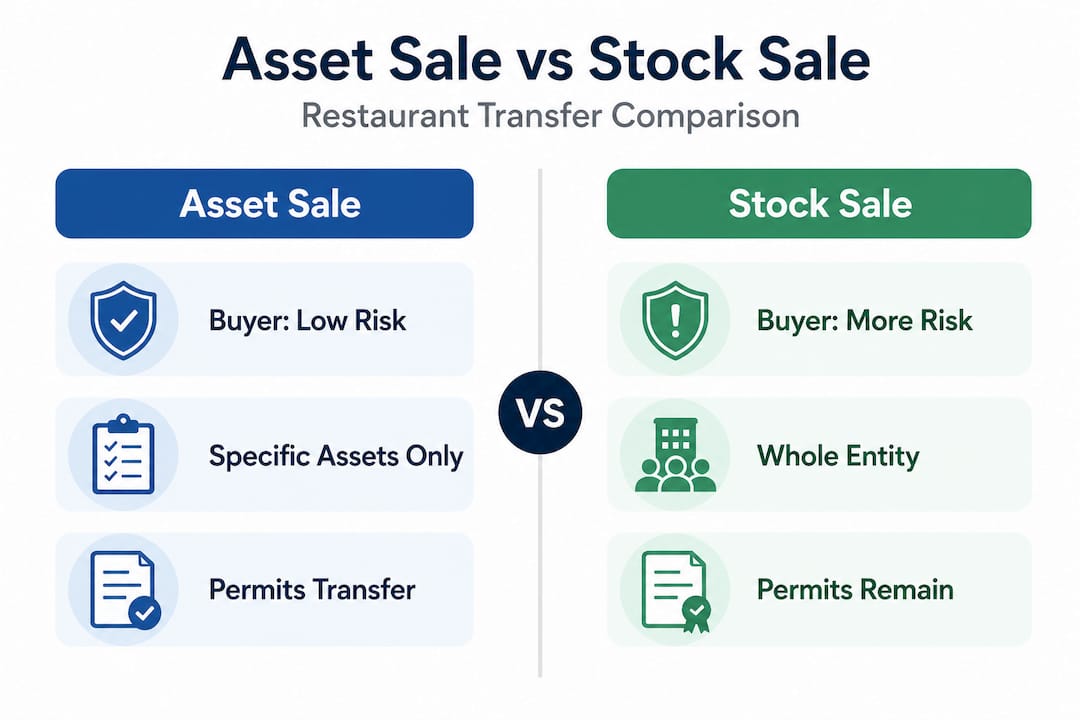
In a stock sale, the buyer purchases ownership shares of the entity that owns the restaurant. The legal entity remains unchanged. Every contract, debt, permit, and liability stays exactly where it is, attached to that entity. The buyer steps into the seller’s position as shareholder.
In an asset sale, the buyer purchases only the agreed-upon assets. The seller’s legal entity stays in place. The buyer may form a new entity to receive the assets, starting relatively clean.
Here is how the two structures compare:
| Factor | Asset sale | Stock sale |
|---|---|---|
| Liability exposure for buyer | Low: only current assets acquired | High: all legacy liabilities transfer |
| Tax benefit for buyer | Higher: stepped-up asset basis | Lower: no step-up |
| Tax impact for seller | Typically higher ordinary tax rates | Often more favorable capital gains |
| Simplicity of transfer | More complex, per-asset approvals | Simpler entity transfer |
| Preferred by | Buyers | Sellers |
As confirmed by asset vs stock sale analysis, this dynamic plays out consistently: buyers favor asset sales for liability protection and tax benefits, while sellers would prefer stock sales but rarely get them in restaurant transactions. The result is that the overwhelming majority of independent restaurant sales are structured as asset deals.
For buyers exploring restaurant acquisition methods, understanding this distinction is not optional knowledge. It shapes every negotiation, from purchase price to indemnification clauses in the APA.
The hidden complexities most guides skip
Every checklist about restaurant asset sales hits the basics: get your financials together, hire a lawyer, negotiate the price. That’s fine as far as it goes. But the real friction in these deals comes from what isn’t on the standard checklist.
Consider transition timing. Sellers often focus purely on closing date. Buyers focus on opening day. Those two events are not the same thing, and the gap between them is where deals quietly fall apart. Equipment that was described as “operational” fails its first inspection under the buyer’s watch. The seller’s key chef refuses to stay on through a transition period. A new lease guarantee demand from the landlord surfaces three weeks before closing, and no one budgeted for the additional deposit.
Then there are unrecorded liabilities. A seller’s vendor on a handshake agreement for weekly produce delivery may not appear anywhere in the APA. A health violation under appeal may not show up in a basic permit search. Buyers who rely on verbal assurances during due diligence rather than documented representations and warranties in the APA carry the risk themselves.
Regulatory delays are another reality that many guides romanticize. A 90-day liquor license transfer sounds like a long wait. When it becomes 130 days because of a backlog at the state licensing board, the interim management agreement needs to stay active longer, and both parties are stuck in an uncomfortable limbo. Experienced buyers bake extra time and carrying costs into their financial models before they make an offer.
The most effective way to de-risk a restaurant asset sale is to treat the process like a construction project, not a closing dinner. Every dependency needs to be mapped, every approval tracked on a timeline, and every contingency funded before it becomes an emergency. Sellers who want to prepare properly should study the real-world sale guide before even listing the business.
One final truth: price is rarely what kills a deal. Process failures, missed deadlines, and undisclosed issues are far more common culprits. Getting both parties aligned on the transition timeline, inspection outcomes, and regulatory milestones early makes the difference between a deal that closes and one that falls apart at the finish line.
Find your opportunity or buyer on Pepperlot
Now that you understand exactly what a restaurant asset sale involves, the logical next step is finding the right opportunity or the right buyer. That search matters just as much as the process itself.
Pepperlot is the only marketplace built specifically for restaurant and food and beverage real estate. Every listing includes the operational details that actually matter in an asset sale: equipment inventories, permit status, seating capacity, hood systems, and lease terms. Whether you’re searching for a full restaurant for sale or exploring restaurant lease listings to take over an existing operation, Pepperlot surfaces qualified, curated opportunities without the noise of generic commercial platforms. List your space, connect with active buyers and tenants, and move your transaction forward with a network of over 500 serious operators, landlords, and brokers.
Frequently asked questions
What assets are included in a restaurant asset sale?
A restaurant asset sale generally covers equipment, inventory, licenses, goodwill, and leasehold interests, but never the seller’s company stock or its attached liabilities. The exact scope is defined in the Asset Purchase Agreement and must be itemized clearly.
Do asset sales transfer restaurant leases automatically?
No. Restaurant leases require explicit landlord approval for assignment, and landlords can request new guarantees, higher deposits, or rent changes as conditions of that consent. Consent is never automatic.
How long does it take to transfer a liquor license in a restaurant asset sale?
Liquor license transfers typically take 30 to 120 days, depending on the jurisdiction and state licensing board backlog. Interim management agreements are commonly used to bridge the operational gap during approval.
Why do buyers prefer asset sales over stock sales for restaurants?
Buyers favor asset sales because they avoid inheriting the seller’s prior tax debts, pending lawsuits, and unpaid liabilities. As shown in asset sale vs stock sale research, buyers also benefit from a stepped-up asset basis, which provides better tax treatment on depreciation going forward.
Leave a Reply