TL;DR:
- Zoning verification is the critical first step before lease signing to ensure legal food service use.
- Permits for building, health, and fire safety can take 4 to 6 months, costing $3,000 to $15,000 overall.
- The Certificate of Occupancy finalizes approval, requiring inspections and potentially new applications after layout changes.
Most restaurant deals don’t fall apart over rent. They collapse because an operator signed a lease on a space that couldn’t legally serve food, or because nobody budgeted for the six months of permitting that followed. The permit process is the real gatekeeper between your concept and your opening day, and it’s far more complex than most brokers let on. This guide walks you through every major permit category, realistic cost ranges, honest timelines, and the mistakes that cost operators thousands before they serve a single guest.
Table of Contents
- Why zoning verification is the first critical step
- Building, health, and fire permits: What you need
- Certificate of occupancy: Your final approval
- Permit costs, timelines, and edge cases
- Expert lessons: How permit pitfalls derail restaurant deals
- Find your compliant restaurant space with Pepperlot
- Frequently asked questions
Key Takeaways
| Point | Details |
|---|---|
| Zoning comes first | Always verify zoning and use a contingency clause before committing to any restaurant lease. |
| Multiple permits needed | Restaurants require building, health, fire, and occupancy permits with parallel applications and inspections. |
| Timing and costs | Permit timelines average 4-6 months and costs run from $3,000 to $15,000 or more depending on location. |
| Special permit challenges | Liquor, outdoor dining, and entertainment permits need public hearings and can face neighbor opposition. |
| Finish with CoO | Final approval requires a Certificate of Occupancy after all inspections and permit steps are completed. |
Why zoning verification is the first critical step
Before you fall in love with a space, you need to know whether the city will let you cook in it. Zoning is the legal framework that determines what type of business can operate at a specific address, and it must be your very first check. Not the second. Not after you’ve negotiated rent.
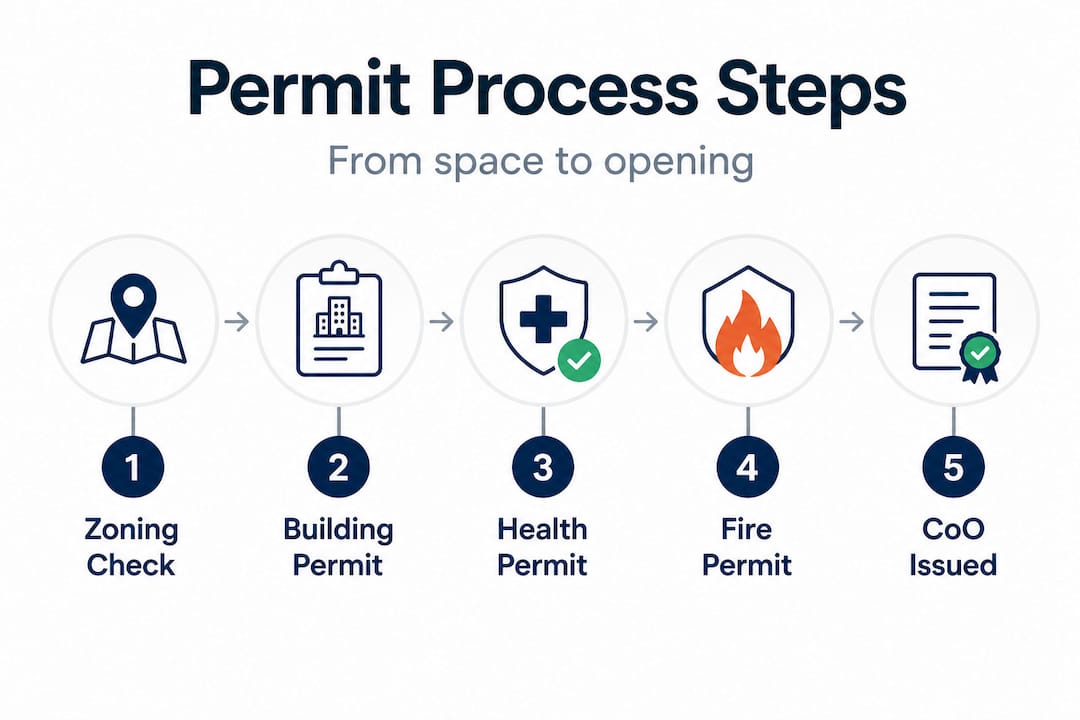
Zoning verification is the first critical step for restaurant property permits. It determines whether the location legally allows food service operations. Critically, properties zoned for general retail may still exclude restaurants that require exhaust systems or high occupancy loads. That distinction catches a surprising number of operators off guard.
Here’s where people go wrong:
- Trusting the broker’s word. Brokers want to close deals. They may genuinely believe a space is restaurant-ready, but “I think it’s zoned for food service” is not legal confirmation.
- Assuming prior use means current permission. Just because a restaurant operated there five years ago doesn’t mean the current zoning still allows it, especially if the area was rezoned.
- Skipping the contingency clause. Always include a zoning contingency in your letter of intent and lease, giving yourself 30 to 60 days to verify official zoning status before you’re legally bound.
- Missing exclusions in the zoning code. Some commercial zones permit restaurants in theory but exclude operations that require commercial exhaust hoods, high-volume grease traps, or occupancy counts above a certain threshold.
Understanding zoning requirements for leases is especially important in states like California, where local zoning codes layer on top of state regulations, creating multiple approval hurdles. And restaurant property zoning carries nuances that apply nationally, not just in high-regulation markets.
“The city’s planning or zoning department is the only authoritative source. Pull the zoning certificate yourself, or hire someone to do it. Broker optimism is not a legal defense.”
Pro Tip: When you call the zoning office, ask specifically whether the intended use (full-service restaurant, quick service, food hall, etc.) is permitted outright, or whether it requires a conditional use permit. That single question can save you weeks of wasted time.
Building, health, and fire permits: What you need
Once you’ve confirmed zoning, the next layer is construction and safety permitting. This is where timelines balloon and costs surprise operators who didn’t plan early enough.

Building permits are required for any construction or renovation, covering structural integrity, electrical systems for cooking equipment, plumbing with grease interceptors, mechanical systems for hoods and HVAC, and fire suppression systems specific to commercial kitchens. Each of those categories may require its own sub-permit, its own inspection, and its own queue.
Here’s a practical breakdown of the major permit categories you’ll likely need:
| Permit type | What it covers | Typical cost range |
|---|---|---|
| Building permit | Structural work, walls, floors | $500 to $5,000+ |
| Electrical permit | Wiring, panel upgrades, equipment | $300 to $2,000 |
| Plumbing permit | Grease traps, sinks, drainage | $300 to $1,500 |
| Mechanical permit | Hoods, HVAC, ventilation | $200 to $1,000 |
| Fire suppression permit | Kitchen fire systems, sprinklers | $500 to $3,000 |
| Health department permit | Food handling, inspection approval | $100 to $1,000 |
The permit process varies by jurisdiction: at the federal level, you need an EIN; at the state level, a business license and food service license; at the local level, health, fire, building, and zoning all have separate processes. The SBA recommends starting the permit process 6 to 12 months before your target opening, particularly if your concept includes a liquor license.
Here’s the sequence that works best for most operators:
- Confirm zoning and secure your contingency period in writing.
- Hire an architect experienced in restaurant tenant improvements. Their drawings must meet code before permits are approved.
- Submit building, electrical, plumbing, and mechanical permits simultaneously where the jurisdiction allows. Parallel processing saves weeks.
- Apply for your health department permit and schedule a pre-inspection meeting early. Health departments often have their own set of kitchen layout requirements that can conflict with architectural plans.
- Submit fire suppression and alarm permits after the mechanical plans are finalized.
- Follow up actively. Most permit offices work on a queue basis. Proactive follow-up, or hiring a permit expeditor, can shave weeks off approval timelines.
This restaurant permit checklist outlines many of these steps with state-specific details, and if you’re taking over an existing space, health permits takeover advice is essential reading before you assume prior approvals carry over.
Pro Tip: In complex jurisdictions like San Francisco, Chicago, or New York City, hiring a permit expeditor is not optional, it’s a survival strategy. Expeditors know which reviewers handle which permit types, how to flag stalled applications, and how to navigate city-specific quirks that aren’t documented anywhere publicly. Their fees, typically $2,000 to $8,000, almost always pay for themselves in saved time.
Certificate of occupancy: Your final approval
You’ve passed your building inspection. Your kitchen passed the health department walk-through. Your fire suppression system has been tested and signed off. Now comes the document that actually lets you open your doors: the Certificate of Occupancy, commonly called a CoO.
A CoO is final approval confirming the building complies with all applicable codes, is properly zoned for restaurant use, and meets safety standards. It’s issued only after passing building, fire, and health inspections. Without it, you cannot legally open to the public, no matter how beautiful your dining room looks.
| CoO detail | What to know |
|---|---|
| Typical cost | $100 to $400 |
| Timeline after final inspection | 4 to 8 weeks |
| Required inspections | Building, fire, health |
| Triggers for a new CoO | Layout changes, ownership transfer, use change |
Common mistakes that derail operators at this final stage:
- Assuming the old CoO transfers automatically. It doesn’t. If you’re taking over an existing restaurant, any change to the layout, capacity, or kitchen configuration requires a new CoO application.
- Prior owner provisos. Some CoOs contain conditions tied specifically to the prior owner’s operating license. When ownership changes, those provisos may need to be renegotiated or reapproved.
- Skipping the pre-inspection walkthrough. Many jurisdictions allow an informal pre-inspection before the official CoO inspection. Use it. Discovering code violations during the formal inspection resets your timeline.
- Underestimating the 4 to 8 week wait. That timeline begins after your final inspection passes. If you schedule your inspection too close to your target opening, any minor deficiency pushes your opening by weeks.
“Think of the CoO as the finish line, but don’t sprint to it. Walk carefully, because stumbling at the end costs just as much time as stumbling at the beginning.”
Understanding the hidden buildout costs that accumulate during the CoO phase, including re-inspection fees, contractor callbacks, and code upgrade requirements, helps you budget more accurately from the start.
Permit costs, timelines, and edge cases
Now that you understand each permit category, let’s talk real numbers and realistic timelines because the industry data on both might surprise you.
Total permit and license costs for opening a restaurant range from $3,000 to $15,000, excluding liquor. Building permits alone run $500 to $5,000 or more. A food service permit adds $100 to $1,000. Liquor license fees range from $300 to $14,000 in standard markets, but in quota states like Florida or Massachusetts, market-rate liquor licenses can cost $50,000 to $400,000 because the number of licenses is legally capped.
Permitting timelines average 4 to 6 months nationally. In major cities, expect the higher end of that range or beyond. In New York City, the full permitting and buildout process frequently takes 4 to 7 months just for permits, with total buildout running 9 to 18 months. Austin, a market that has seen explosive restaurant growth, often runs 9 to 18 months for total buildout because of city review backlogs.
Beyond standard permits, here are edge cases that catch operators completely off guard:
- Special-use permits and conditional use permits. If your concept involves alcohol service, outdoor dining, or live entertainment, you likely need a special-use or conditional use permit. These require public hearings and neighbor input, meaning community opposition can delay or deny your approval entirely.
- Variances. If your site doesn’t meet standard requirements for parking ratios, setbacks, or signage, you’ll need a variance. Variances cost $10,000 to $55,000 and take 3 to 6 months to process, including the public hearing cycle.
- Provisos that don’t transfer. Some permits or approvals are tied to the specific owner or operating entity, not the property itself. If you’re buying or subleasing from another operator, always confirm which approvals transfer and which you’ll need to reapply for. This is a critical piece of due diligence that many buyers skip.
- Entertainment permits. Even a small stage or a DJ requires an entertainment license in many jurisdictions. These often involve noise ordinances, fire egress reviews, and neighbor notifications.
Pro Tip: Budget permitting and buildout costs with a 20% contingency above your initial estimate. Permit fees change, re-inspection costs add up, and surprises in the walls of older restaurant spaces are nearly universal.
Expert lessons: How permit pitfalls derail restaurant deals
Here’s the uncomfortable reality we’ve seen play out across dozens of restaurant transactions: most permit delays are entirely avoidable. They happen because operators trust the wrong sources at the wrong time, or because they try to compress a sequential process into an impossible timeline.
Zoning must be verified officially, with a contingency clause protecting your lease, before you commit any serious resources to a location. We’ve seen operators spend $50,000 on architect fees and interior design mood boards before discovering the property couldn’t accommodate a commercial hood. That’s not bad luck, it’s a process failure.
The second lesson is about parallel processing. Most permit applications are submitted sequentially because that’s how contractors work, one thing at a time. But many jurisdictions allow simultaneous submission of building, mechanical, plumbing, and electrical permits. An experienced restaurant contractor or permit expeditor knows this and uses it to compress timelines by four to eight weeks.
The third lesson is one that brokers rarely mention: community relations. Neighbor opposition during public hearings can deny special-use permits outright, or saddle your approval with restrictions that make your concept unworkable, limits on hours, outdoor seating bans, or noise curfews. If your concept requires a special-use permit, engage the surrounding community before you file. A single neighborhood meeting, conducted genuinely and transparently, dramatically reduces the risk of organized opposition.
Finally, never assume a “turnkey” restaurant space means a paperless opening. Even a fully equipped, previously operating restaurant space may require a new CoO if you change the layout, a new health permit in your entity’s name, and fresh fire inspections if equipment has been modified. The permits are tied to the operation and the configuration, not just the address. Do your due diligence before the lease is signed, not after.
Find your compliant restaurant space with Pepperlot
Permit clarity starts with the right property, and that means knowing what you’re walking into before you negotiate a single dollar of rent.
Pepperlot’s full restaurant listings include the critical infrastructure details that generic commercial real estate platforms omit: existing grease traps, current permits, seating capacity, hood systems, and outdoor patio configurations. These details directly affect your permitting timeline and your buildout budget. Pepperlot’s location intelligence tools also help you analyze zoning suitability, local competition, and market demand before you commit to a space, so you can enter the permit process with your eyes open and your timeline protected.
Frequently asked questions
How long does it typically take to secure all permits for a restaurant?
Restaurant permitting averages 4 to 6 months nationally, with longer timelines in major cities and for buildouts that include liquor licenses or special-use approvals.
Can I rely on broker advice for zoning confirmation?
Always seek official zoning confirmation from the city’s planning department before signing a lease; broker advice may miss legal restrictions or outdated zoning classifications.
What is a Certificate of Occupancy, and do I need a new one if I buy an existing restaurant?
You likely need a new CoO if the property layout changes or if existing approvals were tied to the prior owner; always verify with local authorities before assuming approvals transfer.
What are common permit costs for opening a restaurant?
Permit and license fees range from $3,000 to $15,000 excluding liquor; liquor licenses can cost significantly more depending on state quota rules and local market conditions.
How can community opposition affect permit approval?
Neighbors can object and even block special-use permits for alcohol service, entertainment, or outdoor seating during public hearings, making early community engagement a critical strategy for operators.
Leave a Reply