
TL;DR:
- Many restaurant operators are misled by the term “fully equipped,” which often lacks a clear industry standard and may not enable immediate operation. Verifying essential systems, equipment condition, and code compliance is crucial before signing a lease, as hidden costs and infrastructure issues frequently cause delays and overruns. Approaching “fully equipped” as a checklist rather than a promise ensures proper assessment and reduces the risk of costly surprises during opening.
Many restaurant operators sign a lease on a “fully equipped” space expecting to unlock the doors and start cooking, only to discover weeks later that thousands of dollars of additional work stand between them and opening day. The phrase gets used liberally in listings, broker conversations, and landlord pitch decks, but it carries no standardized definition in the industry. This guide breaks down exactly what the term covers, how to verify every claim, and what due diligence steps protect your budget and your timeline before you commit to any space.
Table of Contents
- Defining a fully equipped restaurant space: More than marketing language
- Comparing first-generation, second-generation, and turnkey spaces
- What to verify: Your due diligence checklist for ‘fully equipped’ spaces
- The pitfalls and hidden costs operators miss most
- The truth most experts won’t tell you about ‘fully equipped’ spaces
- Explore your next move with expert-vetted restaurant spaces
- Frequently asked questions
Key Takeaways
| Point | Details |
|---|---|
| No universal definition | Each ‘fully equipped’ restaurant space includes different features, so always verify specifics. |
| Second-gen spaces save time | Leveraging existing infrastructure often speeds your opening but still requires close inspection for fit. |
| Diligence prevents surprises | A thorough walkthrough and checklist can help you avoid costly code or equipment issues. |
| Not all inclusions are equal | Older systems may need upgrades even if they’re present, especially for your unique concept. |
| Checklist beats assumption | Treat every ‘fully equipped’ listing as a starting point for careful evaluation, not a guarantee. |
Defining a fully equipped restaurant space: More than marketing language
When a listing says “fully equipped,” the words mean something different depending on who wrote them. A landlord might consider the space equipped because it has a working exhaust hood and grease trap. A broker might use it because there’s a six-burner range sitting in the kitchen. Neither definition guarantees that you can run service on day one.
The restaurant kitchen equipment categories that actually define readiness are: cooking line, refrigeration, prep stations, dishwashing, dry storage, ventilation, fire suppression, and smallwares. A space that checks every one of those boxes is rare. Most listings that carry the “fully equipped” label satisfy two or three categories and expect you to fill in the rest.
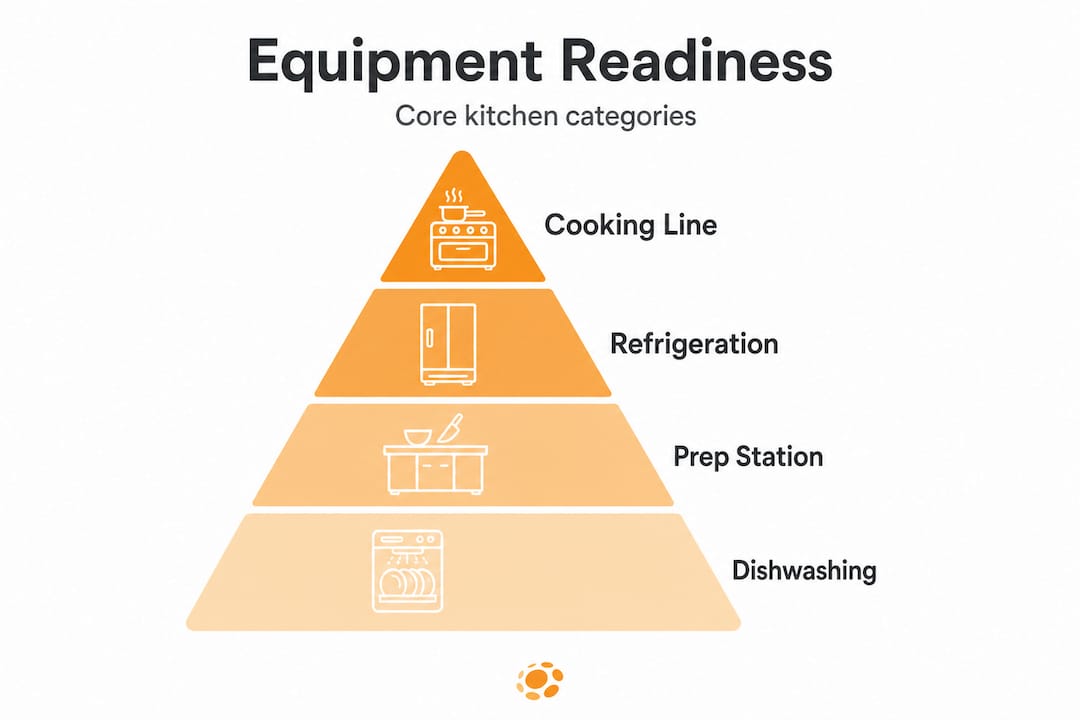
There’s also the critical distinction between what the landlord delivers and what you’re expected to build. Build-out provisions in restaurant leasing draw a clear line: the landlord’s scope covers delivering the space in “shell” or “vanilla box” condition, which means basic infrastructure, while everything that makes it a functional restaurant falls to the tenant. That division isn’t always spelled out in plain language in a listing, which is why operators get caught off-guard.
Here’s what a truly complete “fully equipped” space should include across the main categories:
- Cooking line: Range, griddle, fryer, broiler, or oven depending on concept
- Refrigeration: Walk-in cooler, walk-in freezer, reach-in units, and prep table refrigeration
- Prep area: Work tables, sinks, slicers, mixers, and cutting equipment
- Dishwashing: Commercial dishwasher with the right water temperature output for code compliance
- Storage: Dry storage shelving, under-counter storage, and lockable areas for supplies
- Ventilation: Type 1 or Type 2 hood with makeup air system, sized for the cooking equipment
- Fire suppression: Ansul or equivalent system tied to the hood, inspected and tagged
- Smallwares: Pots, pans, utensils, cutting boards, sheet pans, hotel pans
“Fully equipped” as a label is a marketing decision, not a technical standard. Your job as the operator is to convert that label into a verified inventory before you sign anything.
To understand your full obligations before signing, it helps to learn how to lease a restaurant space step by step, especially around the sections that define landlord versus tenant responsibilities in the build-out process.
Comparing first-generation, second-generation, and turnkey spaces
Not all restaurant spaces are born equal, and the generation category tells you a lot about what to expect before you ever walk through the door. These three types show up constantly in listings, and the differences between them are financially significant.
First-generation spaces (also called “first-gen” or “grey shell” spaces) are delivered raw. You get four walls, a concrete floor, basic utilities stubbed in, and not much else. If a listing describes a first-gen space as “fully equipped,” that’s almost certainly a misuse of the term. Budget accordingly, because a full restaurant build-out in a first-gen space can run anywhere from $150 to $450 per square foot depending on your market and concept complexity.

Second-generation spaces retain infrastructure from a previous restaurant tenant. According to second-generation restaurant space research, these spaces commonly include existing hood and ventilation systems, grease traps, gas and electric service sized for commercial use, and commercial-grade plumbing. That retained infrastructure can reduce your build-out cost and timeline meaningfully. But “commonly includes” is not the same as “definitely includes and works correctly.”
Turnkey spaces are supposed to be the closest thing to move-in ready. The promise is that everything is installed, operational, and ready for your concept. In practice, turnkey is another label that needs to be verified, not trusted. Equipment may be dated, improperly maintained, or mismatched for your menu.
| Space type | What’s typically included | Build-out cost | Risk level |
|---|---|---|---|
| First-generation | Utilities stubbed, bare walls | Highest | Predictable but expensive |
| Second-generation | Hood, grease trap, plumbing, electrical | Moderate | Medium, depends on condition |
| Turnkey | Full equipment, systems, sometimes FF&E | Lowest | Varies widely by verification |
Pro Tip: When evaluating a second-gen or turnkey space, bring your chef or kitchen designer on the first walkthrough. They’ll spot equipment sizing mismatches and layout problems that you might miss, and their input can become a negotiating point when discussing lease terms or purchase price.
For a deeper breakdown of the advantages and trade-offs, the second-gen restaurant spaces overview covers the most important cost and timing factors. You can also explore the full second-generation restaurant spaces guide for a more detailed analysis of what to look for.
What to verify: Your due diligence checklist for ‘fully equipped’ spaces
Due diligence on a restaurant space goes far beyond confirming that a stove is present. You need to verify existence, condition, code compliance, and capacity for every major system. Skipping even one category can result in a health inspection failure, a fire marshal hold, or an insurance denial that delays your opening by weeks or months.
Here’s a practical sequence for your verification process:
- Exhaust hood and ventilation: Confirm the hood type (Type 1 for grease-producing equipment, Type 2 for heat only), check the inspection tag date, and verify makeup air is functional. Hoods that haven’t been cleaned or inspected in over a year are a code red.
- Grease trap: Confirm size, location, and last pump-out date. An undersized or neglected grease trap triggers municipal violations fast.
- Plumbing: Check for three-compartment sink, handwashing sink placement per code, mop sink, and sufficient hot water capacity for dishwashing and sanitation.
- HVAC: Verify both kitchen and dining room systems. Kitchen HVAC must account for the heat load from cooking equipment.
- Gas service: Check the BTU capacity at the meter and confirm it matches the combined load of all cooking equipment.
- Electrical panel: Look at amperage, the number of circuits, and whether the panel has available capacity for your equipment list.
- Fire suppression system: Must be tagged, inspected within the last six months, and tied to the correct cooking equipment positions.
- Equipment condition: For every piece of equipment, ask for the age, last service date, and any repair history. Test everything that can be turned on.
- Code compliance history: Request the most recent health inspection report and any outstanding violations or permits.
- Ownership and warranty: Clarify whether equipment transfers with the space and whether any warranties remain active.
A space that fails code readiness checks because systems are undersized or non-compliant for a new concept can cost more to correct than building from scratch. Never assume “fully equipped” means “code-ready.”
A thorough restaurant expansion checklist can help you stay organized across multiple sites when you’re comparing options and running parallel due diligence processes.
Pro Tip: Ask the landlord or seller for written documentation on every major system: the last hood cleaning certificate, the grease trap pump-out receipt, and the fire suppression inspection tag. If they can’t produce those documents, that’s your signal to price the cost of bringing each system current into your offer or walk away.
The pitfalls and hidden costs operators miss most
Even experienced operators get surprised. The “fully equipped” label creates a psychological shortcut that can lower your guard at exactly the moment you need to stay sharp.
Here are the hidden costs that show up most often after a deal closes:
- Hood and fire system upgrades: The hood might exist, but if it was designed for a lighter menu and you’re running a high-volume fry operation, you’ll need a larger system. Fire suppression must be reconfigured every time equipment positions change.
- Equipment repairs with no warranty coverage: Commercial kitchen equipment transferred in a lease or sale rarely comes with active warranties. A walk-in compressor failure or a commercial dishwasher breakdown in your first month means paying out of pocket.
- Grease trap undersizing: A trap sized for a coffee shop cannot handle the volume of a full-service kitchen. Pumping frequency goes up, violations accumulate, and in some cities you’re required to install a larger trap before you can open.
- Electrical capacity gaps: You add a high-BTU salamander, a blast chiller, and a commercial espresso machine, and suddenly you’re tripping breakers. Panel upgrades are expensive and require permits that extend your timeline.
- HVAC mismatch: Dining room air conditioning that was sufficient for a lighter-volume concept becomes inadequate when you’re running a packed house with a full cooking line operating at capacity.
- Code violations from a prior tenant: Inherited infrastructure can include violations the previous operator ignored or was grandfathered through. You won’t get that same pass when the inspector visits for your new permit.
- Concept mismatch: A kitchen designed for a pizza operation has different layout logic, equipment positioning, and ventilation needs than a ramen concept. Reconfiguring for your menu can erase the cost savings you anticipated from taking a second-gen space.
These aren’t edge cases. They’re common enough that subleasing a restaurant space from an operator who’s already solved these problems can sometimes be a smarter short-term strategy than taking over a “fully equipped” space with unknown infrastructure.
The honest reality is that the average restaurant build-out budget overruns by 20 to 30 percent, and a significant portion of those overruns trace directly back to infrastructure surprises in spaces that were marketed as ready to operate.
The truth most experts won’t tell you about ‘fully equipped’ spaces
Here’s the perspective that rarely makes it into the listing descriptions or the broker pitch: “fully equipped” is not a promise. It’s a prompt. The moment you read those words in a listing, your next move should be to open a checklist, not start planning your opening menu.
The operators who consistently open on time and on budget treat every infrastructure claim as a starting point for investigation. They don’t argue with the label. They simply verify it. That mindset shift saves more money than any single negotiating tactic.
There’s also a concept-fit dimension that almost nobody discusses until it’s too late. A space can be genuinely and completely equipped for a previous restaurant concept and be functionally wrong for yours. A full-service steakhouse kitchen and a counter-service taco concept require different equipment, different hood sizing, different plumbing configurations. The infrastructure being present doesn’t mean it’s useful for what you’re trying to build.
The smartest move we see operators make consistently is this: they define their own equipment list first, based on their menu and projected volume, and then they measure every “fully equipped” space against that list. Not against a generic definition of what “equipped” should mean. Against their specific operational requirements.
Launching in a second-gen restaurant space can absolutely be the fastest and most cost-effective path to opening, but only when you’ve done the work to confirm the infrastructure aligns with what you’re building. The due diligence investment, whether that’s hiring an equipment inspector, bringing in a kitchen designer, or spending an afternoon pulling permits, pays for itself many times over before your first service.
Explore your next move with expert-vetted restaurant spaces
You now have the framework to evaluate any “fully equipped” claim with precision, protecting your budget and your opening timeline from the most common and costly surprises in restaurant real estate.
Pepperlot is built specifically for operators who want clarity before they commit. Every listing on the platform includes restaurant-specific details like grease trap status, hood type, seating capacity, and permit history, so you’re not piecing together critical information from vague descriptions. Whether you’re looking for fully equipped restaurants for lease or exploring restaurant spaces for sale, Pepperlot connects you with vetted listings and expert support at every stage of the process. Start your search with the specificity your concept deserves.
Frequently asked questions
Does a fully equipped restaurant space always include smallwares and furniture?
Not always. Most spaces that claim to be fully equipped cover major infrastructure like cooking equipment and refrigeration, but smallwares such as utensils, pots, and pans, as well as dining room furniture, are often excluded and must be sourced separately.
How do I confirm if systems are code-compliant for my restaurant concept?
Hire a licensed inspector with commercial kitchen experience to assess each system’s size, condition, and compliance status, and check with your local health and fire authorities before signing. A space marketed as equipped may still fail inspection if systems aren’t sized correctly for your concept.
What are the main risks of second-generation restaurant spaces?
The main risks are worn or outdated equipment, infrastructure that doesn’t match your menu concept, and surprise code upgrade requirements. Second-generation spaces can range from truly valuable inherited assets to another operator’s expensive unresolved problems.
What does ‘shell’ condition actually provide if not a full kitchen?
Shell condition delivers basic HVAC, plumbing stubs at connection points, an electrical panel, and fire suppression systems brought to code. According to build-out provisions in restaurant leasing, the full kitchen build-out, including all cooking equipment, ventilation finish, and smallwares, is the tenant’s responsibility.
Why should I treat ‘fully equipped’ as a checklist, not a guarantee?
Because inclusions, working condition, and code compliance vary dramatically from one listing to the next with no universal standard. Treating the claim as a verification prompt rather than a guarantee is the single most effective habit for protecting your opening budget.
Recommended
- Full Restaurant for Lease | PepperLot
- Full Restaurant for Lease | PepperLot
- Full Restaurant for Lease | PepperLot
- Expert Restaurant Real Estate Tips: Secure the Ideal Space – Pepperlot Blog
Browse restaurant space for lease and restaurants for sale on PepperLot.
Leave a Reply