Tag: leasing

  • Leasing vs Buying a Restaurant Building: How to Run the Numbers

    Leasing vs Buying a Restaurant Building: How to Run the Numbers

    Most advice on this question is written for businesses in general. Restaurants are not businesses in general. A law office can move into 2,000 square feet of empty shell space and be open in a month. A restaurant in that same shell needs gas service, a Type I hood, make up air, a grease interceptor, floor drains, a three compartment sink, a mop sink, and a health department sign off. That gap is the whole decision.

    So the useful question is not whether to lease or buy. It is who pays for the build out, and who keeps the value of it when you are done.

    The number that decides it: occupancy cost

    Before anything else, work out what you can afford. In restaurants, occupancy cost is measured as a percentage of gross sales. It includes base rent, common area maintenance, property taxes, and insurance. The general working range is 6 to 10 percent of gross sales. Quick service can sometimes carry a little more because of higher sales per square foot. Full service with a large dining room usually needs to sit lower.

    If you project 1.2 million dollars in annual sales and you hold occupancy at 8 percent, your total annual occupancy budget is 96,000 dollars, or 8,000 dollars a month. That is your ceiling. Every lease you look at and every mortgage you model has to fit under it. Run this before you tour a single space. It eliminates most of the market in a few minutes and stops you falling for a room you cannot afford to operate in.

    What leasing actually costs

    The headline rent is not the cost. Four other things move the number.

    The build out. A restaurant built from a cold dark shell commonly runs 250 to 500 dollars per square foot and can go higher in dense urban markets with expensive permitting. Second generation restaurant space, meaning a location that already operated as a restaurant, commonly runs 50 to 150 dollars per square foot because the hood, gas, grease interceptor, and drains are already in place. On a 3,000 square foot space, that difference is often 500,000 dollars or more. For a fuller picture of the total number, see our guide to how much it costs to open a restaurant.

    The tenant improvement allowance. Landlords will contribute toward build out, usually quoted as dollars per square foot. A meaningful allowance is real money, but understand what you are trading for it. Allowances get repaid through higher base rent over the term. You are borrowing from your landlord at a rate you should calculate rather than accept.

    The personal guarantee. Almost every restaurant lease asks for one, and this is the item that follows you home. Negotiate for a limited guarantee, a burn off after a set number of on time payments, or a good guy clause that caps your exposure if you surrender the space cleanly. Landlords say no less often than tenants expect, because a landlord would rather have a clean handover than a fight.

    Free rent. Ask for construction period rent abatement covering the months you are building and not selling. Three to six months is a normal ask on a ten year term. Our step by step guide to leasing restaurant space walks through the rest of the negotiation, and if you are being quoted a triple net deal, read what operators must know about NNN leases first.

    What you leave behind. Everything you build into the premises typically becomes the landlord’s property at the end of the term. You spent the money. They keep the asset. That is the central trade of leasing.

    What buying actually costs

    Buying converts rent into debt service and hands you the asset. It also hands you a second business.

    The financing. Owner occupied commercial property has better loan options than investment property. SBA 504 loans are built for exactly this, and the owner occupancy requirement for an existing building is 51 percent of the square footage, which a restaurant operating in its own building satisfies easily. Down payments in the 10 to 15 percent range are common, against 25 to 35 percent for conventional commercial debt. SBA 7(a) is the other route and can wrap real estate, equipment, and working capital into one loan.

    The costs rent was hiding. As a tenant, the roof is not your problem. As an owner it is, along with the HVAC units, the parking lot, the plumbing under the slab, property taxes, and building insurance. Budget a capital expenditure reserve every year. Owners who skip this get one bad winter and a five figure emergency.

    The upside. You control your own occupancy cost for the life of the loan instead of facing a renewal negotiation every five to ten years. You capture appreciation. And your build out spending improves an asset you own rather than one you rent.

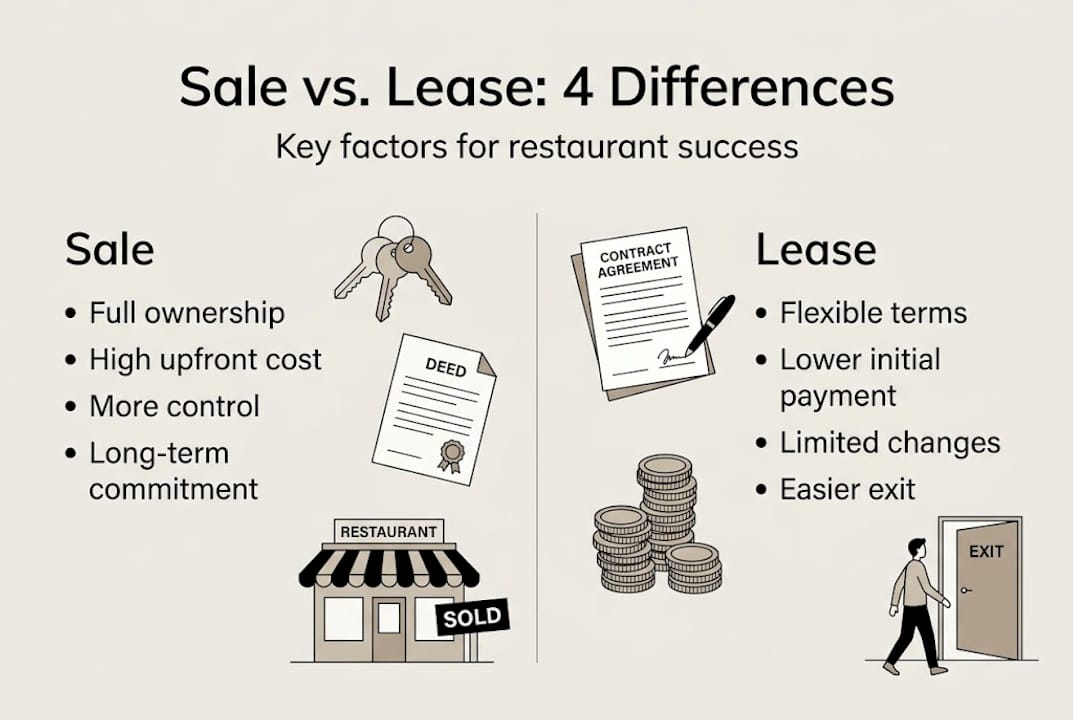
    The exit. This is where owning quietly wins. When you sell a restaurant business that leases its space, you sell goodwill, equipment, and an assignable lease, and the buyer’s lender will scrutinise that lease hard. When you own the building, you can sell the business and keep the building as an income property, sell both together, or do a sale leaseback and pull your equity out while continuing to operate. You have options a tenant does not have. For the narrower question of selling a restaurant business versus assigning its lease, see restaurant sale vs lease. Our step by step guide to buying restaurant property covers the acquisition process itself.

    When leasing is the right call

    Lease when you are testing a concept and are not certain it works in that trade area. Lease when the location you want sits in a corridor where nothing is for sale, which describes most high street and downtown retail. Lease when your capital is better spent on equipment, staff, and marketing than on a down payment. Lease when you plan to grow to several locations, because tying capital up in real estate slows expansion. And lease when the second generation space in front of you is good enough that the build out savings outweigh everything else.

    When buying is the right call

    Buy when the concept is proven and you know the location works. Buy when you are in a suburban or secondary market where freestanding restaurant buildings with their own parking actually trade. Buy when your projected debt service comes in at or below market rent for comparable space, which happens more often than operators expect. Buy when you intend to operate for a decade or more. And buy when the build out is heavy, because if you are spending 400,000 dollars on a kitchen you should think carefully before spending it inside someone else’s building.

    The middle path most operators miss

    You do not have to choose in a straight line.

    Lease with a purchase option. Negotiate a right of first refusal, or an option to purchase at a set price or an appraised value at a defined point in the term. Landlords approaching retirement are often receptive. This lets you prove the concept on someone else’s balance sheet and buy once you know.

    Buy the building and lease out the surplus. A freestanding building with more square footage than your concept needs can carry a second tenant whose rent covers a meaningful share of your debt service.

    Sale leaseback later. Buy, operate, build value, then sell the real estate to an investor and lease it back. You free the equity for expansion while staying in the location.

    A worked comparison

    Take a 3,000 square foot second generation restaurant space in a suburban market.

    Leasing at 30 dollars per square foot triple net comes to 90,000 dollars a year in base rent, plus roughly 8 dollars per square foot in common charges and taxes, so about 114,000 dollars a year, or 9,500 dollars a month. Add 200,000 dollars of build out that you will not own at the end. Assume a ten year term with an escalator, so the number climbs every year.

    Buying the same building at 900,000 dollars with an SBA 504 loan at 10 percent down means 90,000 dollars of equity in and roughly 810,000 dollars financed. Debt service, taxes, insurance, and a capital reserve land in a broadly similar monthly range. The difference is that in year ten your rent has escalated and you own nothing, or your loan balance has amortised down and you own a building.

    The numbers move with your market and your rate. The structural point does not. Leasing keeps your capital liquid and your exposure short. Buying converts your occupancy cost into equity and hands you a maintenance obligation.

    What to check before you commit either way

    Ask these about any space, leased or purchased. Is there an existing Type I hood, and does the make up air unit work. What is the incoming gas service in BTU, and is it enough for your equipment package. Is there a grease interceptor, what size, and does it meet current local code rather than the code when it was installed. What is the electrical service in amps. Is the space zoned for your use, and does it need a special use permit for alcohol, late hours, or outdoor seating. If it is second generation, why did the last operator leave, because the answer is either a bad operator or a bad location, and only one of those is your problem.

    Search both at once

    Most listing sites make you choose a lane before you have run the numbers. That is backwards. You should be looking at leases and buildings for sale side by side, in the same market, and letting the math decide.

    PepperLot is a commercial real estate marketplace built exclusively for the food and beverage industry, covering restaurant leasing, property sales, and business sales across all 50 states. You can search restaurant space for lease and restaurants and restaurant buildings for sale in the same place, and compare what each option really costs before you sign anything.

    Start with your occupancy cost ceiling. Everything else follows from it.

    Browse sell a restaurant on PepperLot.

  • Ghost Kitchen vs Traditional Restaurant Space

    The rise of delivery platforms pushed many operators toward ghost kitchens, commissaries, and shared kitchen models. Traditional restaurant space still wins when the brand depends on dine-in experience, bar revenue, or visible storefront marketing. Choosing the wrong format creates permit problems, capacity bottlenecks, or unnecessary rent.

    ## Ghost kitchen defined

    A ghost kitchen, also called a cloud kitchen or dark kitchen, is a production facility without a customer-facing dining room. Brands run delivery and sometimes pickup from these sites. Capital requirements for front-of-house build-out disappear, but kitchen infrastructure, permits, and platform fees remain.

    ## Traditional restaurant space

    A full restaurant lease includes dining room, bar if applicable, restrooms, signage, and customer ingress. You pay for front-of-house square footage but gain brand visibility, higher average checks, and alcohol revenue where licensed.

    ## Commissary and shared kitchen models

    Commissaries rent time in a permitted shared kitchen, common for caterers, food trucks, and packaged food producers. Shared kitchens offer monthly plans with storage allocations. These models reduce capital but limit access hours and customization.

    ## When ghost kitchen makes sense

    Delivery-first brands, virtual franchises, menu testing, and market expansion without full build-out are strong use cases. Operators who need low capital deployment and fast iteration benefit most.

    ## When traditional space makes sense

    Concepts relying on dine-in atmosphere, full bar programs, event dining, or high-visibility street presence usually need a traditional restaurant lease. Landlords and lenders also often prefer established restaurant use with proven foot traffic.

    ## Permit and operational differences

    Not every commercial kitchen permit supports every food production type. Food trucks may need a commissary relationship. Alcohol service generally requires a customer-facing licensed premises. Verify permit class before signing either format.

    ## Cost comparison framework

    Compare total monthly occupancy, capital required to open, speed to revenue, and revenue per square foot potential. A ghost kitchen may save rent but cap average check. A dining room costs more but unlocks additional dayparts and beverage margin.

    ## Hybrid strategies

    Some operators run delivery production from a commissary while maintaining a smaller front-of-house location. Others start in ghost kitchen format and expand into full restaurant space once unit economics are proven.

    Browse restaurant space for lease and restaurants for sale on PepperLot.

  • What fully equipped restaurant space really means for owners

    What fully equipped restaurant space really means for owners


    TL;DR:

    • Many restaurant operators are misled by the term “fully equipped,” which often lacks a clear industry standard and may not enable immediate operation. Verifying essential systems, equipment condition, and code compliance is crucial before signing a lease, as hidden costs and infrastructure issues frequently cause delays and overruns. Approaching “fully equipped” as a checklist rather than a promise ensures proper assessment and reduces the risk of costly surprises during opening.

    Many restaurant operators sign a lease on a “fully equipped” space expecting to unlock the doors and start cooking, only to discover weeks later that thousands of dollars of additional work stand between them and opening day. The phrase gets used liberally in listings, broker conversations, and landlord pitch decks, but it carries no standardized definition in the industry. This guide breaks down exactly what the term covers, how to verify every claim, and what due diligence steps protect your budget and your timeline before you commit to any space.


    Table of Contents

    Key Takeaways

    Point Details
    No universal definition Each ‘fully equipped’ restaurant space includes different features, so always verify specifics.
    Second-gen spaces save time Leveraging existing infrastructure often speeds your opening but still requires close inspection for fit.
    Diligence prevents surprises A thorough walkthrough and checklist can help you avoid costly code or equipment issues.
    Not all inclusions are equal Older systems may need upgrades even if they’re present, especially for your unique concept.
    Checklist beats assumption Treat every ‘fully equipped’ listing as a starting point for careful evaluation, not a guarantee.

    Defining a fully equipped restaurant space: More than marketing language

    When a listing says “fully equipped,” the words mean something different depending on who wrote them. A landlord might consider the space equipped because it has a working exhaust hood and grease trap. A broker might use it because there’s a six-burner range sitting in the kitchen. Neither definition guarantees that you can run service on day one.

    The restaurant kitchen equipment categories that actually define readiness are: cooking line, refrigeration, prep stations, dishwashing, dry storage, ventilation, fire suppression, and smallwares. A space that checks every one of those boxes is rare. Most listings that carry the “fully equipped” label satisfy two or three categories and expect you to fill in the rest.

    Infographic ranking key restaurant equipment categories

    There’s also the critical distinction between what the landlord delivers and what you’re expected to build. Build-out provisions in restaurant leasing draw a clear line: the landlord’s scope covers delivering the space in “shell” or “vanilla box” condition, which means basic infrastructure, while everything that makes it a functional restaurant falls to the tenant. That division isn’t always spelled out in plain language in a listing, which is why operators get caught off-guard.

    Here’s what a truly complete “fully equipped” space should include across the main categories:

    • Cooking line: Range, griddle, fryer, broiler, or oven depending on concept
    • Refrigeration: Walk-in cooler, walk-in freezer, reach-in units, and prep table refrigeration
    • Prep area: Work tables, sinks, slicers, mixers, and cutting equipment
    • Dishwashing: Commercial dishwasher with the right water temperature output for code compliance
    • Storage: Dry storage shelving, under-counter storage, and lockable areas for supplies
    • Ventilation: Type 1 or Type 2 hood with makeup air system, sized for the cooking equipment
    • Fire suppression: Ansul or equivalent system tied to the hood, inspected and tagged
    • Smallwares: Pots, pans, utensils, cutting boards, sheet pans, hotel pans

    “Fully equipped” as a label is a marketing decision, not a technical standard. Your job as the operator is to convert that label into a verified inventory before you sign anything.

    To understand your full obligations before signing, it helps to learn how to lease a restaurant space step by step, especially around the sections that define landlord versus tenant responsibilities in the build-out process.


    Comparing first-generation, second-generation, and turnkey spaces

    Not all restaurant spaces are born equal, and the generation category tells you a lot about what to expect before you ever walk through the door. These three types show up constantly in listings, and the differences between them are financially significant.

    First-generation spaces (also called “first-gen” or “grey shell” spaces) are delivered raw. You get four walls, a concrete floor, basic utilities stubbed in, and not much else. If a listing describes a first-gen space as “fully equipped,” that’s almost certainly a misuse of the term. Budget accordingly, because a full restaurant build-out in a first-gen space can run anywhere from $150 to $450 per square foot depending on your market and concept complexity.

    Agent inspecting empty restaurant lease space

    Second-generation spaces retain infrastructure from a previous restaurant tenant. According to second-generation restaurant space research, these spaces commonly include existing hood and ventilation systems, grease traps, gas and electric service sized for commercial use, and commercial-grade plumbing. That retained infrastructure can reduce your build-out cost and timeline meaningfully. But “commonly includes” is not the same as “definitely includes and works correctly.”

    Turnkey spaces are supposed to be the closest thing to move-in ready. The promise is that everything is installed, operational, and ready for your concept. In practice, turnkey is another label that needs to be verified, not trusted. Equipment may be dated, improperly maintained, or mismatched for your menu.

    Space type What’s typically included Build-out cost Risk level
    First-generation Utilities stubbed, bare walls Highest Predictable but expensive
    Second-generation Hood, grease trap, plumbing, electrical Moderate Medium, depends on condition
    Turnkey Full equipment, systems, sometimes FF&E Lowest Varies widely by verification

    Pro Tip: When evaluating a second-gen or turnkey space, bring your chef or kitchen designer on the first walkthrough. They’ll spot equipment sizing mismatches and layout problems that you might miss, and their input can become a negotiating point when discussing lease terms or purchase price.

    For a deeper breakdown of the advantages and trade-offs, the second-gen restaurant spaces overview covers the most important cost and timing factors. You can also explore the full second-generation restaurant spaces guide for a more detailed analysis of what to look for.


    What to verify: Your due diligence checklist for ‘fully equipped’ spaces

    Due diligence on a restaurant space goes far beyond confirming that a stove is present. You need to verify existence, condition, code compliance, and capacity for every major system. Skipping even one category can result in a health inspection failure, a fire marshal hold, or an insurance denial that delays your opening by weeks or months.

    Here’s a practical sequence for your verification process:

    1. Exhaust hood and ventilation: Confirm the hood type (Type 1 for grease-producing equipment, Type 2 for heat only), check the inspection tag date, and verify makeup air is functional. Hoods that haven’t been cleaned or inspected in over a year are a code red.
    2. Grease trap: Confirm size, location, and last pump-out date. An undersized or neglected grease trap triggers municipal violations fast.
    3. Plumbing: Check for three-compartment sink, handwashing sink placement per code, mop sink, and sufficient hot water capacity for dishwashing and sanitation.
    4. HVAC: Verify both kitchen and dining room systems. Kitchen HVAC must account for the heat load from cooking equipment.
    5. Gas service: Check the BTU capacity at the meter and confirm it matches the combined load of all cooking equipment.
    6. Electrical panel: Look at amperage, the number of circuits, and whether the panel has available capacity for your equipment list.
    7. Fire suppression system: Must be tagged, inspected within the last six months, and tied to the correct cooking equipment positions.
    8. Equipment condition: For every piece of equipment, ask for the age, last service date, and any repair history. Test everything that can be turned on.
    9. Code compliance history: Request the most recent health inspection report and any outstanding violations or permits.
    10. Ownership and warranty: Clarify whether equipment transfers with the space and whether any warranties remain active.

    A space that fails code readiness checks because systems are undersized or non-compliant for a new concept can cost more to correct than building from scratch. Never assume “fully equipped” means “code-ready.”

    A thorough restaurant expansion checklist can help you stay organized across multiple sites when you’re comparing options and running parallel due diligence processes.

    Pro Tip: Ask the landlord or seller for written documentation on every major system: the last hood cleaning certificate, the grease trap pump-out receipt, and the fire suppression inspection tag. If they can’t produce those documents, that’s your signal to price the cost of bringing each system current into your offer or walk away.


    The pitfalls and hidden costs operators miss most

    Even experienced operators get surprised. The “fully equipped” label creates a psychological shortcut that can lower your guard at exactly the moment you need to stay sharp.

    Here are the hidden costs that show up most often after a deal closes:

    • Hood and fire system upgrades: The hood might exist, but if it was designed for a lighter menu and you’re running a high-volume fry operation, you’ll need a larger system. Fire suppression must be reconfigured every time equipment positions change.
    • Equipment repairs with no warranty coverage: Commercial kitchen equipment transferred in a lease or sale rarely comes with active warranties. A walk-in compressor failure or a commercial dishwasher breakdown in your first month means paying out of pocket.
    • Grease trap undersizing: A trap sized for a coffee shop cannot handle the volume of a full-service kitchen. Pumping frequency goes up, violations accumulate, and in some cities you’re required to install a larger trap before you can open.
    • Electrical capacity gaps: You add a high-BTU salamander, a blast chiller, and a commercial espresso machine, and suddenly you’re tripping breakers. Panel upgrades are expensive and require permits that extend your timeline.
    • HVAC mismatch: Dining room air conditioning that was sufficient for a lighter-volume concept becomes inadequate when you’re running a packed house with a full cooking line operating at capacity.
    • Code violations from a prior tenant: Inherited infrastructure can include violations the previous operator ignored or was grandfathered through. You won’t get that same pass when the inspector visits for your new permit.
    • Concept mismatch: A kitchen designed for a pizza operation has different layout logic, equipment positioning, and ventilation needs than a ramen concept. Reconfiguring for your menu can erase the cost savings you anticipated from taking a second-gen space.

    These aren’t edge cases. They’re common enough that subleasing a restaurant space from an operator who’s already solved these problems can sometimes be a smarter short-term strategy than taking over a “fully equipped” space with unknown infrastructure.

    The honest reality is that the average restaurant build-out budget overruns by 20 to 30 percent, and a significant portion of those overruns trace directly back to infrastructure surprises in spaces that were marketed as ready to operate.


    The truth most experts won’t tell you about ‘fully equipped’ spaces

    Here’s the perspective that rarely makes it into the listing descriptions or the broker pitch: “fully equipped” is not a promise. It’s a prompt. The moment you read those words in a listing, your next move should be to open a checklist, not start planning your opening menu.

    The operators who consistently open on time and on budget treat every infrastructure claim as a starting point for investigation. They don’t argue with the label. They simply verify it. That mindset shift saves more money than any single negotiating tactic.

    There’s also a concept-fit dimension that almost nobody discusses until it’s too late. A space can be genuinely and completely equipped for a previous restaurant concept and be functionally wrong for yours. A full-service steakhouse kitchen and a counter-service taco concept require different equipment, different hood sizing, different plumbing configurations. The infrastructure being present doesn’t mean it’s useful for what you’re trying to build.

    The smartest move we see operators make consistently is this: they define their own equipment list first, based on their menu and projected volume, and then they measure every “fully equipped” space against that list. Not against a generic definition of what “equipped” should mean. Against their specific operational requirements.

    Launching in a second-gen restaurant space can absolutely be the fastest and most cost-effective path to opening, but only when you’ve done the work to confirm the infrastructure aligns with what you’re building. The due diligence investment, whether that’s hiring an equipment inspector, bringing in a kitchen designer, or spending an afternoon pulling permits, pays for itself many times over before your first service.


    Explore your next move with expert-vetted restaurant spaces

    You now have the framework to evaluate any “fully equipped” claim with precision, protecting your budget and your opening timeline from the most common and costly surprises in restaurant real estate.

    https://pepperlot.com

    Pepperlot is built specifically for operators who want clarity before they commit. Every listing on the platform includes restaurant-specific details like grease trap status, hood type, seating capacity, and permit history, so you’re not piecing together critical information from vague descriptions. Whether you’re looking for fully equipped restaurants for lease or exploring restaurant spaces for sale, Pepperlot connects you with vetted listings and expert support at every stage of the process. Start your search with the specificity your concept deserves.


    Frequently asked questions

    Does a fully equipped restaurant space always include smallwares and furniture?

    Not always. Most spaces that claim to be fully equipped cover major infrastructure like cooking equipment and refrigeration, but smallwares such as utensils, pots, and pans, as well as dining room furniture, are often excluded and must be sourced separately.

    How do I confirm if systems are code-compliant for my restaurant concept?

    Hire a licensed inspector with commercial kitchen experience to assess each system’s size, condition, and compliance status, and check with your local health and fire authorities before signing. A space marketed as equipped may still fail inspection if systems aren’t sized correctly for your concept.

    What are the main risks of second-generation restaurant spaces?

    The main risks are worn or outdated equipment, infrastructure that doesn’t match your menu concept, and surprise code upgrade requirements. Second-generation spaces can range from truly valuable inherited assets to another operator’s expensive unresolved problems.

    What does ‘shell’ condition actually provide if not a full kitchen?

    Shell condition delivers basic HVAC, plumbing stubs at connection points, an electrical panel, and fire suppression systems brought to code. According to build-out provisions in restaurant leasing, the full kitchen build-out, including all cooking equipment, ventilation finish, and smallwares, is the tenant’s responsibility.

    Why should I treat ‘fully equipped’ as a checklist, not a guarantee?

    Because inclusions, working condition, and code compliance vary dramatically from one listing to the next with no universal standard. Treating the claim as a verification prompt rather than a guarantee is the single most effective habit for protecting your opening budget.

    Browse restaurant space for lease and restaurants for sale on PepperLot.

  • NNN leases for restaurants: what operators must know

    NNN leases for restaurants: what operators must know


    TL;DR:

    • NNN leases require tenants to pay property taxes, insurance, maintenance, and other operating costs directly.
    • Restaurant-specific NNN expenses include grease trap cleaning, hood maintenance, and high HVAC costs, increasing overall risk.
    • Careful lease review, expense caps, and ongoing monitoring are essential to avoid unexpected costs and protect margins.

    Signing an NNN lease sounds straightforward until the first year-end reconciliation lands on your desk and your total occupancy cost is 35% higher than you budgeted. Many restaurant operators walk into triple net deals assuming the label tells the whole story. It doesn’t. The fine print determines who fixes the grease trap, who absorbs a property tax hike, and who pays when the HVAC fails in July. Getting these details right before you sign isn’t just good practice. It’s the difference between a profitable location and one that quietly drains your margins for years.

    Table of Contents

    Key Takeaways

    Point Details
    NNN means more responsibility Restaurant tenants pay not just rent but real estate taxes, insurance, and property maintenance.
    Costs can vary widely Base rent may be lower, but total occupancy is often higher and rises with uncapped expenses.
    Negotiation is critical Clarifying definitions and setting expense caps can prevent nasty surprises down the road.
    Owners gain steady income Property owners enjoy less management and more predictable cash flow under NNN structures.
    Lease language beats labels Always study what ‘NNN’ covers in your agreement, labels often don’t match real obligations.

    What is an NNN lease? Definitions and essentials

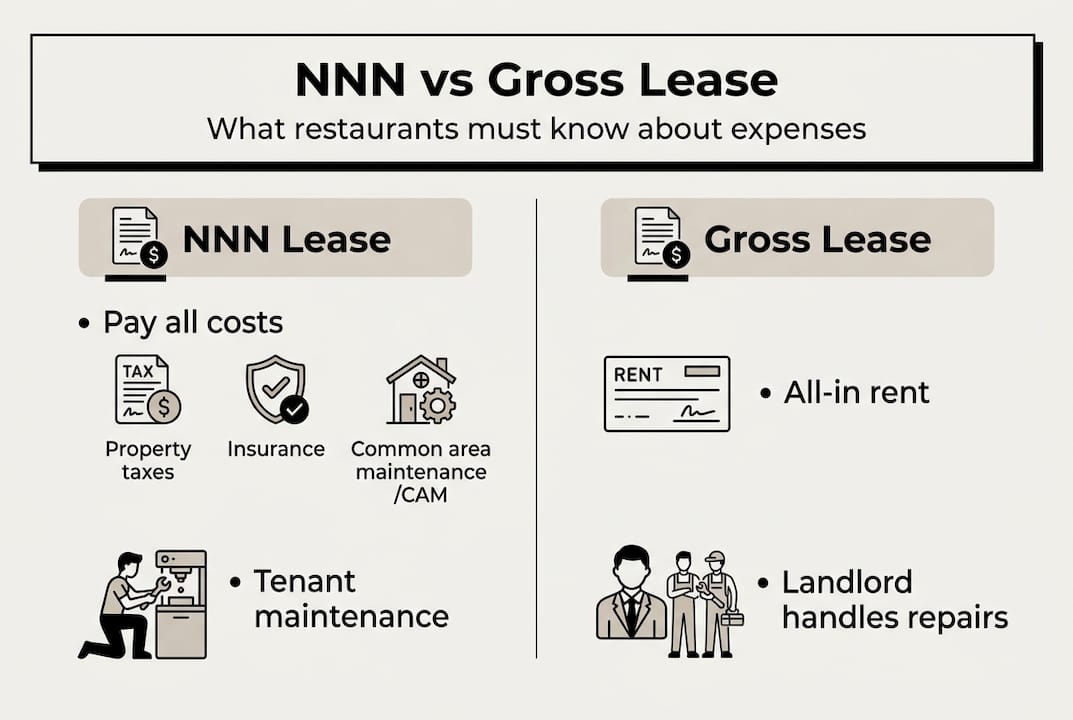
    The term “triple net” gets used casually in commercial real estate, but its meaning shifts depending on the lease in front of you. At its core, a triple net lease is a commercial real estate agreement where the tenant pays base rent plus property taxes, building insurance, and maintenance costs, the three “nets,” along with utilities and often common area maintenance (CAM) fees in multi-tenant settings. The word “net” means the landlord receives rent that is net of those expenses. The tenant absorbs them directly.

    This structure stands in contrast to a gross lease, where the landlord bundles all expenses into one rent figure and manages them independently. A modified gross lease splits the difference, with some costs included in rent and others passed through to the tenant. For restaurant operators, restaurant leasing basics matter here because the cost exposure in an NNN structure is significantly higher and more variable than most operators initially realize.

    Infographic comparing NNN and gross leases for restaurants

    Cost type NNN lease Gross lease Modified gross lease
    Base rent Tenant Tenant Tenant
    Property taxes Tenant Landlord Split/negotiated
    Building insurance Tenant Landlord Split/negotiated
    Maintenance/repairs Tenant Landlord Split/negotiated
    Utilities Tenant Often included Often tenant
    CAM fees Tenant Landlord Varies

    The key takeaway: in a true NNN lease, you are essentially operating as if you own the building without the equity benefit of ownership. Everything that keeps the property running lands on your budget.

    • Property taxes: can increase annually based on local assessments, often beyond your control
    • Building insurance: covers the structure itself, separate from your own business liability coverage
    • Maintenance: includes HVAC systems, parking lots, plumbing, and structural elements unless specifically excluded
    • CAM fees: apply in shared retail centers and cover shared spaces like parking areas and landscaping

    Pro Tip: Before signing any NNN lease, ask the landlord for a full expense history going back three years. What you see will tell you more than any broker ever will.

    One important note: a real-world restaurant lease rarely matches the textbook definition exactly. Some leases labeled NNN exclude roof repairs. Others cap CAM increases. The label is a starting point, not a guarantee.

    Unique features of NNN leases for restaurants

    Retail tenants deal with NNN leases too, but restaurants face a distinct category of risk. The physical demands of a food service operation create maintenance expenses that a clothing store never encounters.

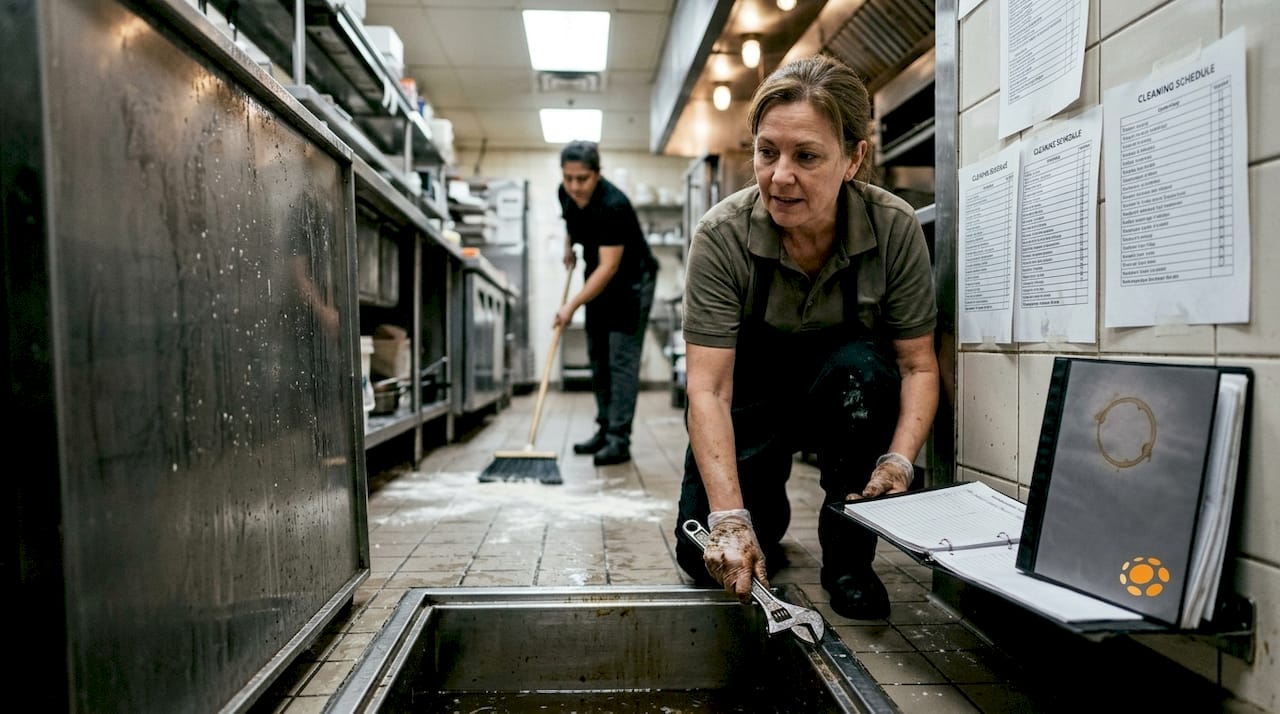
    Kitchen manager performs grease trap maintenance

    Consider a quick-service restaurant (QSR) scenario. A 5,000 square foot QSR at $30 per square foot base rent runs $150,000 per year in base rent alone. Add property taxes, insurance, CAM, HVAC maintenance, and utilities, and total occupancy costs can climb well above $200,000 annually. Franchisees operating brands like McDonald’s or Taco Bell often face exactly this math.

    What makes restaurants different from standard retail tenants:

    Obligation Restaurant NNN tenant Retail NNN tenant
    Grease trap cleaning Yes, frequently Not applicable
    Hood/exhaust maintenance Yes, required Not applicable
    HVAC wear and tear Heavy, high-frequency Moderate
    Plumbing demands Intensive (3-compartment sinks) Standard
    Health code compliance Ongoing tenant responsibility Not applicable
    Structural exclusions Often roof, parking Often roof only

    Restaurant-specific operating expense examples show just how quickly costs accumulate when you factor in commercial kitchen requirements. Grease traps need cleaning every one to three months depending on volume. Hood systems require semi-annual professional inspections for fire code compliance. These are not optional line items.

    Here are the key operator risks you need to model before signing:

    1. Variable tax hikes: Local property tax reassessments can spike suddenly, and NNN tenants absorb those increases directly.
    2. Uninsured maintenance: Some repairs fall outside the landlord’s insurance and outside the tenant’s policy, leaving a gray zone.
    3. HVAC replacement costs: A full commercial HVAC replacement can cost $15,000 to $40,000 and may fall entirely on the tenant.
    4. Lease language gaps: Exclusions buried in exhibits can shift roof and structural costs to you unexpectedly.
    5. Reconciliation surprises: End-of-year CAM reconciliations can result in large lump-sum payments if estimates were low.

    Rising taxes and insurance alone can add 20 to 30 percent to your costs over a lease term if there are no caps negotiated. For a restaurant operating on 10 to 15 percent net margins, that kind of swing isn’t just uncomfortable. It can be the difference between staying open and closing.

    Looking at a real NNN lease case study helps ground these numbers in practice before you commit to a specific location.

    Pros and cons: Restaurant operator and owner perspectives

    NNN leases didn’t become the dominant structure for freestanding restaurant properties by accident. They offer real advantages, but those advantages flow differently depending on which side of the transaction you’re on.

    For landlords, the appeal is straightforward. Passive income with predictable cash flow and minimal management responsibility makes NNN leases attractive to investors who want real estate exposure without active property management. A landlord with a 15-year NNN lease to a national QSR brand essentially owns a bond with a building attached.

    For restaurant operators, the calculus is more complicated. You gain control over your own maintenance standards and can often negotiate longer terms that protect your investment in build-out and equipment. But you absorb all the variability.

    Operator pros:

    • Control over maintenance quality and vendor selection
    • Potentially lower base rent compared to gross lease equivalents
    • Long-term lease security supports investment in the space
    • Ability to negotiate specific exclusions (roof, structure) to limit exposure

    Operator cons:

    • Unpredictable total occupancy costs year to year
    • Requires in-house or contracted facilities management expertise
    • Large capital reserves needed for major system replacements
    • CAM reconciliation disputes with landlords are common

    Property owner pros:

    • Low management overhead
    • Stable, long-term income stream
    • Tenant absorbs inflation-driven cost increases

    Property owner cons:

    • If the tenant fails financially, vacancy risk is high
    • Deferred maintenance by tenants can damage property value
    • Refinancing or selling depends heavily on tenant credit quality

    “Lease language trumps label. An NNN lease may exclude the roof entirely. Always abstract every key term before you sign anything.”

    Understanding whether an NNN deal fits your operation requires comparing it honestly against alternatives. The restaurant sale vs. lease decision also shapes whether NNN exposure is worth it relative to your capital structure. And if you’re considering subleasing part of your space later, knowing your assignment vs. sublease rights matters just as much as the NNN terms themselves.

    Pro Tip: Always negotiate expense caps on property taxes and insurance increases. Even a 5% annual cap can save tens of thousands over a 10-year lease term.

    How to negotiate and manage an NNN lease effectively

    Knowing the risks is only useful if you act on them. Here’s a practical sequence for handling NNN negotiations and ongoing management.

    Before you sign:

    1. Itemize every expense: Request a full written breakdown of what the NNN covers and what it excludes. Do not rely on verbal summaries.
    2. Clarify each party’s responsibility: Confirm in writing who handles roof, parking lot, structural walls, HVAC units, and plumbing.
    3. Negotiate expense caps: Push for annual caps on tax and insurance pass-throughs, typically 3 to 5 percent per year.
    4. Check for exclusions: Ask specifically whether roof, foundation, and exterior walls are included or excluded from your obligations.
    5. Review CAM calculations: Understand how the landlord calculates your share in a multi-tenant center. Management fees buried in CAM are common.

    After you sign:

    1. Build a maintenance schedule: Document every critical system, its age, and its expected replacement timeline. Budget accordingly.
    2. Reconcile annually: Review landlord-provided expense statements against actual invoices every year. Billing errors happen regularly.
    3. Track tax assessments: Monitor local property tax records so you’re not blindsided by increases before they hit your monthly statement.
    4. Negotiate HVAC clauses: Older buildings often have aging systems. Push for landlord responsibility on full replacements above a certain dollar threshold.

    Following these lease term best practices protects you both at signing and throughout the term. And reviewing real lease examples gives you a concrete sense of how these terms appear in actual documents.

    A solid NNN lease checklist confirms that lease language ultimately controls everything. The label “NNN” can mean very different things in two leases side by side.

    Pro Tip: Preventive maintenance isn’t optional under an NNN lease. Skipping scheduled service on grease traps or hood systems can trigger health code violations that close your doors faster than any rent dispute.

    Why most restaurants underestimate NNN lease risks

    Here’s an uncomfortable truth: most operators who struggle with NNN leases didn’t miss the numbers. They trusted the label.

    The term “NNN” sounds clean and defined. It isn’t. We’ve seen operators sign leases assuming “triple net” covers everything in a clear formula, only to discover mid-term that roof repair costs weren’t included or that CAM reconciliations included management fees no one mentioned at signing.

    The real failure mode isn’t ignorance of NNN mechanics. It’s the assumption that all NNN leases are the same. Labels in commercial real estate are shorthand, not contracts. The actual lease challenges that sink operators are almost always buried in exhibits and addenda, not the main lease body.

    Survivors in this industry treat annual lease reviews as seriously as they treat P&L reviews. They build margin cushions for tax and insurance spikes. They add service contracts for HVAC and grease traps before problems arise. They question every line on a CAM reconciliation statement. This isn’t paranoia. It’s the operational discipline that separates operators who thrive from those who get surprised into closure.

    Find the right restaurant lease for your next venture

    Now that you understand what NNN leases actually cost and how to protect yourself, the next step is finding the right space under the right terms.

    https://pepperlot.com

    Pepperlot lists restaurant spaces for lease with the details that actually matter: grease trap specs, hood systems, seating capacity, parking, and existing permits. No generic commercial listings that make you dig for restaurant-relevant information. You can also use Pepperlot’s location intelligence tools to analyze local competition, demographics, and demand before you commit to any location. Smarter site selection starts before the lease negotiation, and having the right data changes every conversation with a landlord.

    Frequently asked questions

    What does a restaurant NNN lease typically include?

    A restaurant NNN lease requires you to pay base rent, property taxes, building insurance, maintenance, utilities, and often CAM fees on top of your base rent figure.

    Is NNN leasing better for landlords or restaurant tenants?

    NNN leases typically favor landlords with passive income and minimal management needs, but restaurant tenants who negotiate caps and exclusions can still structure favorable deals.

    Do NNN restaurant leases always include all repairs?

    No. Lease language controls what’s included, and many NNN leases specifically exclude roof, foundation, or certain HVAC replacement costs from tenant obligations.

    How can operators protect against rising NNN costs?

    Negotiate annual expense caps on taxes and insurance, clarify all exclusions in writing, and budget for 20 to 30 percent cost increases over a multi-year lease term as a conservative baseline.

    Browse restaurant space for lease on PepperLot.

  • Expert Restaurant Real Estate Tips: Secure the Ideal Space

    Expert Restaurant Real Estate Tips: Secure the Ideal Space


    TL;DR:

    • Choosing the right location involves evaluating physical fit, visibility, parking, demand, and competition.
    • Keep occupancy costs under 10% of projected gross sales and request detailed lease breakdowns.
    • Match your restaurant concept to the location and use data-driven analysis to prevent mismatched failures.

    Your restaurant’s location can generate a packed dining room every Friday night, or it can quietly drain your savings until you close your doors. The difference often comes down to two decisions most operators underestimate: choosing the right space and negotiating the right lease. Unlike other business costs, your real estate commitment locks you in for years, sometimes decades. A miscalculation at the start creates a burden that clever marketing or great food cannot fix. This guide walks you through the critical criteria, cost frameworks, negotiation tactics, and specialist considerations you need to secure a restaurant space that actually supports your concept and your bottom line.

    Table of Contents

    Key Takeaways

    Point Details
    Right-sizing your space Match your location’s layout and size to your menu, service style, and projected guest count for operational success.
    Occupancy costs matter Cap rent and occupancy costs at no more than 10% of projected sales for long-term profitability.
    Negotiate smart Always seek key lease terms like kick-out and co-tenancy clauses to protect your investment.
    Team up for deals Use experienced restaurant brokers and legal experts to avoid costly mistakes during negotiations.
    Adapt for your segment QSR and fast casual restaurants may face different lease terms but can thrive with the right strategy.

    Essential criteria for choosing a restaurant location

    Site selection is not just about picking a busy street. It is a structured evaluation of how a space will serve your concept, your staff, and your customers every single day.

    Start with the physical fit. Your kitchen needs to accommodate your equipment layout, your storage requirements, your hood ventilation system, and your service flow. A beautiful dining room means nothing if your back-of-house is cramped and inefficient. As Bank of America outlines, the space must match your concept in terms of kitchen operations, storage, and seating capacity before any other factor gets considered.

    Beyond the building itself, assess these external factors:

    • Visibility and signage: Can drivers and foot traffic see your restaurant clearly? Poor visibility kills awareness before you even open.
    • Parking and access: Is there dedicated parking, nearby lots, or strong public transit? Barriers to entry reduce covers.
    • Local demand: Are your target customers actually living, working, or passing through this area in meaningful numbers?
    • Zoning and permits: Does the space have the right municipal classification for food service? Are permits transferable from a previous tenant?
    • Competition density: How many similar restaurants operate within a half-mile radius? Use a restaurant site checklist to score each factor systematically.

    On competition, the nuance matters. Some competition confirms demand, which is a healthy signal. But too many similar concepts fighting over the same customer pool creates a race to the bottom on pricing and marketing spend. The smarter play is either to enter an area with clear unmet demand or to position your concept as genuinely complementary to what already exists.

    Pro Tip: Visit any shortlisted location at least three different times during peak hours. Lunch, dinner, and weekend service will each reveal different traffic patterns, parking realities, and neighborhood energy that a cold Tuesday morning visit will completely hide.

    Do not rush this stage. Every hour you spend evaluating locations before signing saves months of operational pain after opening.

    How to analyze occupancy costs and set your lease budget

    Once you have a feel for your target location, the numbers need to work. This is where many operators make emotionally driven decisions they later regret.

    Manager preparing restaurant financial budget

    The core benchmark you need to know: keep occupancy costs under 10% of your projected gross sales. Under 6% is excellent, 6 to 8% is healthy, 8 to 10% is acceptable, and anything over 10% puts your operation in a risky position from day one. Occupancy costs include your base rent plus all additional fees.

    Here is how a typical lease cost structure breaks down:

    Cost component What it means
    Base rent The fixed monthly amount per square foot
    NNN (triple net) fees Property taxes, building insurance, and maintenance passed to tenant
    CAM charges Common area maintenance fees for shared spaces like lobbies or parking lots
    Percentage rent Additional rent tied to a portion of your gross sales above a threshold

    To put this into practice, here is a sample budget table based on projected annual gross sales:

    Annual gross sales Max safe occupancy cost (10%) Target cost (7%)
    $800,000 $80,000/year $56,000/year
    $1,200,000 $120,000/year $84,000/year
    $2,000,000 $200,000/year $140,000/year

    To set your maximum safe lease commitment, follow these steps:

    1. Build a conservative revenue projection based on your concept, covers per service, and average check size.
    2. Multiply projected gross sales by 0.07 to 0.10 to get your occupancy cost ceiling.
    3. Request full NNN and CAM breakdowns from the landlord, not just the base rent headline figure.
    4. Factor in buildout costs amortized over your lease term.
    5. Leave a cash reserve for permitting delays and pre-opening expenses that often run longer than expected.

    You can also explore restaurant real estate 101 for a deeper breakdown of how lease structures vary by property type and market.

    Pro Tip: Buildout and permitting delays average two to four months in most urban markets. Budget at least three months of rent at zero revenue when calculating your true pre-opening cost. Many operators skip this and find themselves cash-negative before their first customer walks in.

    Lease negotiation strategies: what to ask for (and avoid)

    Knowing your numbers gives you power at the negotiating table. Now use that power strategically.

    The clauses below are non-negotiable asks for any serious restaurant operator:

    1. Kick-out clause: If your sales fall below a defined threshold for a sustained period, you can exit the lease without catastrophic penalties. This is critical protection against underperforming locations.
    2. Co-tenancy clause: If a major anchor tenant leaves the center or building, you have the right to reduce rent or exit. Losing an anchor can decimate foot traffic overnight.
    3. Assignment and subletting rights: If you need to sell your business or restructure, you want the right to transfer the lease without landlord approval blocking the deal.
    4. Renewal options with fixed terms: Lock in your right to renew at a predetermined rate, not a vague “market rent” figure that can spike unpredictably.

    As restaurant lease experts advise, negotiating kick-out clauses for low performance and co-tenancy protection for anchor tenant dependency are two of the most overlooked but highest-impact lease protections available.

    Here is a quick comparison of negotiation wins versus deal-breakers:

    Negotiate to win Watch out for
    Kick-out clause Unlimited personal guarantees
    Co-tenancy protection Vague “market rate” renewal language
    Assignment rights No cap on NNN cost escalations
    Free rent period during buildout Exclusivity clauses that are too narrow
    Tenant improvement allowance Short renewal windows with no notice period

    “Never negotiate a restaurant lease alone. Assemble a team with a restaurant-specialized broker, a commercial real estate attorney, and a CPA who understands hospitality financials before you open any discussion with a landlord.”

    This advice from lease negotiation specialists reflects a reality that catches solo operators off guard repeatedly. Landlords negotiate leases every week. Most operators do it once or twice in their careers. The experience gap is real.

    Review your local real estate FAQ for answers to common lease questions before your first landlord meeting.

    Special considerations: QSRs, NNN leases, and when the math changes

    Not every restaurant deal fits the same mold. Quick service restaurants operate under different real estate math, and understanding that math matters whether you are a franchisee or an independent operator entering fast casual.

    For QSRs and franchise concepts, NNN leases are the standard, with cap rates around 5.7% in 2025 and total occupancy costs that can reach 9 to 11% of gross sales in some markets, which technically exceeds the standard benchmark. Yet these operations succeed because their sales volume and customer throughput more than compensate for the higher cost ratio.

    Here is how QSR lease metrics compare to full-service restaurant benchmarks:

    Metric Full-service restaurant QSR or fast casual
    Typical occupancy cost ratio 6 to 10% of gross sales 9 to 11% of gross sales
    Common lease structure Modified gross or NNN Triple net (NNN)
    Cap rate expectation Varies widely ~5.7% in 2025
    Lease term length 5 to 10 years 10 to 20 years

    Key considerations specific to QSR and fast casual deals:

    • High throughput offsets high costs: Drive-through and counter service models generate more transactions per hour than sit-down restaurants, making a higher occupancy ratio sustainable.
    • Brand covenant matters: Franchised locations with proven national brands receive better lease terms because landlords see lower default risk.
    • Location type shifts the analysis: A standalone pad site with strong drive-through access justifies premium rents that an inline strip center location does not.
    • Franchise disclosure documents define your range: Many franchise agreements cap the rent you can agree to, so read the FDD carefully before touring spaces.

    For operators exploring this segment, browsing fast casual lease examples gives you a real-world sense of how these properties are structured and priced in today’s market.

    The overlooked art of matching restaurant concept and location

    Here is something the standard real estate playbook rarely says out loud: most restaurant location failures are not caused by bad markets. They are caused by mismatched concepts.

    Operators fall in love with a deal. The space is beautiful, the rent is low, the landlord is motivated. But the neighborhood skews young and fast-paced while the concept is a sit-down tasting menu. Or the location is buried in an office park that goes quiet by 7 PM, and the concept depends on dinner revenue. The numbers looked fine on paper. The concept never had a chance.

    Location intelligence is the discipline that closes this gap. Instead of relying on gut feel or walkability impressions, you layer demographic data, competition density, average check affinity, and foot traffic patterns to score how well a space actually fits your model. The buy vs. lease insights discussion adds another layer, because the right financial structure also depends on your concept’s growth trajectory.

    The most durable restaurant real estate decisions we see are made by operators who start with their concept identity and work backward to location requirements, not the other way around. Find the space that fits your brand, your customers, and your operational model. A slightly higher rent in the right location will always outperform a bargain space that fights your concept every service.

    Find your next restaurant space with Pepperlot

    Pepperlot was built specifically for operators who take restaurant real estate seriously. Every listing on the platform includes the details that actually matter to restaurateurs: hood systems, grease traps, seating capacity, patio access, existing permits, and equipment included.

    https://pepperlot.com

    Whether you are evaluating a featured restaurant for lease, exploring a restaurant business for sale, or running location analysis before you commit, Pepperlot’s location intelligence tools give you the competitive and demographic context to make a data-driven decision. Stop guessing. Start evaluating with the right information in front of you.

    Frequently asked questions

    What is the ideal percentage of rent in restaurant revenue?

    Aim to keep total occupancy costs under 10% of projected gross sales. Under 6% is excellent, 6 to 8% is healthy, and anything above 10% creates real financial risk.

    What clauses are critical in a restaurant lease negotiation?

    Prioritize kick-out clauses, co-tenancy protection, and assignment rights. Kick-out and co-tenancy clauses are among the most overlooked but highest-value protections you can negotiate.

    How do QSR lease terms differ for franchisees?

    QSRs commonly use triple net leases with cap rates near 5.7% and may carry occupancy costs of 9 to 11% of gross sales, supported by high transaction volumes.

    Should I buy or lease restaurant space?

    Leasing offers lower upfront cost and operational flexibility, while buying builds equity and long-term control but requires significantly more capital and carries greater financial exposure early on.

    How can I make my restaurant stand out in a competitive area?

    Differentiate your concept clearly or seek locations where your offer is complementary to existing businesses. Some competition signals healthy demand, but saturation without differentiation is a trap worth avoiding.

    Browse restaurant space for lease and restaurants for sale on PepperLot.

  • How to Lease Restaurant Space: Step-by-Step Guide

    How to Lease Restaurant Space: Step-by-Step Guide

    Two restaurants open in the same building, paying nearly identical rent. One thrives for a decade. The other closes in 18 months. The difference often comes down to a single document: the lease. A poorly structured lease can trap you in a space that kills your margins before you serve your first table. A well-negotiated one gives you breathing room to build something real. This guide walks you through every stage of the restaurant leasing process, from defining your requirements and researching locations to negotiating terms and completing due diligence, so you can make decisions with clarity and confidence.

    Table of Contents

    Key Takeaways

    Point Details
    Know your needs List your non-negotiable features and dealbreakers before touring restaurant spaces.
    Benchmark costs Keep total occupancy cost no higher than 10 percent of projected sales for a viable lease.
    Negotiate smart terms Seek key protections like rent abatement, TI allowance, and renewal options when you negotiate.
    Verify everything Do thorough due diligence and review all documents before signing to avoid costly surprises.

    Clarify your restaurant requirements and dealbreakers

    Before you visit a single space, you need a clear picture of what you actually need. Skipping this step is one of the most common and costly mistakes operators make. You end up falling in love with a location that can’t support your ventilation requirements or doesn’t have the electrical capacity for your kitchen equipment.

    The step-by-step leasing process starts with assessing your concept, ventilation needs, parking access, kitchen size, and utility capacity before you ever walk through a door. That sequence matters. Getting clear on your needs first filters out spaces that look great but won’t work operationally.

    Here are the core requirements to define before your search:

    • Concept fit: Does the space match your service style (fast casual, full service, bar, ghost kitchen)?
    • Kitchen infrastructure: Hood systems, grease traps, gas lines, and electrical capacity are expensive to add later.
    • Seating capacity: Does the floor plan support your revenue model?
    • Ventilation and HVAC: Inadequate systems are often non-negotiable to fix without major cost.
    • Parking and accessibility: Critically important for suburban concepts; less so for dense urban locations.
    • Visibility and foot traffic: Street-level exposure can make or break discovery-driven concepts.
    • Zoning and permitted uses: Confirm the space is legally approved for food service.

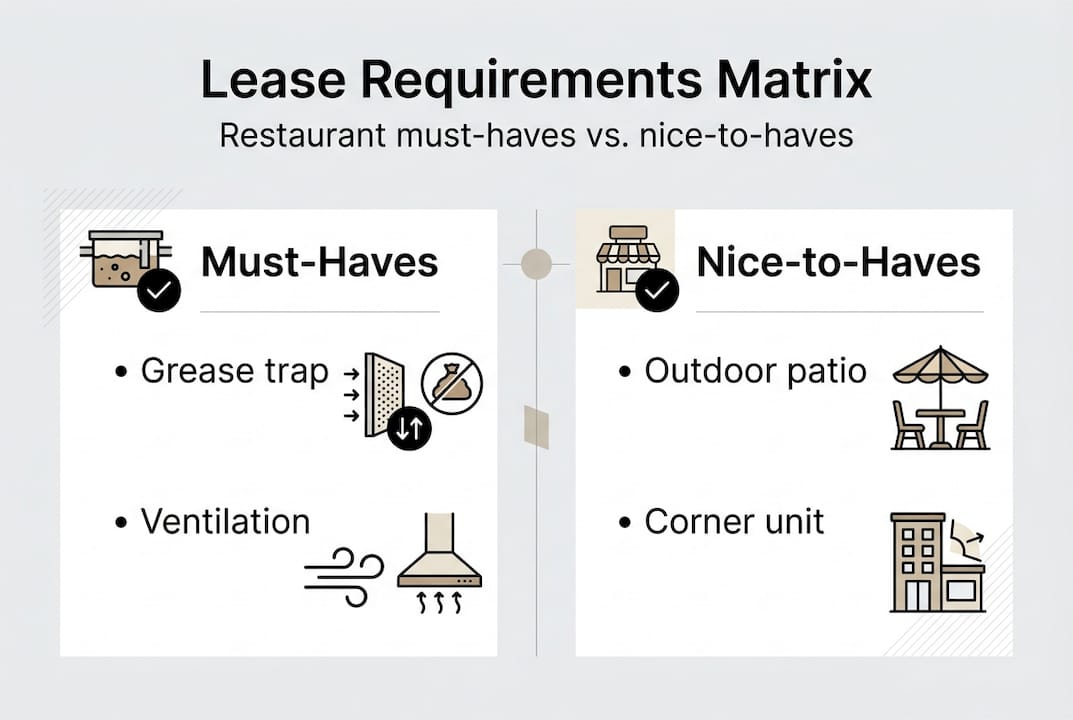
    Beyond that list, build a simple requirements matrix. Split your criteria into two columns: must-haves and nice-to-haves. This sounds basic, but it saves enormous time. When you’re evaluating six spaces simultaneously, a clear matrix stops emotion from overriding logic.

    Infographic contrasting must-have and nice-to-have features

    Requirement Must-Have Nice-to-Have
    Grease trap installed Yes ,
    Outdoor patio No Yes
    Private parking lot Depends on market ,
    Full hood system Yes ,
    Corner location No Yes
    1,500+ sq ft kitchen Yes ,

    Pro Tip: Before starting your search, complete a restaurant site evaluation checklist to turn your requirements into a structured scoring tool. It makes side-by-side comparisons far easier.

    Also revisit your buy vs. lease decision at this stage. Some operators assume leasing is always the right path, but the answer depends on your capital position and long-term plans.

    Research and compare ideal locations

    Once your requirements are locked in, you can start building a short-list of viable locations. This is where operators often move too fast, touring spaces before they understand the financial parameters they’re working within.

    Start with the numbers. Total occupancy costs, rent plus NNN (triple net fees covering taxes, insurance, and maintenance), should fall between 6% and 10% of your projected gross sales. Base rent ranges from $10 to $150 per square foot annually depending on market. Buildout costs typically run $75 to $400 per square foot. Lease terms usually span 5 to 10 years. These benchmarks are your financial fence. Evaluate every space against them before you get attached.

    Here’s a practical sequence for comparing locations:

    1. Shortlist candidates based on your requirements matrix and preliminary rent data from your restaurant real estate guide.
    2. Visit each space during peak business hours to observe foot traffic, parking flow, and neighboring businesses.
    3. Run preliminary financials for each site: estimate your sales per square foot, apply the 6-10% occupancy benchmark, and confirm the math works before going deeper.

    Pro Tip: Build a simple spreadsheet with columns for each site and rows for rent per sq ft, estimated NNN, total occupancy cost, buildout estimate, lease term, and traffic notes. Plug in each location’s numbers and compare side by side without relying on memory or gut feeling.

    Here’s what a basic comparison might look like:

    Factor Space A (Downtown) Space B (Suburban strip)
    Base rent (per sq ft/yr) $85 $38
    Estimated NNN $18 $9
    Total occupancy cost $103/sq ft $47/sq ft
    Condition Move-in ready Needs full buildout
    Buildout estimate $50,000 $280,000
    Foot traffic (peak) High Moderate
    Lease term offered 5 years 10 years

    Space A costs more per foot but less upfront. Space B demands a longer commitment and higher buildout investment. Neither is automatically better. The right answer depends on your concept’s revenue model and your appetite for risk.

    Managers compare lists of restaurant spaces

    This is where deals are won or lost. Most operators go into lease negotiations focused only on rent. Experienced ones know the surrounding terms often matter just as much.

    Here are the key items to negotiate on every restaurant lease:

    • Rent abatement: Request 3 to 6 months of free or reduced rent during your buildout period. You’re not generating revenue yet, so you shouldn’t be paying full rent.
    • Tenant improvement (TI) allowance: Landlords typically offer $20 to $80 per square foot for buildout costs. On a 2,000 sq ft space, an $40/sq ft TI allowance means $80,000 from the landlord toward construction.
    • Exclusivity clause: Prevents the landlord from leasing to a direct competitor in the same building or center.
    • Assignment and sublease rights: Critical if your plans change. These rights let you transfer or sublease the space without full landlord control.
    • Renewal options: Lock in the right to renew at predetermined escalation rates (typically 2% to 3% annually).
    • CAM caps: Limit annual increases in common area maintenance fees to 3% to 5%.
    • Kick-out clause: Allows you to exit the lease early if sales fall below a defined threshold.

    “Project conservative sales when calculating your rent-to-sales ratio. Exceeding 10% occupancy cost is unsustainable long-term and the leading lease-related cause of restaurant failure.”

    Understand the sale vs. lease differences that affect how these terms are structured. And if you’re considering a space with an existing operator, learn how lease assignment works before assuming you can simply take it over.

    Pro Tip: Always ask for a cap on annual rent and CAM increases written directly into the lease. Without it, a landlord can raise costs significantly in years four or five, eroding margins you didn’t plan for.

    Due diligence and landlord priorities: What both sides must verify

    Good lease terms only protect you if the underlying facts are accurate. Due diligence is the verification step that most people rush, and the one that costs them the most when skipped.

    For tenants, here’s a core checklist of what to verify before signing:

    • Permitted use clause: Confirm the lease explicitly allows your type of food service operation.
    • Zoning and code compliance: Check with the local municipality that the space meets current health and fire codes.
    • Existing licenses and permits: Ask whether any existing food service or liquor licenses are transferable.
    • Utility history: Request prior year utility bills. Hidden HVAC inefficiencies or aging electrical systems can add thousands in monthly operating costs.
    • Infrastructure ownership: Clarify who owns fixed improvements like hood systems and grease traps if you ever vacate.
    • Operating restrictions: Look for hidden clauses around hours of operation, delivery access, or noise limitations.

    For landlords, the vetting process for restaurant tenants is more demanding than most other retail categories. Require strong financials and a detailed operating history. Ask for a written business plan and proof of concept. Name yourself as an additional insured on the tenant’s liability policy. Clarify upfront what happens to fixed infrastructure if the restaurant fails, because re-tenanting a restaurant space after failure carries unique physical and financial risks.

    Pro Tip: Review the hidden buildout costs that tend to surface during due diligence. If you’re evaluating a sublease, also understand the full subleasing process and how it differs from a direct lease.

    What most restaurant lease guides miss (and what actually works)

    Most leasing guides tell you to negotiate hard and read every clause. That’s true, but it misses the deeper point. The biggest mistakes we see aren’t about missing a clause. They’re about optimism.

    Operators build their rent-to-sales calculations on best-case projections. Then reality hits: slower-than-expected ramp, a tough first winter, a new competitor two blocks away. The lease was designed for the dream, not the business. Planning for lower sales than your optimistic model isn’t pessimism. It’s the thing that keeps you in business long enough to hit those numbers eventually.

    The same logic applies to TI allowances and free rent periods. A $100,000 TI allowance looks like a gift. But if it comes with a 12-year lease, 4% annual escalations, and no kick-out clause, you’ve traded flexibility for cash. Sometimes that trade makes sense. Often it doesn’t. Know what you’re giving up before you take the money.

    For landlords, the temptation is to chase popular F&B concepts because they drive traffic and improve property value. That’s real. But as the challenges of leasing restaurants show, strong F&B tenants also demand significantly more vetting and maintenance than other retail uses. A well-run regional operator with three locations is often a better bet than a first-time restaurateur with a viral concept and thin financials.

    “Strong F&B tenants boost traffic and property value, but they require thorough vetting due to higher failure rates and greater physical demands on the space.”

    Don’t let the excitement of a busy concept substitute for digging into the operator’s actual history.

    Find and lease great restaurant spaces with expert support

    You now have a practical framework for finding the right space, understanding the numbers, and negotiating terms that protect you on both sides of the deal. The next step is putting it into action.

    https://pepperlot.com

    Pepperlot connects operators and landlords through a marketplace built exclusively for restaurant real estate. Whether you’re looking for a turnkey opportunity like this Las Vegas restaurant for lease or a high-visibility San Francisco restaurant space, listings include the restaurant-specific details that actually matter: hood systems, grease traps, permits, and seating. Use Pepperlot’s location intelligence tools to analyze foot traffic, competition, and demographics before you commit.

    Frequently asked questions

    What should restaurant occupancy cost be as a percentage of sales?

    Total occupancy cost, rent plus NNN fees, should stay between 6% and 10% of gross sales. Exceeding 10% puts long-term sustainability at serious risk.

    What lease terms should I ask for as a restaurant tenant?

    Prioritize rent abatement during buildout, a tenant improvement allowance, renewal options, and capped increases on CAM fees. Also negotiate exclusivity and sublease rights to protect your flexibility.

    How can a landlord screen prospective restaurant tenants?

    Review the operator’s financials, track record, and business plan before anything else. Require proof of liability insurance with the landlord named as insured and confirm they have relevant operating experience.

    What is a tenant improvement allowance?

    A tenant improvement allowance is money the landlord contributes toward building out your space. It is typically negotiated as a per-square-foot dollar amount, ranging from $20 to $80 per square foot depending on the market and lease terms.

    Browse restaurant space for lease on PepperLot.

  • Choosing the right restaurant space: types and key factors

    Choosing the right restaurant space: types and key factors


    TL;DR:

    • Choosing the right restaurant space impacts costs, operations, and survival chances.
    • Second-generation spaces offer quick setup and cost savings but may require maintenance.
    • Alternative formats like food halls and ghost kitchens enable rapid testing with lower capital investment.

    Choosing a restaurant space is one of the most consequential decisions you’ll make as an operator. Get it right and you have a foundation built for growth. Get it wrong and you’re burning cash on a build-out that takes 18 months, fighting permits that don’t match your concept, or locked into a lease where foot traffic never materializes. The type of space you choose shapes your startup costs, your time to open, your daily operations, and ultimately your survival odds. This guide breaks down every major restaurant space type, from raw new builds to ghost kitchens, with clear comparisons and practical advice to help you choose with confidence.

    Table of Contents

    Key Takeaways

    Point Details
    Know your needs Match restaurant space size and layout to your dining concept and projected customer volume.
    Consider second-gen Second-generation spaces can save over $100,000 and months of buildout time.
    Alternative models Food halls and ghost kitchens offer low-commitment options ideal for pop-ups and delivery brands.
    Location is critical A poor location can cause failure even with the right space; analyze traffic, demographics, and saturation.

    How to evaluate restaurant space needs

    Before you tour a single property, you need to know exactly what you’re looking for. Too many operators fall in love with a space before they’ve done the math. Start with your concept and work backward.

    The first variable is size. Space sizes vary by concept: a small cafe runs 750 to 1,600 sq ft with 20 to 40 seats, a mid-size casual restaurant needs 1,600 to 3,200 sq ft for 50 to 100 seats, and a large full-service venue requires 3,200 to 6,500 sq ft for 100 or more seats. These aren’t arbitrary numbers. They reflect how much revenue you can realistically generate per square foot of rent you’re paying.

    The second variable is your kitchen-to-dining ratio. Fine dining runs a 2:1 ratio (30 to 33% kitchen), casual dining sits between 2:1 and 3:1 (25 to 33%), and quick-service operations run 3:1 to 4:1 (20 to 25%). If you’re opening a high-volume fast-casual concept and you’re looking at a space with a massive dining room and a cramped kitchen, that layout will fight you every single service.

    Beyond size and ratio, you need to assess these critical attributes before committing:

    • Zoning and permitted use: Confirm the space is zoned for food service. Some properties require a conditional use permit that can take months.
    • Existing infrastructure: Grease traps, hood systems, gas lines, and three-compartment sinks are expensive to install from scratch.
    • Occupancy load: Local fire codes set your legal capacity. This directly caps your revenue ceiling.
    • Parking and access: Especially important for suburban and family-dining concepts.
    • Foot traffic and demographics: Use location analysis to verify that your target customer actually passes by in meaningful numbers.

    Pro Tip: Model your revenue before signing anything. Multiply your projected covers per day by your average check size, then by your operating days per year. Compare that number against your total occupancy cost. If rent exceeds 8 to 10% of projected revenue, reconsider the space or renegotiate the terms.

    Understanding restaurant real estate basics early in your search saves you from chasing spaces that look great but don’t pencil out financially.

    New build-out restaurants: custom solutions with higher investment

    A new build-out means you’re starting with a raw shell or completely empty space and building every element of your restaurant from the ground up. No inherited layout. No previous operator’s quirks. Just blank walls and your vision.

    The upside is total control. You design the kitchen exactly how your chef needs it. You configure the dining room for your brand experience. You choose every material, every fixture, every flow. For experience-driven concepts, fine dining, or flagship locations where the environment IS the product, this level of customization is genuinely worth the premium.

    Here’s what that premium looks like:

    • Construction cost: Raw build-outs run $150,000 to $500,000+, or roughly $200 to $400 per square foot depending on market and finish level.
    • Timeline: Expect 12 to 18 months from lease signing to opening day, including permitting, design, and construction.
    • Sales benchmarks: Full-service restaurants need to hit $150 to $250 per square foot in annual sales to break even on a new build. Counter-service concepts need $200 to $300.
    • Permitting complexity: New builds trigger the full permitting gauntlet: zoning, building permits, fire inspections, health department sign-off, and ADA compliance reviews.

    The biggest risk operators underestimate is time. Every month of construction is a month of rent with zero revenue. If your build-out runs six months over schedule (common), that’s six additional months of carrying costs before you serve a single guest.

    Pro Tip: When negotiating a new build-out lease, push hard for a rent abatement period during construction. Landlords often grant three to six months of free rent on raw spaces. This can save tens of thousands of dollars and reduce your financial exposure significantly.

    Understanding build-out costs in detail before you commit will prevent the most common and painful financial surprises operators face.

    Second-generation restaurants: speed and savings

    A second-generation space is a previously operated restaurant that still has its core infrastructure intact: commercial kitchen, hood system, grease trap, bathrooms, and often basic equipment. Someone else already paid for the hard stuff. You’re stepping into a space that’s been purpose-built for food service.

    Chef checks equipment in older restaurant kitchen

    The financial case is compelling. Second-generation spaces save $100,000 or more in build-out costs and can cut your opening timeline from 18 months down to 60 days. In high-cost markets like New York City or California, where construction labor and materials are expensive, those savings can be the difference between a viable launch and an undercapitalized one.

    Here’s what to weigh when evaluating a second-gen space:

    • Layout fit: The previous operator’s kitchen layout may not match your workflow. A pizza concept taking over a sushi bar will likely need significant reconfiguration.
    • Deferred maintenance: Grease traps, hood systems, and HVAC units may be at end-of-life. Always get an independent inspection before signing.
    • Brand confusion: If the previous restaurant had a strong local identity, you may inherit their reputation, positive or negative.
    • Equipment condition: Included equipment is only valuable if it works and fits your menu.

    “The savings on a second-gen space are real, but so are the hidden costs. The operators who win are the ones who inspect thoroughly and negotiate a tenant improvement allowance to cover what needs updating.”, Restaurant real estate broker perspective

    Second-gen spaces are ideal for fast-launch concepts, quick-service operators, and multi-unit chains looking to scale quickly. They’re also a smart fit for operators who want to test a new market without a massive capital commitment. For a deeper look at second-generation spaces and how to evaluate them, the due diligence process matters as much as the deal itself.

    Pro Tip: Before you finalize any second-gen lease, hire a licensed contractor to walk the space and give you a written estimate of deferred maintenance. Use that number in your lease negotiation. Landlords often provide tenant improvement allowances to close deals.

    The conversions vs new builds debate ultimately comes down to your concept fit and capital position. Understanding both sides of that equation helps you negotiate from strength. And if you’re still deciding between owning vs. leasing, the second-gen market offers compelling options in both categories.

    Food halls, ghost kitchens, and alternative models

    Not every restaurant concept needs a traditional lease. The past decade has produced genuinely new operating formats that lower the barrier to entry and let operators test concepts with far less capital at risk.

    Food halls bring multiple food vendors under one roof with shared dining space. The foot traffic is built in, the infrastructure is managed by the operator, and the licensing structure is flexible. Instead of a traditional lease, most food hall arrangements use license agreements or revenue share models where vendors pay 8 to 12% of gross sales. That means lower fixed costs but a permanent cut of your revenue going to the hall operator.

    Ghost kitchens take the concept further. There’s no customer-facing space at all. You operate purely for delivery and pickup, sharing a commercial kitchen with other virtual brands. The setup cost is minimal, the speed to market is fast, and you can run multiple virtual concepts from a single kitchen.

    Here’s a direct comparison of all major space types:

    Space type Upfront cost Time to open Flexibility Branding control
    New build-out $150,000 to $500,000+ 12 to 18 months Low Full
    Second-generation $50,000 to $150,000 60 to 120 days Medium High
    Food hall $10,000 to $50,000 2 to 6 weeks High Limited
    Ghost kitchen $5,000 to $30,000 1 to 4 weeks Very high Minimal

    The tradeoffs are real. Food halls and ghost kitchens give you speed and low capital risk, but you sacrifice brand presence, community connection, and long-term equity. You’re also permanently sharing revenue with the platform operator.

    Pro Tip: Use a food hall or ghost kitchen as a proving ground, not a permanent home. If your concept generates strong sales in a shared environment, you have real data to bring to a landlord when negotiating a traditional lease.

    For operators curious about what a food hall space actually looks like in practice, seeing active listings gives you a concrete sense of what’s available in your target market.

    Comparing restaurant space types: decision guide

    With all four space types on the table, the question becomes: which one is right for you, right now? The answer depends on your business stage, capital position, concept type, and growth plan.

    60% of new restaurants fail within their first three years, and poor location selection is a leading factor. The space type you choose is inseparable from the location decision. A ghost kitchen in a delivery-dense urban neighborhood is a completely different bet than a new build-out in a suburban strip mall.

    Here’s a step-by-step process for matching space type to concept:

    1. Define your format and service model. Delivery-only, fast-casual, full-service, and fine dining each have different space requirements.
    2. Set your capital budget. Be honest about what you can actually spend, including a 20% contingency buffer.
    3. Establish your timeline. If you need to be open in 90 days, a new build is off the table.
    4. Analyze your target location. Use foot traffic data, demographic reports, and competition mapping to validate demand.
    5. Match space type to stage. First-time operators benefit from second-gen or food hall formats. Established multi-unit operators can absorb new build risk more easily.
    6. Filter by operational fit. A space that’s 80% right but opens on time beats a perfect space that opens 12 months late.

    For startups and first-time operators, second-gen spaces offer the best balance of speed, cost, and operational readiness. For franchises and multi-unit chains, new builds provide the brand consistency and layout control that scales. For pop-ups and delivery-only concepts, ghost kitchens and food halls are purpose-built solutions.

    Using data when evaluating restaurant location options gives you an objective filter that removes emotion from what is often an emotional decision.

    A restaurant real estate veteran’s perspective

    Here’s something most guides won’t tell you: the perfect restaurant space doesn’t exist. Every space is a set of trade-offs, and the operators who succeed are the ones who accept that reality early and make deliberate choices rather than chasing an ideal that keeps moving.

    We’ve seen operators burn through $400,000 on a custom new build for a concept that could have launched in a second-gen space for $80,000. The extra $320,000 didn’t buy them a better restaurant. It bought them a prettier one that ran out of runway before it found its audience.

    The most important question isn’t “Is this space perfect?” It’s “Does this space give my concept a real chance to succeed, and can I afford it without betting the entire business on the build?” A fast pivot into a second-gen space has saved more than a few operators who would have spent 18 months in construction limbo with a new build.

    Match your space type to your exit strategy too. If you’re building toward a sale or franchise expansion, the buying vs. leasing analysis changes significantly. Prioritize location fit and operational fundamentals. Amenities are nice. A viable business is necessary.

    Find your ideal restaurant space with Pepperlot

    Pepperlot is built exclusively for restaurant real estate built specifically for restaurant real estate, covering every space type from turnkey full-service restaurants to ghost kitchens and food hall opportunities. Every listing includes the details that actually matter to operators: seating capacity, existing permits, grease trap status, hood systems, and patio access.

    https://pepperlot.com

    Whether you’re evaluating a restaurant space for sale or exploring ghost kitchen options for a delivery-first launch, Pepperlot’s active listings and location analysis tools give you the data you need to make a confident decision. Stop guessing on location and start validating with real market intelligence.

    Frequently asked questions

    What is a second-generation restaurant space?

    A second-generation space is a previously built-out restaurant with essential infrastructure already in place. These spaces save $100,000 or more in build-out costs and can cut opening timelines from 18 months to as few as 60 days.

    How much space do I need for my restaurant concept?

    It depends on your format. Cafes need 750 to 1,600 sq ft, casual restaurants require 1,600 to 3,200 sq ft, and large full-service venues need 3,200 to 6,500 sq ft, with sizing driven by seat count and kitchen ratio.

    What permits are required to open a restaurant?

    You’ll need zoning approval, a food facility or health permit, building and fire code compliance, a business license, and an alcohol license if applicable. Requirements vary by city and state, so confirm with your local planning department early.

    What are the main risks of building out a new restaurant space?

    New builds carry the highest financial risk due to construction costs of $150,000 to $500,000+, long timelines of 12 to 18 months, and frequent permitting delays that extend your pre-revenue carrying costs.

    Which space type is best for a pop-up or delivery-only concept?

    Food halls and ghost kitchens are the best fit for pop-ups and delivery-only brands. They use license agreements or revenue share models of 8 to 12% of gross sales, keeping upfront investment low and time to market fast.

    Browse restaurant space for lease and restaurants for sale on PepperLot.

  • Why specialized real estate platforms are essential for restaurants

    Why specialized real estate platforms are essential for restaurants

    Missing a single filter on a generic property site can cost a restaurant operator months of wasted showings, misdirected inquiries, and deals that fall apart at due diligence. General commercial real estate platforms were built for offices, warehouses, and retail strips, not for operators who need a Type II hood, a grease trap, and food-use zoning all in one space. This guide breaks down exactly why specialized platforms outperform broad search tools for restaurant buyers, landlords, and brokers, and shows you how to build a smarter search strategy that saves time, reduces friction, and puts the right parties in the same room faster.

    Table of Contents

    Key Takeaways

    Point Details
    Streamlined matches Specialized platforms match restaurants and landlords faster by filtering for unique requirements.
    Reduced search friction Food-use filters and intent visibility reduce wasted time and mismatches.
    Balanced platform strategy Combining niche and general real estate sites results in broad exposure and better outcomes.
    F&B-specific insights Industry-focused platforms offer analytics and features general sites lack.

    The common pain points of restaurant real estate searches

    Anyone who has tried to find a restaurant space on a generic commercial platform knows the frustration. You set a square footage range, pick a neighborhood, and get back a list of properties that includes a former dental office, a strip mall unit with no ventilation, and a warehouse with zero kitchen infrastructure. Every result requires manual investigation just to find out it was never designed for food service.

    The core problem is that generic property listings increase search friction for restaurants in ways that don’t affect other commercial tenants. A law firm can move into almost any office. A restaurant cannot move into almost any commercial space. The gap between “commercially zoned” and “ready for food service” is enormous, and general platforms rarely surface it.

    Here are the most common pain points operators, landlords, and brokers report:

    • No food-use zoning filters. A space may look perfect but sit in a zone that prohibits food preparation or requires expensive conditional use permits.
    • Missing infrastructure details. Listings rarely mention grease traps, gas line capacity, hood systems, or three-compartment sinks, all of which are non-negotiable for most food concepts.
    • No turnkey readiness indicator. Operators need to know if a space is a cold dark shell or a fully equipped kitchen. Generic platforms treat both identically.
    • Unqualified inquiries for landlords. When a restaurant space is listed on a general site, landlords field calls from retail tenants, storage users, and curious browsers who have no intention of running a food business.
    • Broker time waste. Brokers spend hours pre-qualifying leads that a specialized filter could have screened in seconds.

    “Finding a restaurant space on a general platform is like searching for a commercial baking ingredient in a grocery store that doesn’t label its aisles. Everything is technically there, but nothing is where you need it.”

    The lack of competitive restaurant listings on general platforms also means landlords miss the chance to attract the most operators who are ready to move. When critical details are absent, serious buyers move on and less-serious prospects fill the void. Specialized restaurant-only listing platforms were built specifically to close this gap.

    How specialized platforms solve these problems

    Specialized platforms flip the script. Instead of forcing restaurant professionals to work around a tool designed for everyone, they build the tool around the restaurant industry’s actual needs.

    The most immediate improvement is filtering. On a platform built for F&B real estate, you can search by grease trap presence, hood type, seating capacity, outdoor patio availability, and existing permits. That one change eliminates the majority of irrelevant results before you ever open a listing.

    Landlord reviews tenant profiles at desk

    For landlords, the advantage is equally significant. A tenant demand-driven marketplace makes tenant intent visible and reduces leasing timelines by surfacing operators who are actively searching for spaces that match specific criteria. A landlord with a turnkey sushi restaurant space doesn’t need to hear from a prospective nail salon. Specialized platforms filter that noise out automatically.

    Here’s a direct comparison of what you get:

    Feature General platform Specialized F&B platform
    Food-use zoning filter Rarely available Standard
    Kitchen infrastructure details Not included Required field
    Cuisine-type matching Not available Available
    Tenant intent visibility None Built-in
    serious lead quality Low High
    Listing turnaround time Standard Faster with niche audience

    The PepperLot restaurant marketplace is a strong example of this model in action. Listings include grease trap status, permit history, seating capacity, and equipment details as standard fields, not optional add-ons. The platform also surfaces benefits for property owners by connecting them directly with operators who are searching for exactly what they have to offer.

    Pro Tip: When listing a restaurant space, include every infrastructure detail you have, even if it seems minor. Operators searching on specialized platforms filter by those exact details, and a complete listing can double your serious inquiries.

    Specialized vs. general real estate platforms: What’s the real difference?

    The difference between specialized and general platforms goes beyond filters. It shows up in deal speed, user satisfaction, and the quality of every interaction from first search to signed lease.

    Infographic comparing restaurant real estate platforms

    Specialized platforms can reduce search friction and shorten timelines for food businesses by ensuring that every listing, every user, and every tool on the platform speaks the same industry language. When a broker searches for a full-service restaurant space with a Type I hood and a beer and wine license, they don’t want to explain what those terms mean to the platform. They want results.

    Here’s how the user experience breaks down by role:

    User type General platform experience Specialized platform experience
    Operator/buyer Filters too broad, results irrelevant Precise filters, relevant results fast
    Landlord High volume, low quality leads Fewer but far more serious inquiries
    Broker Manual pre-qualification required Platform does initial screening
    Seller Limited F&B-specific exposure Targeted audience of serious buyers

    Beyond the table, the communication tools on specialized platforms are also better calibrated. Messaging threads stay focused on deal-relevant details like lease terms, equipment value, and permit transfers rather than generic property questions. This makes the path from inquiry to offer significantly shorter.

    For operators focused on finding the right restaurant space, the platform choice is not a minor logistical detail. It directly affects how long the search takes, how many dead ends you hit, and ultimately whether you secure the right location before a competitor does.

    Key outcomes where specialized platforms consistently outperform general ones:

    • Faster time from listing to serious inquiry
    • Higher conversion rate from inquiry to showing
    • Better match between tenant concept and space design
    • Lower vacancy periods for landlords with F&B-specific properties
    • Reduced legal and due diligence surprises because critical details are disclosed upfront

    Potential drawbacks of niche platforms (and how to manage them)

    Specialized platforms are not perfect for every situation. It’s worth being honest about the scenarios where a niche focus can create limitations.

    The most common issue is a narrower total inventory. If you’re in a smaller market or searching for a space that could work for either retail or food service, a specialized platform may show fewer options than a broad commercial site. A niche-only approach may reduce dealflow if your needs expand beyond the platform’s defined scope.

    Here’s how to manage this intelligently:

    1. Define your must-haves first. Before choosing a platform, list the non-negotiable features your space needs. If all of them are F&B-specific, a specialized platform is your primary tool.
    2. Use specialized platforms as your lead channel. Start your search on a niche platform to find the best-matched options, then supplement with broader searches only if inventory is thin.
    3. Don’t abandon general platforms entirely. Some landlords with great restaurant spaces still list only on general sites. A hybrid approach ensures you don’t miss those opportunities.
    4. Check platform activity levels. A specialized platform with low user activity may not serve you better than a busy general site. Look for platforms with an active, verified user base.
    5. Reassess as your concept evolves. If your restaurant concept pivots to a ghost kitchen or food hall model, your platform strategy should shift accordingly.

    The goal is not platform loyalty. It’s deal quality. Use the tools that match your actual search criteria at each stage of your process.

    Pro Tip: Bookmark restaurant real estate tips from specialized platforms even when you’re browsing general sites. The frameworks they provide for evaluating spaces apply regardless of where you find the listing.

    What the industry misses about specialized platforms

    Most conversations about specialized platforms focus on features. Better filters, smarter matching, faster leads. Those things matter, but they miss the deeper point.

    Specialized platforms change the quality of information in a deal, not just the speed of finding it. When a landlord knows that an operator is searching specifically for a 1,800 square foot full-service space with an existing Type I hood in a high foot-traffic corridor, the entire negotiation changes. Both sides arrive at the table with context. That context reduces misunderstandings, compresses timelines, and builds trust before the first handshake.

    General platforms can’t replicate this because they were never designed to capture F&B-specific intent. They see a tenant looking for commercial space. Specialized platforms see a pizza operator who needs a gas line, a grease trap, and parking for delivery drivers.

    Market shifts reinforce this point. As ghost kitchens, food halls, and hybrid dining concepts reshape the industry, the property requirements for food businesses are becoming more varied and more technical. A platform that doesn’t speak that language will fall further behind. The specialized platform benefits are not static. They compound as the industry gets more complex.

    A hybrid strategy still makes sense in thin markets. But for any serious restaurant operator, landlord, or broker, a specialized platform should be the first call, not the fallback.

    Discover purpose-built spaces for your restaurant

    You now have a clear picture of why platform choice matters in restaurant real estate. The next step is putting that knowledge to work with a tool built specifically for this industry.

    https://pepperlot.com

    PepperLot gives you access to listings that include every detail a food business actually needs to evaluate a space. Browse a food business for sale in Inglewood, CA, or explore a San Francisco restaurant lease with full infrastructure details already disclosed. Use advanced location insights to analyze foot traffic, local competition, and demographic demand before you commit. With over 500 active operators, landlords, and brokers on the platform, your next serious match is closer than you think.

    Frequently asked questions

    What are the key features restaurant buyers should look for on a specialized platform?

    Look for food-use zoning filters, kitchen infrastructure fields like grease traps and hood systems, and tools that match spaces by cuisine type or operational model. These specialized platform features directly streamline restaurant property matches and cut out irrelevant results.

    How do specialized real estate platforms reduce search time for landlords?

    By surfacing tenant intent and demand for specific restaurant properties, these platforms help landlords connect with serious inquiries faster and avoid wasted showings from unqualified prospects.

    Are there risks to only using niche platforms for restaurant real estate deals?

    Yes. A niche-only approach can limit your exposure to broader market inventory, especially in smaller cities, so combining specialized and general search tools gives you the best coverage.

    Which specialized features do platforms like PepperLot and Sytes offer that general sites miss?

    Platforms like PepperLot and Sytes offer F&B-specific filters and analytics, including tenant intent data, turnkey kitchen matching, and infrastructure details that general commercial platforms never capture.

    Browse restaurant space for lease and restaurants for sale on PepperLot.

  • Restaurant sale vs. lease: 4 key differences for success

    Restaurant sale vs. lease: 4 key differences for success

    Choosing between buying and leasing a restaurant space is one of the most consequential decisions you will make as an operator or investor. Many people assume ownership is always the smarter play, but a surprising number of well-funded restaurant groups have stumbled precisely because they locked capital into real estate instead of operations. The real question is not which option sounds better on paper. It is which option fits your concept, your cash position, and your market. This guide walks you through the financial, operational, and strategic differences between sale and lease arrangements so you can make a decision grounded in facts, not assumptions.

    Table of Contents

    Key Takeaways

    Point Details
    Ownership vs. flexibility Owning gives control but ties up capital; leasing offers flexibility with less long-term risk.
    Financial impacts vary Buying costs more up front, while leasing may impact cash flow longer term.
    Operational constraints Leases restrict renovations and usage changes more than ownership does.
    Decision should fit strategy The best choice depends on business goals, stage, and market risks.

    Understanding sale vs. lease: Definitions and fundamentals

    Before you can weigh the pros and cons, you need a clear picture of what each option actually means in the context of restaurant real estate.

    Buying a restaurant property means you are purchasing full ownership of the physical space. You hold the deed, you are responsible for the building, and you have the right to use, modify, or sell the asset as you see fit. Ownership is a long-term commitment that ties your business finances directly to the real estate market.

    Leasing a restaurant property means you are paying a landlord for the right to use the space for a defined period, typically three to ten years with renewal options. You do not own the building. You operate within the terms of a lease agreement, which governs everything from permitted use to alteration rights.

    Both sale and lease are common paths for entering the restaurant business, each with a distinct set of trade-offs that depend heavily on your goals.

    Here is a quick breakdown of when each option tends to show up most in the industry:

    • Buying is more common when an operator has strong capital reserves, plans to stay in one location for ten or more years, or wants to generate rental income from adjacent spaces.
    • Leasing is more common when an operator is launching a first location, testing a new market, or prioritizing capital efficiency over asset accumulation.
    • Sale-leaseback arrangements are a hybrid approach where an owner sells the property and immediately leases it back, freeing up capital while retaining operational control.
    • Subleasing occurs when a tenant rents out part or all of a leased space to another party, subject to the original landlord’s approval.

    Typical lease terms in the restaurant industry range from five to fifteen years, often with personal guarantees and options to renew. Sales involve mortgage financing, title transfer, and ongoing property management responsibilities. Understanding these fundamentals is the foundation for every financial and operational comparison that follows. If you are exploring restaurants for lease in California, you will quickly notice how lease structures vary significantly by market and landlord type.

    Financial comparison: Costs, commitments, and cash flow impact

    Money is where most operators start, and for good reason. The financial gap between buying and leasing a restaurant space is enormous, and it affects everything from your opening day budget to your five-year growth plan.

    Upfront costs tell the first part of the story. Purchasing a restaurant property typically requires a down payment of 10 to 30 percent of the purchase price, plus closing costs, inspections, and legal fees. On a $1.5 million property, that is $150,000 to $450,000 before you have served a single guest. Leasing, by contrast, usually requires a security deposit of one to three months’ rent, plus buildout costs that may be partially offset by a tenant improvement allowance from the landlord.

    Chef and agent closing restaurant property deal

    Cost category Buying Leasing
    Initial outlay High (10-30% down payment) Low (deposit + buildout)
    Monthly obligation Mortgage + taxes + insurance Rent (may include NNN costs)
    Equity potential Yes, builds over time None
    Capital flexibility Lower Higher
    Exit complexity High (property sale required) Moderate (lease assignment)

    Leasing typically requires less upfront capital but can result in higher cumulative payments over time, whereas buying demands more capital up front but may build equity as the property appreciates.

    Infographic comparing sale and lease differences

    Recurring costs also differ sharply. Owners pay a mortgage, property taxes, building insurance, and maintenance. Tenants pay rent and, in triple-net leases, also cover taxes, insurance, and maintenance on top of base rent. Neither model is automatically cheaper. The math depends on local market conditions, interest rates, and how long you plan to operate.

    Pro Tip: Do not evaluate this decision based on monthly payment alone. Model your cash flow over five and ten years, factoring in rent escalations, mortgage paydown, and the opportunity cost of the capital you deploy. Operators looking at leasing restaurants in San Francisco or exploring restaurant leases in Anaheim will find that local rent trends dramatically affect which model wins financially.

    Key financial considerations to keep in mind:

    • Rent escalations of 3 to 5 percent annually can significantly increase your occupancy cost over a ten-year lease.
    • Mortgage interest rates in 2026 continue to affect the true cost of ownership for buyers financing through commercial loans.
    • Tenant improvement allowances can reduce your effective buildout cost when leasing, sometimes covering $50 to $150 per square foot.
    • Owned properties can be refinanced or used as collateral, giving operators a financial lever that tenants do not have.

    Operational flexibility and control: What can you change?

    Financial fit matters, but so does your ability to run and evolve your restaurant the way you want. Sale and lease arrangements create very different operating environments.

    When you own the property, you have near-total control. You can knock down walls, add a commercial kitchen hood, expand your patio, or convert the space to a different restaurant concept without asking anyone’s permission. That autonomy is genuinely valuable, especially for operators who want to grow into a space or adapt to changing guest preferences.

    When you lease, you are working within someone else’s rules. Lease terms often restrict renovations, subletting, or changing restaurant concept, while owners have far more autonomy over their space and operations.

    Here is what operational control looks like in practice for each arrangement:

    • Renovations: Owners can proceed freely. Tenants typically need written landlord approval, and some leases require the tenant to restore the space to original condition at lease end.
    • Concept changes: Owners can pivot without restriction. Tenants may be locked into a specific permitted use clause, such as “full-service dining only,” limiting their ability to shift to fast-casual or ghost kitchen models.
    • Subleasing: Owners can lease out unused space for income. Tenants usually need landlord consent to sublease, which is not always granted.
    • Lease renewal risk: Tenants face the real possibility that a landlord will not renew, will dramatically raise rent, or will redevelop the property. Owners face no such uncertainty.
    • Exit and transfer: Selling a business that includes owned real estate is a different transaction than selling one with a leased space. Both are viable, but the complexity and buyer pool differ.

    Pro Tip: If you are negotiating a lease, push hard for explicit use and alteration clauses. A vague lease that says “tenant may not make structural changes without approval” gives the landlord enormous leverage. Specify what types of changes are pre-approved, what the approval timeline is, and whether the landlord can withhold consent unreasonably. Operators reviewing restaurant leases in Newport Beach know that lease language varies widely and that negotiation upfront saves significant headaches later.

    Risk and opportunity: Long-term growth or agility?

    Every real estate decision carries risk. The question is which risks you are better positioned to absorb, and which opportunities align with your growth strategy.

    Ownership may offer long-term value but can limit agility, while leasing supports fast pivots but grants less control over your long-term fate in a location.

    “The operators who struggle most are not those who chose wrong between buying and leasing. They are the ones who chose without fully understanding the implications of each path for their specific concept and market.”

    Factor Owning Leasing
    Market appreciation Can benefit from rising values No direct benefit
    Market downturn risk Exposed to property value drops Insulated from property value risk
    Business flexibility Lower, capital is locked in Higher, easier to relocate or exit
    Forced relocation risk None Real risk at lease expiration
    Long-term cost certainty Mortgage is fixed (if fixed-rate) Rent escalations add uncertainty

    When evaluating your own situation, work through this decision framework:

    1. Assess your capital position. Do you have enough reserves after a purchase to fund operations for at least twelve months?
    2. Define your time horizon. Are you building a single flagship location or a multi-unit brand that needs capital to scale?
    3. Analyze the local real estate market. Is the area appreciating, stable, or declining? Explore restaurant leases in Oakland to see how market dynamics shape lease terms in competitive urban markets.
    4. Evaluate your concept’s stability. A proven concept with ten years of operating history is a different buyer than a first-time operator testing a new idea.
    5. Model your exit. Whether you plan to sell the business in five years or pass it down, understand how ownership versus leasehold affects your exit value and options.
    6. Consult a restaurant-focused real estate advisor. Generic commercial real estate brokers often miss the nuances that matter most in F&B transactions.

    A fresh take: Why the ‘best’ choice depends on your business model

    Conventional wisdom says experienced operators should own and new entrants should lease. That rule of thumb is useful but dangerously oversimplified.

    We have seen well-capitalized groups buy properties in neighborhoods that shifted dramatically within five years, leaving them holding an asset that no longer matched their brand or customer base. We have also seen scrappy independent operators lock in long-term leases in high-growth corridors and build enormous goodwill equity in a location they do not own.

    The real lesson is that your real estate strategy should be a direct extension of your business model. A high-volume, low-margin fast-casual concept needs capital efficiency above all else, which often favors leasing. A destination fine-dining concept anchored to a specific neighborhood might justify ownership because the location itself is part of the brand.

    New entrants almost always benefit from starting with a lease. The flexibility to learn, pivot, and exit without a property sale is worth more than the equity upside in most early-stage scenarios. Established multi-unit operators, on the other hand, can use property ownership as a wealth-building tool that runs parallel to the restaurant business.

    The best operators we know treat real estate as a strategic input, not an afterthought. Browsing lease options in California with a clear framework in hand produces far better outcomes than reacting to whatever space happens to be available.

    Find your next restaurant space with expert support

    Now that you understand the real differences between buying and leasing, the next step is applying that knowledge to actual listings in your target market.

    https://pepperlot.com

    The PepperLot restaurant real estate marketplace is built specifically for restaurant operators, investors, and landlords who need more than a generic commercial real estate search. Every listing includes restaurant-specific details like hood systems, grease traps, seating capacity, and permit status, so you spend less time filtering and more time evaluating real opportunities. Browse current San Francisco restaurant leases to see active opportunities in one of the country’s most competitive dining markets, or explore restaurants for sale in Folsom if ownership is the right move for your next location.

    Frequently asked questions

    What is the main difference between buying and leasing a restaurant?

    Buying gives you full ownership of the property and all the rights that come with it, while leasing defines different rights that are limited to use of the space for a set period under agreed terms.

    Which option offers better flexibility for restaurant operators?

    Leasing generally allows more flexibility to pivot concepts or exit a location, while owning provides more control over the long term but makes quick strategic changes harder.

    Are up-front costs higher when buying or leasing?

    Up-front costs are significantly higher when buying, since a purchase requires a down payment, closing costs, and financing, compared to a deposit and buildout costs for a lease.

    Can I renovate a leased restaurant location?

    Renovations to a leased space typically require written landlord approval, and lease terms may restrict the scope, timeline, and permanence of any changes you want to make.

    Article generated by BabyLoveGrowth

    Browse sell a restaurant on PepperLot.

  • What Zoning Requirements Should You Check Before Signing a Restaurant Lease in California?

    What Zoning Requirements Should You Check Before Signing a Restaurant Lease in California?

    Published by PepperLot | Restaurant Real Estate & Acquisition

    Signing a lease on a restaurant space is one of the most significant financial commitments you will make as an operator. Once a lease is executed, you are legally obligated often for five to ten years or more regardless of whether the underlying zoning and permitting situation supports your intended use. Before you sign anything, a thorough review of zoning requirements is not optional. It is one of the most important pieces of due diligence you can perform, and failing to do it correctly can result in costly delays, required variances or conditional use permits, or in the worst case the discovery that your concept cannot legally operate at the location at all.

    This guide explains the key zoning requirements California restaurant operators must verify before committing to a lease, with specific guidance for Los Angeles and other major California markets.
    Understanding Zoning Designations in California

    California became the birthplace of modern land use zoning in 1908, and the state’s municipalities have developed complex, layered zoning systems in the more than a century since. Local governments not the state control most zoning decisions in California, which means zoning rules vary significantly from city to city and even neighborhood to neighborhood within a single city.
    At the most basic level, zoning codes divide land into categories: residential zones (R designations), commercial zones (C designations), industrial zones (M designations), and mixed-use zones that combine multiple categories. Restaurants are generally permitted in commercial zones, but the specific type of commercial zone and the specific type of restaurant you plan to operate determines whether your use is permitted by right, requires a conditional use permit (CUP), or is prohibited entirely.
    In Los Angeles, for example, the municipal code includes several tiers of commercial zoning: the CR (Limited Commercial/Residential) zone, C1 (Limited Commercial), C1.5 (Limited Commercial), C2 (Commercial), C4 (Commercial), and others. Each zone has a specific list of permitted uses and associated conditions. A full-service restaurant is generally permitted in C2 and higher commercial zones in Los Angeles, but restaurants with drive-through service adjacent to residential zones may require a conditional use permit under the city’s code.

    Key Zoning Checks Before Signing a Restaurant Lease

    1. Confirm the Space Is Zoned for Your Specific Restaurant Use
    The most fundamental check is verifying that the property’s current zoning designation permits the type of restaurant you intend to operate. Do not rely on a landlord’s verbal assurance that “restaurants are allowed here.” Obtain the official zoning information directly from the city or county planning department, either through an in-person inquiry, an online zoning portal, or a formal zoning verification letter.
    Pay particular attention to distinctions between use types. In many California jurisdictions, a coffee shop or bakery may have a different zoning classification than a full-service restaurant, which may differ again from a bar or nightclub. If your concept involves late-night hours, live entertainment, or alcohol service, these elements may trigger additional conditional use requirements even in zones where a basic restaurant is permitted by right.

    2. Check Whether a Conditional Use Permit Is Required
    Even in a commercially zoned area, many California cities require a Conditional Use Permit (CUP) for certain restaurant-related activities. Common triggers for CUP requirements in California include: alcohol service (beer, wine, or full liquor), late-night operations (typically defined as operating past 11 PM or midnight), entertainment or live music, outdoor dining or patio areas in some jurisdictions, and drive-through service adjacent to residential zones.
    CUPs are not guaranteed approvals they require a formal application, a public hearing process, and the payment of application fees. The timeline for CUP approval in Los Angeles can range from three to six months or longer, depending on the complexity of the application and whether any objections are raised during the public hearing process. If a CUP is required for your intended operation, factor this timeline into your pre-opening schedule and understand that the permit could be denied or conditioned in ways that affect your business model.

    3. Verify Parking Requirements
    Parking is a significant and frequently overlooked zoning issue for restaurant operators in California. Most commercial zones require a minimum number of parking spaces per square foot of restaurant use. Historically, these ratios have been substantial often one parking space per 75 to 100 square feet of dining area but this has been in flux in California following Assembly Bill 2097, which took effect January 1, 2023.
    AB 2097 prohibits public agencies from enforcing minimum parking requirements for developments located within half a mile of a major transit stop. This has eliminated or reduced parking minimums for many urban restaurant locations in transit-rich areas like Downtown Los Angeles, Hollywood, Koreatown, and Westside corridors near Metro stations. However, properties outside the half-mile transit proximity threshold remain subject to local parking minimums.
    Before signing a lease, confirm whether the property meets the parking requirements for your intended use, whether any existing parking non-conformities are grandfathered, and whether AB 2097 transit proximity applies to the site.

    4. Check Signage Restrictions
    Signage is a revenue-generating asset for restaurants it drives walk-in traffic, reinforces brand identity, and contributes to street-level discovery. But zoning codes and local sign ordinances impose significant restrictions on the size, placement, illumination, and type of signage permitted at commercial properties.
    Key questions to investigate include: What is the maximum permitted sign area for the property? Is a monument sign at the street allowed? Are illuminated signs permitted, and if so, are there restrictions on the type of illumination (backlit, LED, neon)? Are there special restrictions in Historic Preservation Overlay Zones (HPOZs), Specific Plan Areas, or other overlay districts that may apply to the property?
    Review sign regulations before signing the lease and negotiate explicit signage rights into the lease agreement, including the right to install signage consistent with applicable regulations without requiring separate landlord approval for each sign change.

    5. Investigate Environmental and Special Overlay Zones
    California has an extensive system of special zoning overlays that layer additional requirements on top of base commercial zoning. Relevant overlays for restaurant operators include: Historic Preservation Overlay Zones (HPOZs), which restrict exterior modifications and may impose design review requirements on signage and facade changes; Specific Plan Areas, which are custom zoning frameworks applied to particular districts with their own permitted use lists and development standards; Coastal Zone areas, where the California Coastal Commission has jurisdiction and imposes additional review requirements for development and changes of use; and Flood Zone designations, which affect building requirements and insurance obligations.
    In Los Angeles specifically, much of the city is covered by one or more overlay zones, and it is not uncommon for a commercially zoned parcel to also fall within an HPOZ, a Specific Plan, a Transit-Oriented Community (TOC) overlay, and a Hillside area each with their own requirements. A title report and a review of the city’s zoning portal or a call to the Planning Department can identify applicable overlays for any specific address.

    6. Confirm Change of Use Requirements
    If the space you are leasing was not previously used as a restaurant, for example, if it was a retail store, office, or light industrial space, converting it to restaurant use triggers a formal Change of Use process with the local building department. This typically requires a building permit application, plan check review by multiple departments (Building, Fire, Health, Planning), and may require significant infrastructure upgrades to meet commercial kitchen standards: grease traps, hood systems, ventilation, gas line capacity, plumbing for a three-compartment sink and dedicated hand-washing sink, and enhanced electrical service.
    Change of Use permits for restaurant conversions in Los Angeles can take six to twelve months or more to process and approve. The cost of bringing a non-restaurant space up to code for food service use can be substantial, often $100,000 or more, and should be factored into your total build-out budget and lease negotiation. Always request a Tenant Improvement Allowance from the landlord to offset a portion of these costs, particularly when converting a non-food use space.

    7. Review California’s Commercial Tenant Protection Act (SB 1103)
    Effective January 1, 2025, California’s SB 1103 the Commercial Tenant Protection Act introduced new requirements for landlords leasing space to serious commercial tenants, including restaurants with fewer than 10 employees. Under SB 1103, landlords must provide serious commercial tenants with a notice of their right to inspect expense documentation before lease execution, and operating expense pass-throughs must meet specific proportionality and documentation requirements. Landlords who fail to comply with these new rules before lease execution may face significant liability. As a restaurant tenant, understanding your rights under SB 1103 is a meaningful new protection particularly when negotiating NNN lease terms.
    Working with a Restaurant Real Estate Specialist

    Given the complexity of zoning due diligence in California, working with a broker or attorney who specializes in restaurant real estate is strongly advisable. A knowledgeable commercial real estate professional can identify potential zoning issues before you invest significant time and money in a lease negotiation, help you understand which CUP requirements apply to your concept, and connect you with planning consultants who can navigate the entitlement process efficiently.
    Platforms like PepperLot are designed specifically for restaurant real estate professionals and operators, providing the location-specific data and deal infrastructure to support informed site decisions.

    Find Pre-Zoned Restaurant Spaces on PepperLot
    Search restaurant leases across California on PepperLot the marketplace built exclusively for food and beverage real estate. Every listing is an F&B business or restaurant-ready space, eliminating the noise of general commercial listings. Use our advanced filters and location intelligence to find spaces zoned and permitted for your concept. Visit pepperlot.com to start your search.
     
    What Should I Do With the Los Angeles Health Department When I Take Over an Existing Restaurant?
    Published by PepperLot | Restaurant Real Estate & Acquisition
    Taking over an existing restaurant in Los Angeles is one of the most efficient paths to becoming a food service operator. You inherit a functional kitchen, existing equipment, a trained customer base, and ideally a space that is already permitted and ready to operate. But one critical step that many new operators underestimate is the required interaction with the Los Angeles County Department of Public Health Environmental Health Division and specifically, the process of obtaining a new Public Health Permit in your name.

    Here is the definitive guide to what you need to know, do, and prepare when dealing with the Los Angeles County Health Department as part of a restaurant takeover.
    Understanding Why You Need a New Health Permit
    This is the most important point to understand upfront: the Public Health Operating Permit issued by the Los Angeles County Department of Public Health is non-transferable. It is issued specifically to a named individual or entity, for a specific location, for a specific type of operation, and for a specific permit period. When ownership of a restaurant changes hands, the prior owner’s health permit does not convey to the new owner it terminates.

    Operating a food facility without a valid, current Public Health Permit is a serious legal violation that can result in immediate closure, significant fines, and reputational damage. As the new owner, your first compliance obligation is to obtain your own permit before or at the earliest possible point after the change of ownership. The Department provides a defined process for change of ownership situations, and understanding that process thoroughly is essential before you close your acquisition deal.

    Step 1: Contact the District Office Before You Close
    The Los Angeles County Department of Public Health operates through a network of district offices located throughout the county. As soon as you know you are moving forward with a restaurant acquisition, contact the district office closest to the restaurant’s location to notify them of the upcoming ownership change and to schedule a change of ownership inspection.
    Changes of ownership for any food business require a contact with the district office to schedule an inspection that will determine whether the business is in compliance with the relevant health and safety codes. Do not wait until after you have signed the purchase agreement or taken possession of the keys starting this process early gives you critical information about any existing compliance issues before you are legally bound to the deal.
    You can find district office locations and contact information on the Los Angeles County Department of Public Health Environmental Health website at publichealth.lacounty.gov/eh. The general permits and licensing unit can also be reached by phone or at EHPermits@ph.lacounty.gov.

    Step 2: Determine Whether Plan Check Is Required
    Whether you need to go through the full Plan Check process before receiving your permit depends on what changes, if any, you intend to make to the food facility. The Los Angeles County Department of Public Health’s Construction Requirements for Retail Food Facilities outline the following scenarios that trigger a Plan Check requirement:
    • No major changes: If you are taking over an existing restaurant with no plans for structural changes, equipment additions, or changes to the method of operation, you may qualify for a streamlined change of ownership process. You will still need an inspection, but you may not need a formal Plan Check submission.
    • Structural or equipment changes: If you plan to add, relocate, or significantly modify any kitchen equipment, including replacing cooking equipment, adding refrigeration, changing the layout of the prep area, or adding a hood system, Plan Check is required before that work begins.
    • Change in operation type: If you are changing the restaurant’s operational scope for example, converting from a limited menu operation to a full-service kitchen, or adding a catering component Plan Check is required to review the proposed changes against the California Retail Food Code.
    • Revoked permit: If the prior owner’s permit was revoked (rather than simply lapsed due to non-renewal), a full Plan Check process is required before the new permit can be issued.
    When in doubt, request a Plan Check Site Evaluation from the district office. A health inspector will visit the facility and assess whether plans are required a proactive step that can prevent costly surprises after you take possession.

    Step 3: Prepare and Submit the Permit Application
    Whether or not Plan Check is required, you will need to complete and submit the Los Angeles County Public Health Permit/License Application. This form must be completed in full, with all fields addressed. Key information required includes:
    • Legal name of the business entity and owner(s)
    • Business address and facility contact information
    • Type of food facility and description of operations
    • Owner’s personal contact information (kept confidential by the department)
    • California Seller’s Permit number (issued by the California Department of Tax and Fee Administration, CDTFA)
    Applications can be submitted in person at a district office, by mail to the Environmental Health Division, or electronically via EHPermits@ph.lacounty.gov. The department recommends submitting your application at least 30 days before your intended start of operations to allow sufficient processing time.
    Acceptable forms of payment for in-person submissions include cash, check, cashier’s check, or money order. Cash payments must be in the exact amount.

    Step 4: Pay the Health Permit Fee
    Health permit fees in Los Angeles County are based on the type and size of your food facility. Annual permit fees for restaurants as of the most recent fee schedule include approximately $772 per year for small restaurants under 25 seats, $1,070 per year for medium restaurants with 26 to 50 seats, and up to $1,472 per year for large restaurants with 51 or more seats. There are additional one-time fees for Plan Check review if required.

    These fees are paid annually and must be kept current. Failure to maintain a current Public Health Permit may result in the closure of the facility under Los Angeles County Code and the California Health and Safety Code.

    Step 5: Pass the Pre-Opening Inspection
    Once your application is processed and fees are paid, a health inspector will conduct a pre-opening inspection of the facility. The inspector will evaluate the following areas:
    • Food storage temperatures and practices
    • Kitchen equipment condition, functionality, and ANSI certification
    • Handwashing sink accessibility and proper soap and towel supply
    • Three-compartment sink setup and sanitizer concentration
    • Pest control measures and evidence of infestation
    • Condition of walls, floors, and ceilings in food preparation areas
    • Employee food handler certification (California Food Handler Cards are required for all food handlers)
    • Adequate refrigeration and temperature monitoring systems
    If the facility passes inspection, your new Public Health Permit is issued and you can legally operate. If deficiencies are noted, the inspector will provide a correction notice outlining the issues and required corrective actions before the permit is issued. Addressing these promptly is essential to avoid delays in your opening.

    Step 6: Ensure All Employees Hold Food Handler Cards
    California law requires that all food handlers in a food facility obtain a California Food Handler Card from an accredited food safety training provider within 30 days of hiring. Food Handler Cards are obtained by completing an accredited food safety training course and passing an examination. The cost is typically $7 to $15 per employee. As the new owner, verify that all employees you are retaining from the prior operation hold current, valid Food Handler Cards, and schedule training for any employees who do not.
    Additionally, at least one employee with a valid Food Safety Manager Certification a more comprehensive certification than the basic Food Handler Card must be present and responsible for food safety operations at all times. The Certified Food Protection Manager (CFPM) certification is typically obtained through a proctored examination such as the ServSafe Food Manager exam.

    Step 7: Address Any Outstanding Health Code Violations from the Prior Owner
    One of the most important pre-acquisition due diligence steps is reviewing the prior owner’s inspection history and any outstanding health code violations or compliance orders. The Los Angeles County Department of Public Health publishes restaurant inspection results publicly accessible through the Environmental Health Division’s online restaurant inspection report system.

    Before closing your acquisition, research the facility’s recent inspection history. A pattern of recurring violations particularly violations related to rodent or cockroach activity, improper food temperatures, or inadequate handwashing facilities may signal systemic infrastructure or practice problems that will require significant investment to resolve. Outstanding compliance orders from the prior owner do not simply disappear when ownership changes; the new owner becomes responsible for bringing the facility into compliance as a condition of permit issuance.
    Other Permits and Licenses to Coordinate

    The health permit is one of several permits and licenses required to legally operate a restaurant in Los Angeles County. Depending on your concept and intended operations, you may also need to coordinate with:
    • Los Angeles Department of Building and Safety (LADBS): For any structural, plumbing, electrical, or mechanical work associated with your build-out or renovation.
    • California Department of Alcoholic Beverage Control (ABC): For any on-premises alcohol sales, including beer and wine (Type 41 license) or full bar service (Type 47 license). ABC licenses are not transferable and require a new application, background check, and public notification process for each new owner.
    • Los Angeles Fire Department (LAFD): For fire suppression system inspection and certificate of occupancy requirements.
    • City of Los Angeles Business Tax Registration Certificate: Required for all businesses operating within the City of Los Angeles.
    • California Seller’s Permit: Required to collect and remit California sales tax, issued by the California Department of Tax and Fee Administration.

    Find Your Next Restaurant Acquisition on PepperLot
    PepperLot is the marketplace built exclusively for restaurant real estate in California. Browse restaurants for sale across Los Angeles, San Diego, San Francisco, and beyond. Access restaurant-specific deal tools including LOI templates, financial forms, and location intelligence to make smarter acquisition decisions. Visit pepperlot.com to explore available opportunities.

    Browse restaurant space for lease on PepperLot.
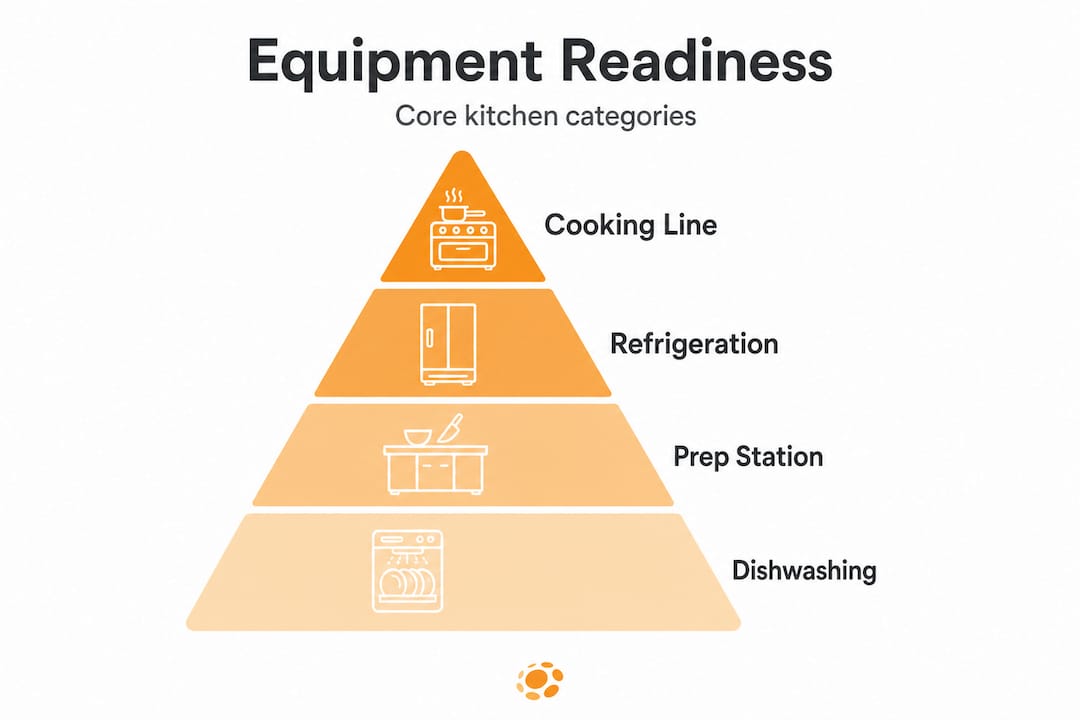
    Browse restaurant space for lease on PepperLot.