
TL;DR:
- NNN leases require tenants to pay property taxes, insurance, maintenance, and other operating costs directly.
- Restaurant-specific NNN expenses include grease trap cleaning, hood maintenance, and high HVAC costs, increasing overall risk.
- Careful lease review, expense caps, and ongoing monitoring are essential to avoid unexpected costs and protect margins.
Signing an NNN lease sounds straightforward until the first year-end reconciliation lands on your desk and your total occupancy cost is 35% higher than you budgeted. Many restaurant operators walk into triple net deals assuming the label tells the whole story. It doesn’t. The fine print determines who fixes the grease trap, who absorbs a property tax hike, and who pays when the HVAC fails in July. Getting these details right before you sign isn’t just good practice. It’s the difference between a profitable location and one that quietly drains your margins for years.
Table of Contents
- What is an NNN lease? Definitions and essentials
- Unique features of NNN leases for restaurants
- Pros and cons: Restaurant operator and owner perspectives
- How to negotiate and manage an NNN lease effectively
- Why most restaurants underestimate NNN lease risks
- Find the right restaurant lease for your next venture
- Frequently asked questions
Key Takeaways
| Point | Details |
|---|---|
| NNN means more responsibility | Restaurant tenants pay not just rent but real estate taxes, insurance, and property maintenance. |
| Costs can vary widely | Base rent may be lower, but total occupancy is often higher and rises with uncapped expenses. |
| Negotiation is critical | Clarifying definitions and setting expense caps can prevent nasty surprises down the road. |
| Owners gain steady income | Property owners enjoy less management and more predictable cash flow under NNN structures. |
| Lease language beats labels | Always study what ‘NNN’ covers in your agreement, labels often don’t match real obligations. |
What is an NNN lease? Definitions and essentials
The term “triple net” gets used casually in commercial real estate, but its meaning shifts depending on the lease in front of you. At its core, a triple net lease is a commercial real estate agreement where the tenant pays base rent plus property taxes, building insurance, and maintenance costs, the three “nets,” along with utilities and often common area maintenance (CAM) fees in multi-tenant settings. The word “net” means the landlord receives rent that is net of those expenses. The tenant absorbs them directly.
This structure stands in contrast to a gross lease, where the landlord bundles all expenses into one rent figure and manages them independently. A modified gross lease splits the difference, with some costs included in rent and others passed through to the tenant. For restaurant operators, restaurant leasing basics matter here because the cost exposure in an NNN structure is significantly higher and more variable than most operators initially realize.
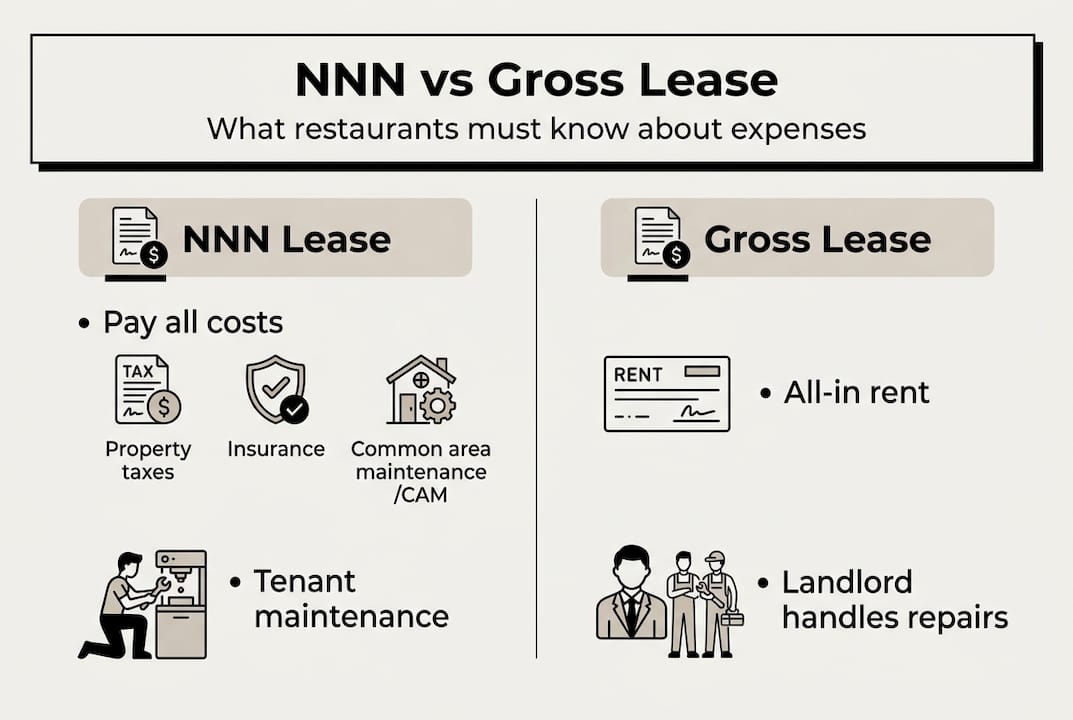
| Cost type | NNN lease | Gross lease | Modified gross lease |
|---|---|---|---|
| Base rent | Tenant | Tenant | Tenant |
| Property taxes | Tenant | Landlord | Split/negotiated |
| Building insurance | Tenant | Landlord | Split/negotiated |
| Maintenance/repairs | Tenant | Landlord | Split/negotiated |
| Utilities | Tenant | Often included | Often tenant |
| CAM fees | Tenant | Landlord | Varies |
The key takeaway: in a true NNN lease, you are essentially operating as if you own the building without the equity benefit of ownership. Everything that keeps the property running lands on your budget.
- Property taxes: can increase annually based on local assessments, often beyond your control
- Building insurance: covers the structure itself, separate from your own business liability coverage
- Maintenance: includes HVAC systems, parking lots, plumbing, and structural elements unless specifically excluded
- CAM fees: apply in shared retail centers and cover shared spaces like parking areas and landscaping
Pro Tip: Before signing any NNN lease, ask the landlord for a full expense history going back three years. What you see will tell you more than any broker ever will.
One important note: a real-world restaurant lease rarely matches the textbook definition exactly. Some leases labeled NNN exclude roof repairs. Others cap CAM increases. The label is a starting point, not a guarantee.
Unique features of NNN leases for restaurants
Retail tenants deal with NNN leases too, but restaurants face a distinct category of risk. The physical demands of a food service operation create maintenance expenses that a clothing store never encounters.

Consider a quick-service restaurant (QSR) scenario. A 5,000 square foot QSR at $30 per square foot base rent runs $150,000 per year in base rent alone. Add property taxes, insurance, CAM, HVAC maintenance, and utilities, and total occupancy costs can climb well above $200,000 annually. Franchisees operating brands like McDonald’s or Taco Bell often face exactly this math.
What makes restaurants different from standard retail tenants:
| Obligation | Restaurant NNN tenant | Retail NNN tenant |
|---|---|---|
| Grease trap cleaning | Yes, frequently | Not applicable |
| Hood/exhaust maintenance | Yes, required | Not applicable |
| HVAC wear and tear | Heavy, high-frequency | Moderate |
| Plumbing demands | Intensive (3-compartment sinks) | Standard |
| Health code compliance | Ongoing tenant responsibility | Not applicable |
| Structural exclusions | Often roof, parking | Often roof only |
Restaurant-specific operating expense examples show just how quickly costs accumulate when you factor in commercial kitchen requirements. Grease traps need cleaning every one to three months depending on volume. Hood systems require semi-annual professional inspections for fire code compliance. These are not optional line items.
Here are the key operator risks you need to model before signing:
- Variable tax hikes: Local property tax reassessments can spike suddenly, and NNN tenants absorb those increases directly.
- Uninsured maintenance: Some repairs fall outside the landlord’s insurance and outside the tenant’s policy, leaving a gray zone.
- HVAC replacement costs: A full commercial HVAC replacement can cost $15,000 to $40,000 and may fall entirely on the tenant.
- Lease language gaps: Exclusions buried in exhibits can shift roof and structural costs to you unexpectedly.
- Reconciliation surprises: End-of-year CAM reconciliations can result in large lump-sum payments if estimates were low.
Rising taxes and insurance alone can add 20 to 30 percent to your costs over a lease term if there are no caps negotiated. For a restaurant operating on 10 to 15 percent net margins, that kind of swing isn’t just uncomfortable. It can be the difference between staying open and closing.
Looking at a real NNN lease case study helps ground these numbers in practice before you commit to a specific location.
Pros and cons: Restaurant operator and owner perspectives
NNN leases didn’t become the dominant structure for freestanding restaurant properties by accident. They offer real advantages, but those advantages flow differently depending on which side of the transaction you’re on.
For landlords, the appeal is straightforward. Passive income with predictable cash flow and minimal management responsibility makes NNN leases attractive to investors who want real estate exposure without active property management. A landlord with a 15-year NNN lease to a national QSR brand essentially owns a bond with a building attached.
For restaurant operators, the calculus is more complicated. You gain control over your own maintenance standards and can often negotiate longer terms that protect your investment in build-out and equipment. But you absorb all the variability.
Operator pros:
- Control over maintenance quality and vendor selection
- Potentially lower base rent compared to gross lease equivalents
- Long-term lease security supports investment in the space
- Ability to negotiate specific exclusions (roof, structure) to limit exposure
Operator cons:
- Unpredictable total occupancy costs year to year
- Requires in-house or contracted facilities management expertise
- Large capital reserves needed for major system replacements
- CAM reconciliation disputes with landlords are common
Property owner pros:
- Low management overhead
- Stable, long-term income stream
- Tenant absorbs inflation-driven cost increases
Property owner cons:
- If the tenant fails financially, vacancy risk is high
- Deferred maintenance by tenants can damage property value
- Refinancing or selling depends heavily on tenant credit quality
“Lease language trumps label. An NNN lease may exclude the roof entirely. Always abstract every key term before you sign anything.”
Understanding whether an NNN deal fits your operation requires comparing it honestly against alternatives. The restaurant sale vs. lease decision also shapes whether NNN exposure is worth it relative to your capital structure. And if you’re considering subleasing part of your space later, knowing your assignment vs. sublease rights matters just as much as the NNN terms themselves.
Pro Tip: Always negotiate expense caps on property taxes and insurance increases. Even a 5% annual cap can save tens of thousands over a 10-year lease term.
How to negotiate and manage an NNN lease effectively
Knowing the risks is only useful if you act on them. Here’s a practical sequence for handling NNN negotiations and ongoing management.
Before you sign:
- Itemize every expense: Request a full written breakdown of what the NNN covers and what it excludes. Do not rely on verbal summaries.
- Clarify each party’s responsibility: Confirm in writing who handles roof, parking lot, structural walls, HVAC units, and plumbing.
- Negotiate expense caps: Push for annual caps on tax and insurance pass-throughs, typically 3 to 5 percent per year.
- Check for exclusions: Ask specifically whether roof, foundation, and exterior walls are included or excluded from your obligations.
- Review CAM calculations: Understand how the landlord calculates your share in a multi-tenant center. Management fees buried in CAM are common.
After you sign:
- Build a maintenance schedule: Document every critical system, its age, and its expected replacement timeline. Budget accordingly.
- Reconcile annually: Review landlord-provided expense statements against actual invoices every year. Billing errors happen regularly.
- Track tax assessments: Monitor local property tax records so you’re not blindsided by increases before they hit your monthly statement.
- Negotiate HVAC clauses: Older buildings often have aging systems. Push for landlord responsibility on full replacements above a certain dollar threshold.
Following these lease term best practices protects you both at signing and throughout the term. And reviewing real lease examples gives you a concrete sense of how these terms appear in actual documents.
A solid NNN lease checklist confirms that lease language ultimately controls everything. The label “NNN” can mean very different things in two leases side by side.
Pro Tip: Preventive maintenance isn’t optional under an NNN lease. Skipping scheduled service on grease traps or hood systems can trigger health code violations that close your doors faster than any rent dispute.
Why most restaurants underestimate NNN lease risks
Here’s an uncomfortable truth: most operators who struggle with NNN leases didn’t miss the numbers. They trusted the label.
The term “NNN” sounds clean and defined. It isn’t. We’ve seen operators sign leases assuming “triple net” covers everything in a clear formula, only to discover mid-term that roof repair costs weren’t included or that CAM reconciliations included management fees no one mentioned at signing.
The real failure mode isn’t ignorance of NNN mechanics. It’s the assumption that all NNN leases are the same. Labels in commercial real estate are shorthand, not contracts. The actual lease challenges that sink operators are almost always buried in exhibits and addenda, not the main lease body.
Survivors in this industry treat annual lease reviews as seriously as they treat P&L reviews. They build margin cushions for tax and insurance spikes. They add service contracts for HVAC and grease traps before problems arise. They question every line on a CAM reconciliation statement. This isn’t paranoia. It’s the operational discipline that separates operators who thrive from those who get surprised into closure.
Find the right restaurant lease for your next venture
Now that you understand what NNN leases actually cost and how to protect yourself, the next step is finding the right space under the right terms.
Pepperlot lists restaurant spaces for lease with the details that actually matter: grease trap specs, hood systems, seating capacity, parking, and existing permits. No generic commercial listings that make you dig for restaurant-relevant information. You can also use Pepperlot’s location intelligence tools to analyze local competition, demographics, and demand before you commit to any location. Smarter site selection starts before the lease negotiation, and having the right data changes every conversation with a landlord.
Frequently asked questions
What does a restaurant NNN lease typically include?
A restaurant NNN lease requires you to pay base rent, property taxes, building insurance, maintenance, utilities, and often CAM fees on top of your base rent figure.
Is NNN leasing better for landlords or restaurant tenants?
NNN leases typically favor landlords with passive income and minimal management needs, but restaurant tenants who negotiate caps and exclusions can still structure favorable deals.
Do NNN restaurant leases always include all repairs?
No. Lease language controls what’s included, and many NNN leases specifically exclude roof, foundation, or certain HVAC replacement costs from tenant obligations.
How can operators protect against rising NNN costs?
Negotiate annual expense caps on taxes and insurance, clarify all exclusions in writing, and budget for 20 to 30 percent cost increases over a multi-year lease term as a conservative baseline.
Recommended
- Restaurant Lease Terms Explained: Secure Your Ideal Space
- Step-by-step workflow for subleasing your restaurant space
- Restaurant sale vs. lease: 4 key differences for success
- Restaurant Lease Assignment vs Sublease Explained | PepperLot Blog
- What is PPC for restaurants? A practical guide for owners | Sorbey Blog | Sorbey
Browse restaurant space for lease on PepperLot.
Leave a Reply