
TL;DR:
- Most restaurant sales fail or stall when sellers are unprepared, risking lower offers or deal failure. Proper organization of documents, financials, legal paperwork, and operational readiness significantly improves sale confidence and value. Early planning and strategic preparation help sellers tell a compelling story, attract credible buyers, and facilitate a smooth transaction process.
Most restaurant sales that fall apart, stall, or close at a discounted price share one common factor: the seller wasn’t ready. Buyers and their attorneys move fast once interest is confirmed, and any gap in your documentation, financials, or legal paperwork becomes leverage against you. A disorganized seller signals risk, and risk means lower offers or no offer at all. This guide walks you through every critical preparation step, from building your due diligence package to structuring the deal for tax efficiency, so you can sell confidently and at full value.
Table of Contents
- Organize your documents and build a due diligence gameplan
- Build a buyer-ready financial stack
- Get your lease, licenses, and legal documentation in order
- Tax strategy and deal structuring for a smooth sale
- Operational readiness: set up for a turnkey hand-off
- Our perspective: what most sellers overlook when preparing a restaurant for sale
- Looking for a seamless restaurant sale or acquisition?
- Frequently asked questions
Key Takeaways
| Point | Details |
|---|---|
| Start due diligence early | Early organization reduces stress and increases your likelihood of a successful sale. |
| Prepare robust financials | Three years of clean, reconciled financial records build buyer confidence and maximize price. |
| Legal documents are critical | Leases, licenses, and consents make or break the ability to transfer your restaurant efficiently. |
| Validate your sale strategy with professionals | Tax advisors and experienced brokers help you avoid costly mistakes in deal structure. |
| Turnkey operations boost appeal | Buyers want to step in and succeed immediately, so systems and staff matter. |
Organize your documents and build a due diligence gameplan
The single biggest mistake sellers make is treating due diligence as something that happens after they receive an offer. By then, you’re scrambling to pull together three years of records while a serious buyer waits and loses confidence. The smarter approach is to treat your sell-side readiness as a structured project with clear ownership, timelines, and a secure data room before you ever market the restaurant.
Think of it like staging a property before listing it. The preparation happens first, not after the first showing. Assign someone, whether that’s your bookkeeper, attorney, or a transaction advisor, to own the documentation process. Set realistic deadlines. A typical diligence preparation process takes 60 to 90 days when done properly.
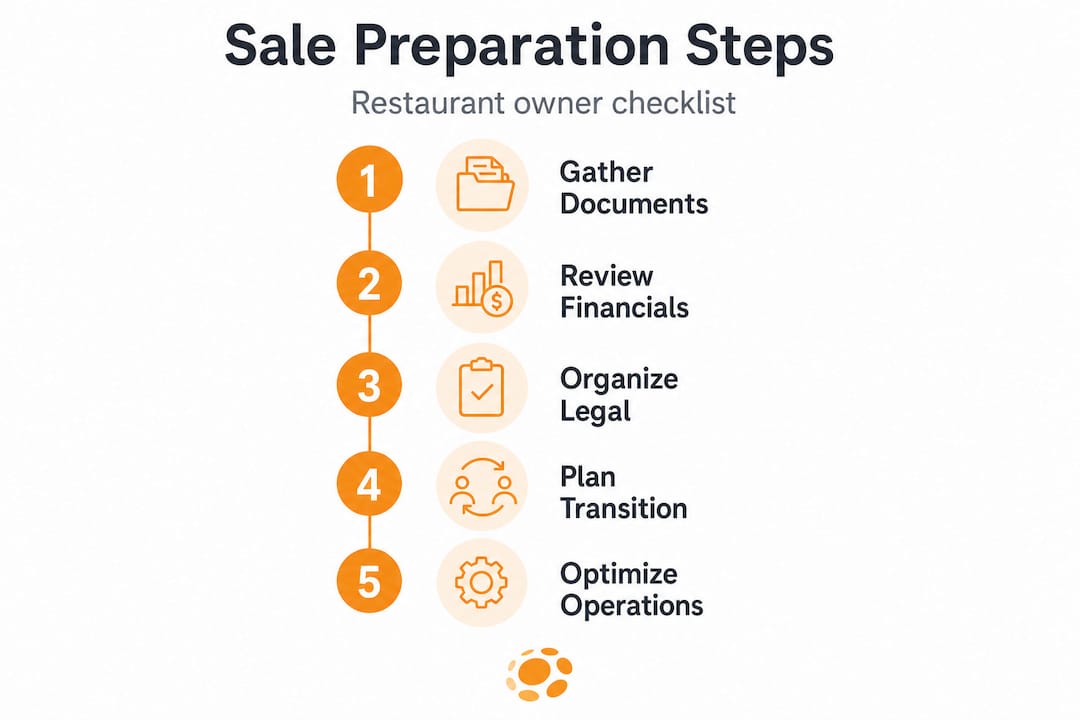
Your data room should be organized, clearly labeled, and accessible to authorized parties only. If you’re selling a restaurant in California or any competitive market, buyers expect professional presentation from day one.
Here’s a foundational document checklist to start with:
- Three years of profit and loss statements (P&Ls)
- Three years of federal and state tax returns
- Monthly POS (point of sale) sales reports by category
- Merchant processing statements (credit card sales reconciliation)
- Payroll records and employee census
- Equipment list and maintenance logs
- Current lease and all amendments
- Business licenses and permits
Understanding what buyers look for in a restaurant goes beyond just good revenue numbers. Buyers want to see that your records are consistent, complete, and trustworthy. A mismatch between your tax returns and P&Ls, for example, raises a red flag that’s very hard to erase.
| Document category | Recommended lookback period | Common gaps |
|---|---|---|
| P&Ls | 3 years minimum | Missing months, cash adjustments |
| Tax returns | 3 years minimum | Discrepancy with P&L income |
| POS reports | 2 to 3 years | Voided transactions, category gaps |
| Merchant processing | 2 to 3 years | Mismatch with reported sales |
| Payroll records | 2 years | Unreported staff, contractor mix-ups |
Pro Tip: Create a master checklist with checkboxes and assign a status (complete, in progress, missing) to each item. This keeps your team accountable and shows buyers that you take the sale seriously.
Build a buyer-ready financial stack
Having organized documents sets you up for the next crucial component: demonstrating the restaurant’s true earnings through bulletproof financials. This is where most sellers either win or lose their deal.

A buyer-ready financial stack means more than just handing over PDFs. It means providing reconciled, clearly annotated financials that walk the buyer from your P&L revenue line straight to your tax return, with every variance explained. Add-backs, also called normalizations, are adjustments that remove owner-specific or one-time expenses to show what the business truly earns for a new operator.
Common add-backs include owner salary above market, personal vehicle expenses run through the business, a one-time renovation cost, or a non-recurring legal fee. Each one needs documentation. Buyers and their lenders will not take your word for it.
Here’s the difference between a strong and weak financial package at a glance:
| Element | Strong package | Weak package |
|---|---|---|
| P&L to tax reconciliation | Fully tied, variances explained | Gaps unexplained |
| Add-back documentation | Receipts and memos attached | Verbal explanation only |
| Year-over-year trends | Narrative explaining changes | Numbers without context |
| Merchant processing | Matches reported card sales | Statements missing or partial |
| EBITDA/SDE normalization | Clearly computed, footnoted | Not addressed |
EBITDA stands for earnings before interest, taxes, depreciation, and amortization. SDE, or seller’s discretionary earnings, adds back the owner’s compensation and personal expenses. These are the two most common metrics buyers and lenders use to value a restaurant, and you must normalize earnings so that every line item makes sense to someone who wasn’t running your business.
Follow this sequence to build a clean financial stack:
- Start with three years of finalized P&Ls from your accounting software.
- Pull matching federal tax returns and identify every line that differs from the P&L.
- Create a reconciliation memo for each year that explains each variance.
- List every add-back with the dollar amount, description, and supporting documentation.
- Calculate normalized EBITDA and SDE with a clear, single-page summary.
- Attach payroll records and merchant processing statements that cross-reference the P&L.
Think about optimizing your restaurant’s presentation for sale not just physically, but financially. A clean, annotated financial package tells buyers you have nothing to hide, which directly translates to confidence and price.
Pro Tip: If your tax returns show significantly less income than your P&Ls, have your CPA draft a brief letter explaining the legitimate accounting differences. This one document can prevent a buyer from walking during diligence.
Get your lease, licenses, and legal documentation in order
With your finances buttoned up, attention turns to the documents that control whether a buyer can actually operate your restaurant. You could have perfect financials and a motivated buyer, but if the lease can’t be assigned or a key license isn’t transferable, the deal dies anyway.
Here are the critical documents to gather and verify:
- Executed lease and all amendments or addenda
- Landlord contact and assignment or consent clause language
- Health department permit and expiration date
- Liquor license status, transferability, and renewal timeline
- Signage permit and any outdoor seating approval
- Certificate of occupancy
- Business license from the city or county
- Any franchise disclosure document or franchise agreement, if applicable
- Food handler certifications and any recent inspection reports
Pay close attention to the lease assignment considerations in your lease. Many leases require landlord consent for any transfer of the business. Some give the landlord the right to recapture the space instead of approving an assignment. That clause alone can end a sale, and the time to discover it is before listing, not mid-deal.
Understanding the full leasing process for restaurant owners is essential background for navigating these clauses effectively. Start your landlord relationship early. Notify them early that you intend to sell, gauge their cooperation level, and negotiate if needed.
“The most common late-stage deal killers in restaurant sales are not financial. They are operational control issues: a landlord who won’t consent to an assignment, a liquor license that can’t transfer in time, or a permit that expired two years ago and nobody noticed. Every one of these is preventable with an extra 60 days of preparation.”
Build the legal-transfer package early in the process so that when a buyer’s attorney asks for the lease on day one of diligence, you send it within hours, not days.
Tax strategy and deal structuring for a smooth sale
Once legal documentation is organized, you must prepare for negotiations by understanding what deal structure will be most advantageous and least risky for you. This is a step most sellers skip until they’re already in a signed letter of intent, and by then, your options are narrowed.
The two primary sale structures are an asset sale and a stock or membership interest sale. In an asset sale, the buyer purchases specific assets: equipment, goodwill, lease rights, and the business name. In a stock sale, they purchase your actual legal entity. Each has very different implications.
Key tax and deal-structure considerations to work through before you list include:
- Whether you’re selling assets or the entity, and who benefits from each structure
- How purchase price allocation across goodwill, equipment, and other assets affects your taxes
- Whether depreciation recapture applies to any of your equipment or leasehold improvements
- State-specific sales tax or transfer tax obligations on restaurant assets
- Whether a seller note or earnout is part of your deal and how it’s taxed
- Capital gains treatment vs. ordinary income on various asset categories
- The impact of deal structure on buyer financing approval and loan eligibility
Most buyers prefer asset sales because they inherit a clean slate without taking on the entity’s historical liabilities. Most sellers, depending on their entity structure, may prefer a stock sale for tax reasons. Your final answer depends on your specific setup, and getting restaurant asset sale guidance early helps you walk into negotiations with clarity rather than confusion.
Pro Tip: Before you set your asking price or accept a letter of intent, run your deal structure by both a CPA with restaurant transaction experience and a business attorney who handles buy-sell agreements. The cost of that consultation is a fraction of what a poorly structured deal can cost you in taxes alone.
Operational readiness: set up for a turnkey hand-off
The best-prepared sellers go beyond documentation by focusing on what enables the new owner to step in seamlessly. Buyers, especially first-time restaurant operators, will pay a premium for a business they can run on day one. Sellers who make that easy for them win higher multiples and faster closes.
The goal here is what industry advisors call “turnkeyability.” According to expert guidance on day-one operational readiness, the most valuable restaurants are those where buyers can step in without a chaos period.
Here’s how to build that:
- Stabilize key staff. Identify your most critical employees and ensure they’re likely to stay through and after the transition. Consider retention bonuses timed to the close date.
- Document your standard operating procedures. Write out opening and closing checklists, food prep processes, vendor ordering schedules, and any specialized techniques unique to your concept.
- Document recipes and training materials. If your food is the product, the buyer needs to be able to replicate it without you standing in the kitchen.
- Create a complete FF&E inventory. FF&E stands for furniture, fixtures, and equipment. Every major item should be listed with its age, model, condition, and last service date.
- Pull maintenance and compliance records. Hood cleaning logs, grease trap service records, pest control receipts, and equipment repair history should all be compiled.
- Prepare a transition plan. Outline what you’ll do post-signing to transfer vendor relationships, introduce the buyer to staff, and hand over digital accounts like your POS, Google Business Profile, and reservation system.
These steps matter for restaurant sale preparation across every market and concept type. A taco counter with clean SOPs and a retained kitchen manager is worth more to a buyer than a fine dining restaurant where all institutional knowledge lives in the owner’s head.
Pro Tip: Build a short transition plan document, just one to two pages, outlining your first 30 days of post-close support. Offering 30 days of consulting post-sale is a powerful way to increase buyer confidence and justify a higher asking price.
Our perspective: what most sellers overlook when preparing a restaurant for sale
Here is the uncomfortable truth: most restaurant sellers treat preparation as a compliance checklist rather than a strategic advantage. They gather the documents because they have to, not because they see diligence as a storytelling opportunity.
The sellers who get the highest prices and fewest renegotiations are the ones who actively manage the buyer’s narrative from day one. They know exactly which add-backs are defensible, they’ve pre-cleared the landlord’s consent, and they’ve thought through how their earnings story holds up under scrutiny. They don’t wait for a buyer’s attorney to discover gaps. They close those gaps first.
One area that deserves more attention is confidentiality. Poor organization and early leaks can erode staff morale, spook suppliers, and alert competitors before you’re ready. Marketing a restaurant for sale requires a structured, controlled approach: non-disclosure agreements before any financials are shared, a teaser document that highlights the opportunity without identifying the business, and a serious buyer screening process.
We’ve seen deals crater not because of bad financials, but because a seller mentioned the sale to the wrong person, which spooked the staff, which made the buyer question stability. The right buyer for your restaurant is not just the highest bidder. It’s the most credible operator who can close fast, satisfy a landlord, and carry the brand forward.
Think like a buyer when reviewing your own package. Ask yourself: if I were putting my own money into this deal, what would make me nervous? Then fix those things before anyone else sees them.
Looking for a seamless restaurant sale or acquisition?
Whether you’re ready to list your restaurant or actively searching for the right acquisition, preparation alone isn’t enough. You need the right platform to connect with serious, buyers who are ready to move and operators.
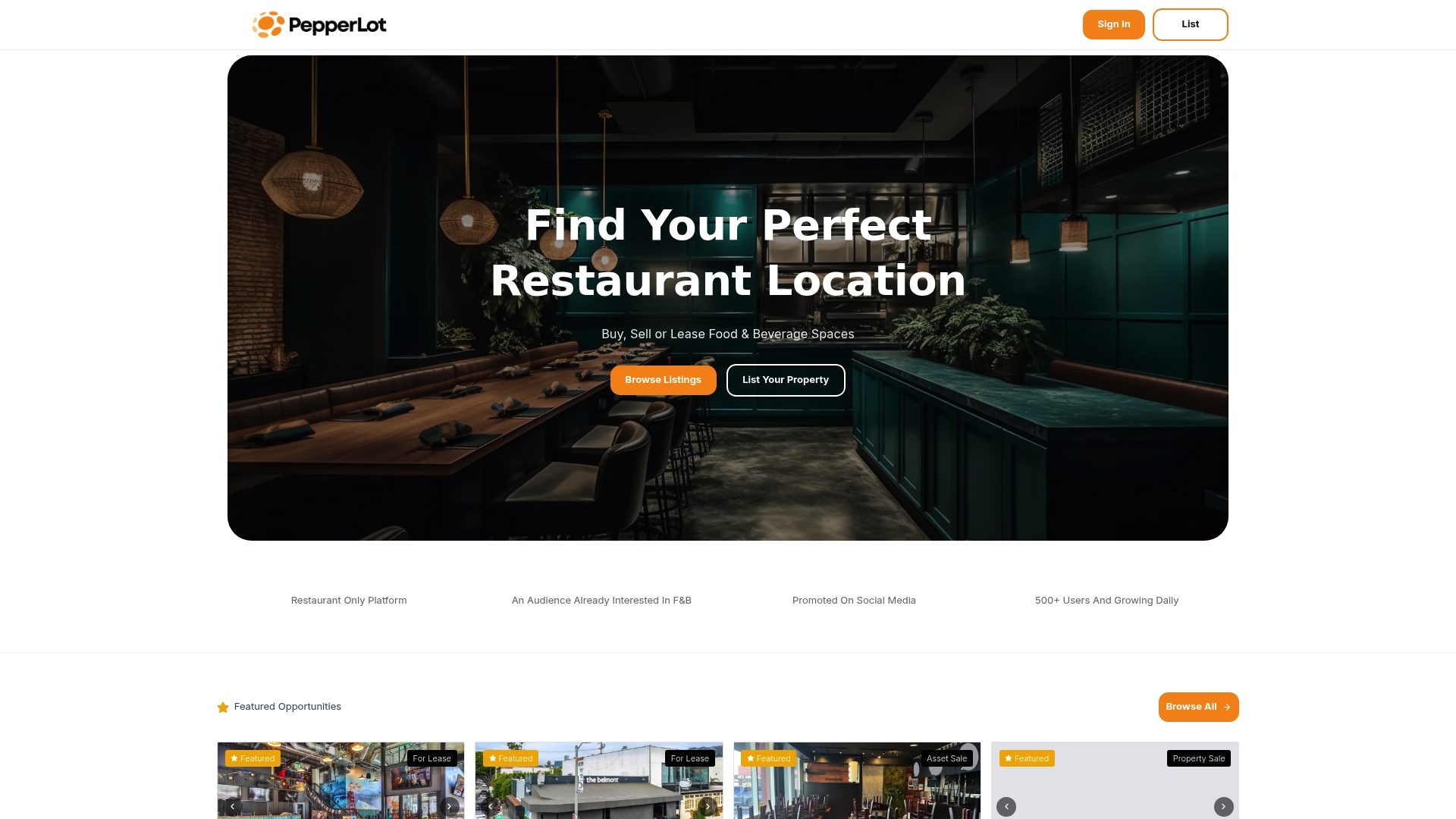
Pepperlot is built exclusively for restaurant real estate built specifically for restaurant and F&B real estate transactions. Browse live opportunities like a full restaurant for sale in Inglewood or explore sub-lease opportunities in Los Angeles with all the restaurant-specific details you need: equipment included, lease terms, seating capacity, and permit status. The Pepperlot platform gives sellers targeted visibility to a network of over 500 active operators, landlords, and brokers, so your listing reaches exactly the right audience without the noise of a generic commercial real estate portal.
Frequently asked questions
How early should I start preparing my restaurant for sale?
Start at least six months before your target listing date to allow time to gather documents, address financial gaps, and resolve any lease or permit issues. Starting sell-side readiness early and organizing a diligence workplan before marketing significantly reduces deal risk.
What financial documents do buyers expect to see?
Buyers expect three years of P&Ls, balance sheets, tax returns, POS reports, and merchant processing statements at minimum. A buyer-ready financial stack that includes reconciliations and normalized earnings signals a credible, organized seller.
Why do lease and licenses matter so much in a sale?
Leases and licenses are what give a buyer the legal right to operate the restaurant after closing, making them non-negotiable deal components. Building the lease and licensing package early prevents last-minute failures caused by non-transferable permits or landlord refusals.
How does my choice of asset sale vs. stock sale affect taxes?
An asset sale typically triggers depreciation recapture and different capital gains treatment across individual asset categories, while a stock sale may offer more favorable tax outcomes depending on your entity type. Tax and deal-structure planning before listing lets you negotiate from an informed position rather than reacting mid-deal.
What increases the value of my restaurant in a sale?
Stable staff, documented SOPs, clean and normalized financials, and organized legal records all directly increase perceived value and buyer confidence. Investing in day-one operational readiness signals to buyers that the business runs on systems, not just the owner’s personal involvement.
Recommended
- How to Buy a Restaurant: A Step-by-Step Guide for First-Time Buyers | PepperLot Blog
- How to Sell a Restaurant Space in California, The Complete Guide for Owners and Investors | PepperLot Blog
- Step-by-step guide to buying restaurant property – Pepperlot Blog
- Restaurants for Sale: How to Find the Right Opportunity | PepperLot Blog
Browse sell a restaurant on PepperLot.
Leave a Reply