
TL;DR:
- Hiring a specialized restaurant broker reduces transaction friction by leveraging industry-specific knowledge, network access, and deal management expertise.
- They add value by handling valuation, marketing to buyers who are ready to move, negotiating terms, and addressing permit and lease issues early, ensuring smoother closings.
- Choosing the right advisor depends on deal complexity and size, with restaurant brokers ideal for single-unit sales and M&A advisors suited for multi-unit or franchise transactions.
Buying or selling a restaurant property without the right guidance is one of the most expensive mistakes you can make in the hospitality business. Unlike standard commercial real estate, restaurant transactions involve layers of complexity: equipment valuations, health department permits, grease trap inspections, lease assignment clauses, and liquor license transfers, all stacked on top of typical property negotiations. Many operators and investors walk into these deals thinking a general real estate agent will be enough. They’re usually wrong. This guide breaks down exactly what a restaurant broker does, how they create measurable value, and how to choose the right advisor for your specific transaction.
Table of Contents
- Defining the role: What is a restaurant broker?
- How restaurant brokers create value for buyers and sellers
- Choosing the right advisor: Restaurant broker vs. business broker vs. M&A advisor
- What to expect: The restaurant brokerage process from start to finish
- Our take: What most experts miss about restaurant brokerage
- Find your next opportunity with expert restaurant brokerage
- Frequently asked questions
Key Takeaways
| Point | Details |
|---|---|
| Specialized expertise | Restaurant brokers possess unique experience and connections that general agents lack. |
| Increased deal success | Brokers manage every stage for faster, less risky closings and fewer failed deals. |
| Advisor fit matters | Pick the right advisor, restaurant broker, business broker, or M&A advisor, based on your deal’s scale and complexity. |
| Step-by-step process | A clear brokerage process helps owners and buyers move from listing to closing with fewer surprises. |
| Leverage early and often | Involve your broker early for best results and ongoing market intelligence. |
Defining the role: What is a restaurant broker?
After outlining the purpose of this guide, it’s crucial to answer the basic and most misunderstood question: what exactly does a restaurant broker do?
A restaurant broker is a specialized intermediary who facilitates the buying, selling, and leasing of restaurant properties and food and beverage businesses. They are not generic real estate agents who occasionally list a diner. They are industry insiders who understand the specific mechanics of restaurant transactions from the ground up. As the Pepperlot Blog notes, restaurant brokers specialize in food and beverage business transactions, offering industry-specific connections and insights that general agents simply can’t match.
So what separates them from a typical real estate agent or even a general business broker?
- Industry-specific knowledge: A restaurant broker understands local health codes, zoning classifications, commercial kitchen requirements, and the often complex world of lease assignments. They know whether a space’s hood ventilation system meets fire code or whether the grease interceptor needs replacement before a sale closes.
- Property valuation expertise: They can assess a restaurant’s value based on real metrics like adjusted EBITDA (earnings before interest, taxes, depreciation, and amortization), equipment condition, and transferability of permits, not just square footage and location.
- Marketing to the right audience: They reach buyers who are actually serious and interested in food service businesses, not general investors browsing commercial listings.
- Deal management: From listing to closing, they coordinate negotiations, legal steps, lease transfer approvals, and licensing transitions.
- Network access: Their professional network spans potential buyers, operators, equipment vendors, attorneys, and landlords, all critical in a niche where relationships close deals.
“A restaurant broker isn’t just a middleman. They’re an industry translator who helps both sides speak the same language and avoid the costly misunderstandings that kill restaurant deals.”
Understanding the different restaurant real estate listing types is also essential context, since the broker’s role shifts depending on whether the deal involves a full asset sale, a lease assignment, or a ground-up buildout.
How restaurant brokers create value for buyers and sellers
Now that you know what a restaurant broker is, let’s explore how they deliver real-world value to both buyers and sellers.

The clearest way to think about broker value is this: they reduce friction. Every step of a restaurant transaction has friction points, documentation gaps, pricing disputes, unqualified buyers, lease complications, and permit roadblocks. A skilled broker systematically addresses each one.
Here’s how the process typically unfolds for both sides:
- Pre-listing preparation: For sellers, a broker conducts an initial valuation review, identifies gaps in documentation, and advises on presentation strategy to attract serious buyers. They’ll tell you if your asking price is realistic or if a specific equipment upgrade would increase your sale value before going to market.
- Targeted marketing: Rather than broadcasting to the general public, brokers leverage their networks and restaurant-only listing platforms to surface pre-serious candidates. This is especially valuable in confidential sales where you don’t want staff or competitors to know the business is on the market.
- Candidate screening: Brokers vet buyers for financial capacity, industry experience, and intent before anyone gets near your financials. This protects sellers from wasting time with tire-kickers and protects buyers from being taken seriously only to lose a deal at due diligence.
- Negotiation management: This is where significant value gets created or destroyed. A specialized broker’s connections and expertise can lead to faster closings and fewer deal failures, because they know which terms are negotiable and which are deal-breakers in restaurant-specific contexts.
- Due diligence and closing coordination: Restaurant transactions often hit snags during due diligence because buyers discover unresolved permit issues or equipment liabilities. Brokers who see these issues coming early can structure deals to address them before they become reasons to walk away.
Pro Tip: In competitive urban markets, experienced restaurant brokers often have access to “off-market” deals that never appear on any public listing. These opportunities exist because sellers want discretion and brokers with active networks are the first call. If you’re a buyer and you’re only searching public platforms, you’re seeing a fraction of what’s actually available.
The financial stakes justify the investment in expertise. Restaurant transaction timelines vary widely, but those managed by a specialist broker consistently close with fewer contingencies and more predictable outcomes than those handled by general agents or attempted without representation.
Choosing the right advisor: Restaurant broker vs. business broker vs. M&A advisor
Not all transactions, or advisors, are created equal. Let’s break down how to choose the right representation for your restaurant deal.
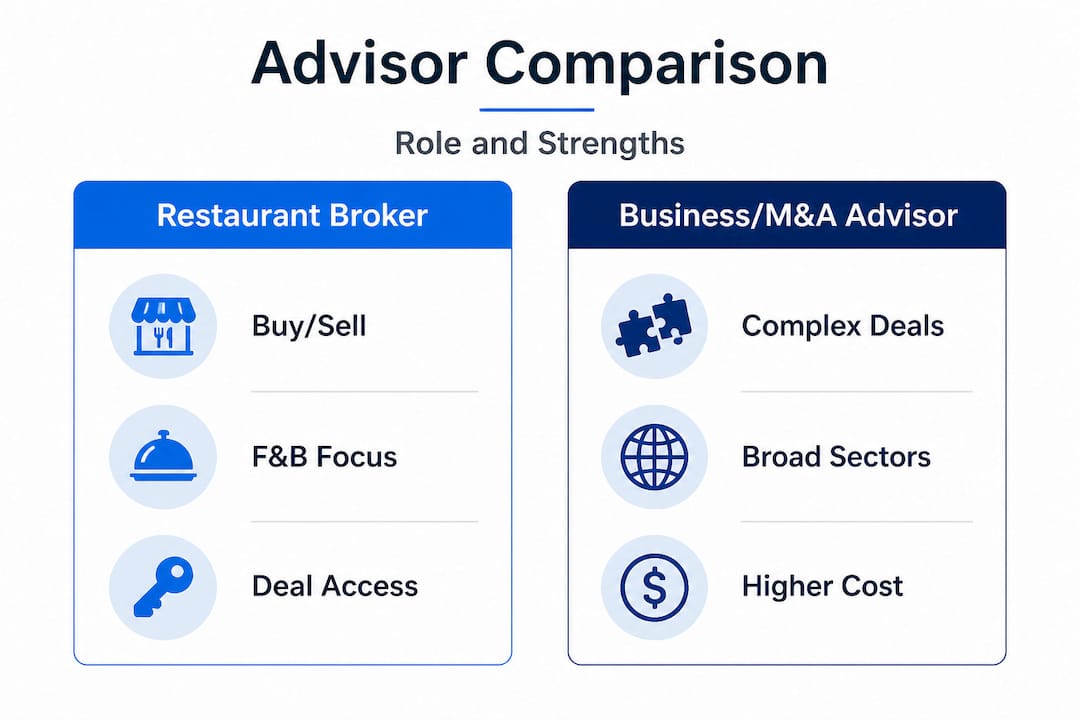
One of the most common and expensive mistakes restaurant operators make is hiring the wrong type of advisor for their deal size and complexity. Here’s a clear breakdown of the three main categories.
| Advisor type | Best for | Core strengths | Typical cost structure | Deal complexity |
|---|---|---|---|---|
| Restaurant broker | Single-unit sales, leases, asset transfers | Industry network, local market knowledge, niche expertise | Commission on sale price (typically 8-12%) | Low to medium |
| Business broker | Small single-location businesses with limited F&B focus | General business valuation, buyer sourcing | Commission on sale price (typically 10-12%) | Low |
| M&A advisor | Multi-unit groups, chains, franchise portfolios | Process rigor, competitive buyer process, institutional relationships | Retainer plus success fee | High |
Smaller, single-unit transactions fit the business broker model, while more complex, multi-unit or group transactions benefit from an M&A advisor with process-driven capabilities. Choosing the wrong tier is costly in both directions. Hiring an M&A firm for a two-location taco spot will mean high fees and a process designed for institutional buyers who aren’t interested in small deals. Hiring a general business broker to sell a 12-location casual dining group will mean an under-resourced process that undervalues the business and misses the right buyer pool.
When evaluating your options, consider these key factors:
- Number of locations: One to three units usually fits the restaurant broker or business broker model. Four or more locations, especially with a brand or franchise element, typically calls for an M&A advisor.
- Buyer type: Operators looking for individual units are best reached by restaurant brokers. Private equity firms or strategic acquirers require the institutional presentation an M&A advisor provides.
- Timeline and confidentiality needs: Restaurant brokers often manage tighter timelines with a focused, discreet approach suited to owner-operated businesses.
- Complexity of assets: If the deal involves real estate ownership (not just a lease), significant equipment, multiple licenses, or franchise rights, you need an advisor with specific experience in all of those layers.
Spending time understanding the full range of restaurant listing types before selecting an advisor helps you align expectations and ensures you’re not paying for a process that doesn’t fit your transaction.
What to expect: The restaurant brokerage process from start to finish
Once you’ve chosen the right broker, understanding the typical process helps set realistic expectations and reduces surprises.
A successful restaurant transaction follows a defined sequence of stages, each with its own deliverables, risks, and timelines. Here’s what a complete brokerage engagement looks like.
- Initial consultation (Week 1 to 2): The broker meets with you to understand the asset, your goals, your timeline, and any deal-breaker terms. This is the foundation. Owners who are vague at this stage often create costly confusion later.
- Valuation and pricing (Week 2 to 4): The broker conducts a thorough valuation using industry-standard methods, including EBITDA multiples, asset appraisals, and comparable sales. Restaurant businesses typically sell for 2 to 3 times adjusted EBITDA, though location and brand strength affect this significantly.
- Marketing and listing (Week 4 to 8): The broker creates a confidential information memorandum (CIM), a professional document summarizing the business without revealing its identity publicly. They then market to their network and on relevant platforms.
- Candidate screening and NDAs (Weeks 6 to 10): Interested buyers sign a non-disclosure agreement before accessing financials. The broker screens them for suitability and financial capacity.
- Negotiation and letter of intent (Weeks 8 to 14): buyers who are ready to move submit offers. The broker negotiates key terms including price, asset inclusions, lease assignment, training period, and transition support.
- Due diligence (Weeks 12 to 18): The buyer reviews financials, inspections, permits, and operational records. Most deals that fall apart do so here, usually because of surprises that could have been identified earlier.
- Closing (Weeks 16 to 24): Final legal documents are signed, funds are transferred, licenses and leases are formally assigned, and ownership changes hands.
| Stage | Typical duration | Common sticking points |
|---|---|---|
| Consultation and valuation | 2 to 4 weeks | Unrealistic price expectations |
| Marketing | 4 to 8 weeks | Insufficient documentation |
| Screening and NDAs | 2 to 4 weeks | Unqualified buyer pool |
| Negotiation | 2 to 6 weeks | Lease assignment landlord approval |
| Due diligence | 4 to 6 weeks | Permit gaps, undisclosed liabilities |
| Closing | 2 to 4 weeks | Licensing transfer delays |
The most critical preparation tip: gather your financial statements, lease documents, equipment lists, and permit copies before the first meeting with your broker. Sellers who show up ready move through the process in weeks, not months.
Our take: What most experts miss about restaurant brokerage
Beyond the process and definitions, here’s a candid inside look at what makes or breaks these transactions.
Most articles about restaurant brokers focus on the mechanics: the steps, the fees, the timelines. What gets far less attention is the relational and strategic dimension of brokerage, and frankly, that’s where the real value lives.
The best restaurant brokers we’ve observed in the market function less like transactional agents and more like trusted advisors. They’re the ones who get called first when an operator is thinking about expanding, not just when they’re ready to sell. That distinction matters enormously. When a broker is brought in early, they can shape the strategy around the transaction instead of just executing it. They might advise you to hold off on selling for six months until a lease renewal is secured, which could add significant value. They might identify that a competitor location is coming to market and help you acquire it before it’s listed publicly.
There’s also an uncomfortable truth that most articles gloss over: a one-time transactional relationship with a broker almost always produces worse outcomes than an ongoing advisory relationship. Clients who treat their broker as a single-use service get a single-use result. Those who maintain relationships get access to intelligence, deal flow, and strategic insight that no fee structure officially covers.
The impact of niche platforms in the restaurant space reinforces this point. Brokers who operate within focused industry ecosystems, not generic real estate marketplaces, develop deeper knowledge and better networks precisely because they stay close to their niche. The best client outcomes happen when operators engage brokers who live and breathe the restaurant space, and when they treat that relationship as an ongoing partnership rather than a one-time transaction.
Find your next opportunity with expert restaurant brokerage
Ready to put this knowledge to use? Here’s where expert support meets real-world opportunities.
Pepperlot is built specifically for restaurant and F&B real estate, which means every listing, every tool, and every feature is designed with operators, buyers, and brokers in mind. Whether you’re searching for restaurants for sale or using location intelligence tools to evaluate a new site’s demographic fit, you’re working in a platform that speaks your language.
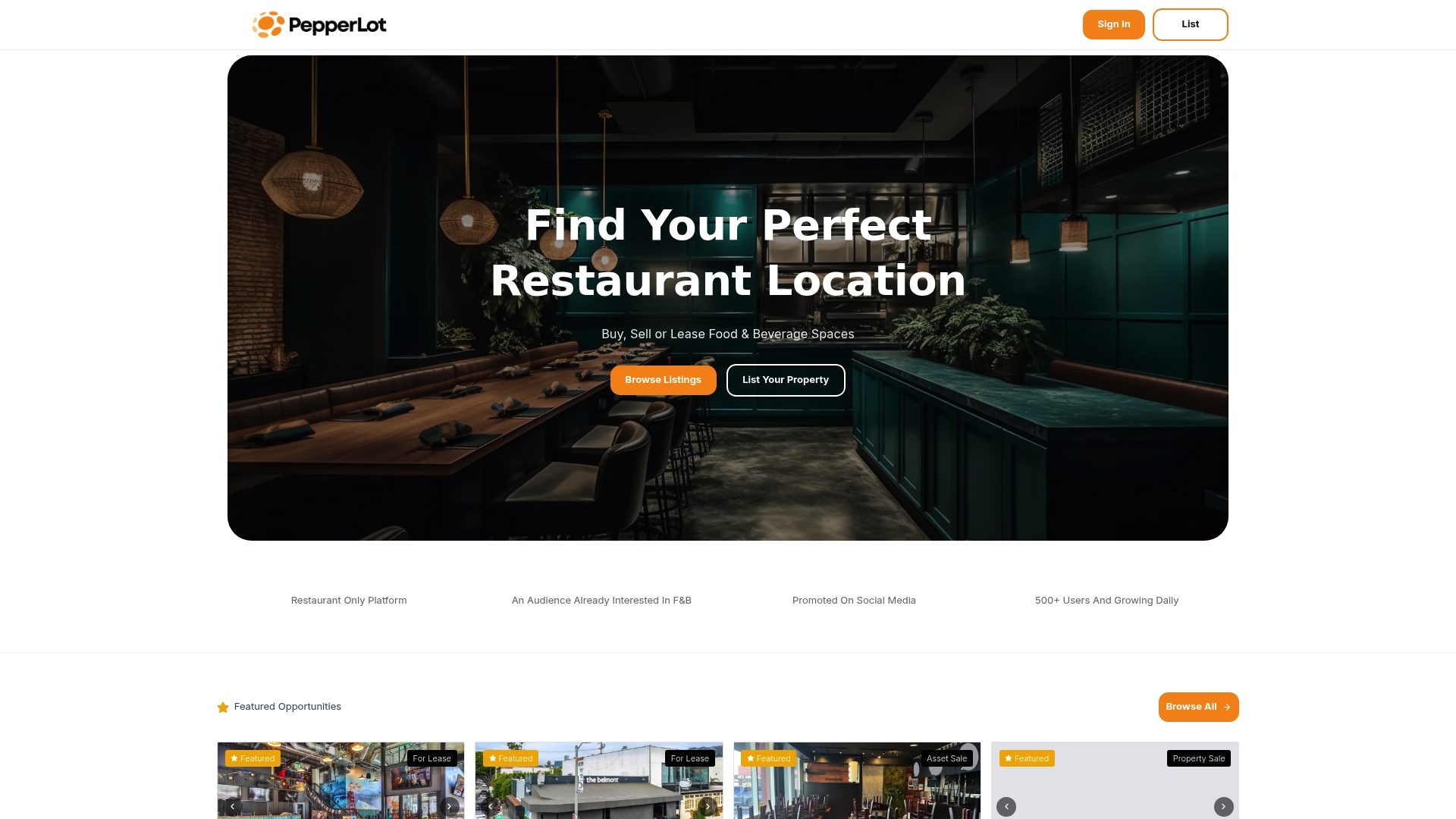
Pepperlot’s network of more than 500 active operators, landlords, and brokers means your listing reaches genuinely serious eyes, not a general audience browsing commercial properties. Listings include restaurant-specific details like seating capacity, grease trap status, permit history, and kitchen equipment, so serious buyers get the information they need without back-and-forth delays. If you’re ready to move forward, Pepperlot is the focused, industry-specific starting point your transaction deserves.
Frequently asked questions
Do I need a restaurant broker to sell my eatery?
While you can sell without a broker, most owners benefit from a broker’s network, negotiation skill, and process management, especially for competitive or confidential sales. Brokers provide key connections and expertise for a smoother sale that general agents often can’t replicate.
How are restaurant brokers paid?
Brokers usually earn a commission based on the closing price, paid when the deal closes, and the exact rate is negotiated up front, typically ranging from 8 to 12 percent of the sale price.
What’s the difference between a restaurant broker and a real estate agent?
Restaurant brokers have specialized knowledge in food and beverage business deals, while general agents usually lack the industry expertise needed for complex transactions. Restaurant brokers offer industry-specific insights and network benefits that directly affect deal outcomes.
When should I consider an M&A advisor instead of a restaurant broker?
For multi-unit groups or chain-level transactions, an M&A advisor’s process-driven, competitive approach is better suited than a broker’s. Larger, more complex deals require the institutional buyer relationships and structured processes that M&A advisors are specifically built to manage.
Can a broker help with leasing a new restaurant space?
Yes, restaurant brokers frequently guide operators through lease negotiations and site selection, saving time and avoiding costly missteps. Brokers can assist with everything from evaluating lease terms to identifying spaces that match your operational requirements.
Recommended
- Why Restaurant-Only Listing Platforms Benefit Property Owners and Agents | PepperLot Blog
- Types of restaurant real estate listings: A guide for 2026
- Why specialized real estate platforms are essential for restaurants
Browse restaurants for sale and sell a restaurant on PepperLot.
Leave a Reply