Tag: selling

  • How to Sell a Restaurant Without a Broker

    Selling a restaurant without a broker is realistic for many independent operators, especially when the deal is local, the buyer is an industry peer, or broker commissions would consume too much of an already thin margin. Success depends on preparation, buyer screening, and disciplined process, not just posting a listing online. This guide covers the broker-free path. For the full process end to end, see our guide on how to sell a restaurant.

    When FSBO works well

    Owner-operators with clean books, transferable permits, and a realistic price often find buyers through industry networks or restaurant-specific marketplaces. Asset sales of second-generation spaces also move well when equipment and lease position are clearly documented.

    Brokers add value in complex multi-unit deals, national buyer searches, or situations requiring confidentiality coordination across multiple parties. FSBO is not anti-broker; it is a cost and control decision.

    What is your restaurant worth?

    Pricing is where most FSBO sales succeed or fail. Without a broker to push back, sellers tend to price on sunk cost or emotion, and an overpriced listing sits until it goes stale.

    Most operating restaurants sell on a multiple of seller’s discretionary earnings, or SDE. That is your net profit plus your own salary, personal expenses run through the business, interest, depreciation, and one-time costs. Independent restaurants typically trade at 1.5 to 2.5 times SDE. Strong lease terms, consistent multi-year financials, and a transferable alcohol license push toward the top of that range. Declining sales, a short lease, or heavy owner dependence push toward the bottom.

    If the business is not profitable, you are selling assets, not earnings. An asset sale prices the equipment, leasehold improvements, and lease position. Second-generation spaces with a full hood system, walk-in, and grease trap in a good location commonly sell for a fraction of the original build-out cost, which is exactly why buyers want them.

    Two sanity checks before you set a price: compare against similar restaurants for sale in your market, and ask what a buyer’s monthly loan payment would look like against your cash flow. If the business cannot cover its own purchase debt plus a manager’s salary, experienced buyers will pass at that price.

    The paperwork checklist

    Serious buyers ask for the same package every time. Having it ready before you list is the single biggest time saver in a FSBO sale.

    • Profit and loss statements for the trailing 2 to 3 years, plus year-to-date
    • Business tax returns for the same period
    • Current lease, all amendments, and the landlord’s assignment requirements
    • Equipment inventory with owned, leased, and financed items clearly separated
    • Licenses and permits: health, alcohol, signage, and whether each transfers or requires a new application
    • Payroll summary and staffing structure
    • Franchise agreement and transfer terms, if applicable
    • Utility costs and any service contracts that convey

    Buyers filter on hood, grease trap, seating count, alcohol license, and lease term before they ever request financials, so surface those details in the listing itself.

    Step 1: Prepare the listing package

    Assemble the documents above, a floor plan if available, and high-quality photos. If confidentiality matters, prepare a blind version of the listing that describes the concept and numbers without naming the business.

    Step 2: Choose the right marketplace

    General business sites attract inquiries from buyers who do not understand restaurant diligence. A restaurant-only platform improves signal-to-noise ratio and reduces wasted tours.

    Use confidential listing mode if staff, customers, or competitors should not see the business name or exact location publicly.

    Step 3: Screen buyers early

    Require proof of funds or a lender letter before sharing sensitive financials. Use NDAs when disclosing detailed P&L or tax returns. Serious restaurant buyers expect a structured process.

    Step 4: Negotiate structure, not just price

    Asset vs business sale, seller financing, training period, inventory count method, and lease assignment timeline all affect net proceeds and closing probability. Price is one variable in a multi-part deal.

    Seller financing deserves special attention in FSBO deals. Carrying 10 to 30 percent of the price widens your buyer pool and supports your asking price, but it makes you the buyer’s lender, so screen accordingly and secure the note against the business assets.

    Step 5: Close with the right professionals

    Use a restaurant-experienced attorney and escrow or closing agent familiar with alcohol license transfer and UCC searches on equipment. Permit delays are a common closing risk; build timeline buffers into the purchase agreement.

    How long does it take?

    A realistic FSBO timeline runs 4 to 9 months from listing to close. Finding the right buyer typically takes 2 to 5 months. Once you accept an offer, diligence and closing add 60 to 120 days, and two items drive most of that: landlord consent to assign the lease and alcohol license transfer, which in some states takes 60 to 90 days on its own. Start the landlord conversation and the license transfer research early, not after you have a signed offer.

    Common FSBO mistakes

    • Overpricing at launch, then chasing the market down with visible price cuts
    • Telling staff too early, which risks walkouts before a deal exists
    • Sharing detailed financials before verifying proof of funds
    • Ignoring the lease assignment clause until closing, when the landlord holds all the leverage
    • Letting the listing go stale with no photo updates or status changes
    • Negotiating with multiple buyers informally instead of running one clear process

    Marketing discipline

    Respond quickly to inquiries, update the listing when status changes, and avoid negotiating with multiple buyers without clear process. Transparency builds trust with experienced operators who have seen deals fall apart over avoidable surprises.

    Frequently asked questions

    Do I need a lawyer to sell my restaurant without a broker? Yes. A broker is optional; a lawyer is not. Asset purchase agreements, lease assignments, and license transfers carry real liability, and a restaurant-experienced attorney typically costs a small fraction of a broker commission.

    How long does it take to sell a restaurant without a broker? Plan on 4 to 9 months from listing to close. Well-priced listings with clean books and a transferable lease move fastest.

    What is my restaurant worth? Profitable independents typically sell for 1.5 to 2.5 times seller’s discretionary earnings. Unprofitable restaurants sell as asset deals priced on equipment, build-out, and lease position.

    Can I keep the sale confidential from staff and customers? Yes. Use a confidential listing that withholds the business name and exact address, require NDAs before disclosure, and control when the identity is revealed.

    Should I offer seller financing? It widens your buyer pool and supports a stronger price, but you become the lender. If you offer it, secure the note against the business assets and screen the buyer’s experience, not just their deposit.

    Browse restaurants for sale on PepperLot, or list your restaurant free when you are ready to sell.

    Browse sell a restaurant on PepperLot.

  • How to prepare your restaurant for sale: a step-by-step guide

    How to prepare your restaurant for sale: a step-by-step guide


    TL;DR:

    • Most restaurant sales fail or stall when sellers are unprepared, risking lower offers or deal failure. Proper organization of documents, financials, legal paperwork, and operational readiness significantly improves sale confidence and value. Early planning and strategic preparation help sellers tell a compelling story, attract credible buyers, and facilitate a smooth transaction process.

    Most restaurant sales that fall apart, stall, or close at a discounted price share one common factor: the seller wasn’t ready. Buyers and their attorneys move fast once interest is confirmed, and any gap in your documentation, financials, or legal paperwork becomes leverage against you. A disorganized seller signals risk, and risk means lower offers or no offer at all. This guide walks you through every critical preparation step, from building your due diligence package to structuring the deal for tax efficiency, so you can sell confidently and at full value.

    Table of Contents

    Key Takeaways

    Point Details
    Start due diligence early Early organization reduces stress and increases your likelihood of a successful sale.
    Prepare robust financials Three years of clean, reconciled financial records build buyer confidence and maximize price.
    Legal documents are critical Leases, licenses, and consents make or break the ability to transfer your restaurant efficiently.
    Validate your sale strategy with professionals Tax advisors and experienced brokers help you avoid costly mistakes in deal structure.
    Turnkey operations boost appeal Buyers want to step in and succeed immediately, so systems and staff matter.

    Organize your documents and build a due diligence gameplan

    The single biggest mistake sellers make is treating due diligence as something that happens after they receive an offer. By then, you’re scrambling to pull together three years of records while a serious buyer waits and loses confidence. The smarter approach is to treat your sell-side readiness as a structured project with clear ownership, timelines, and a secure data room before you ever market the restaurant.

    Think of it like staging a property before listing it. The preparation happens first, not after the first showing. Assign someone, whether that’s your bookkeeper, attorney, or a transaction advisor, to own the documentation process. Set realistic deadlines. A typical diligence preparation process takes 60 to 90 days when done properly.
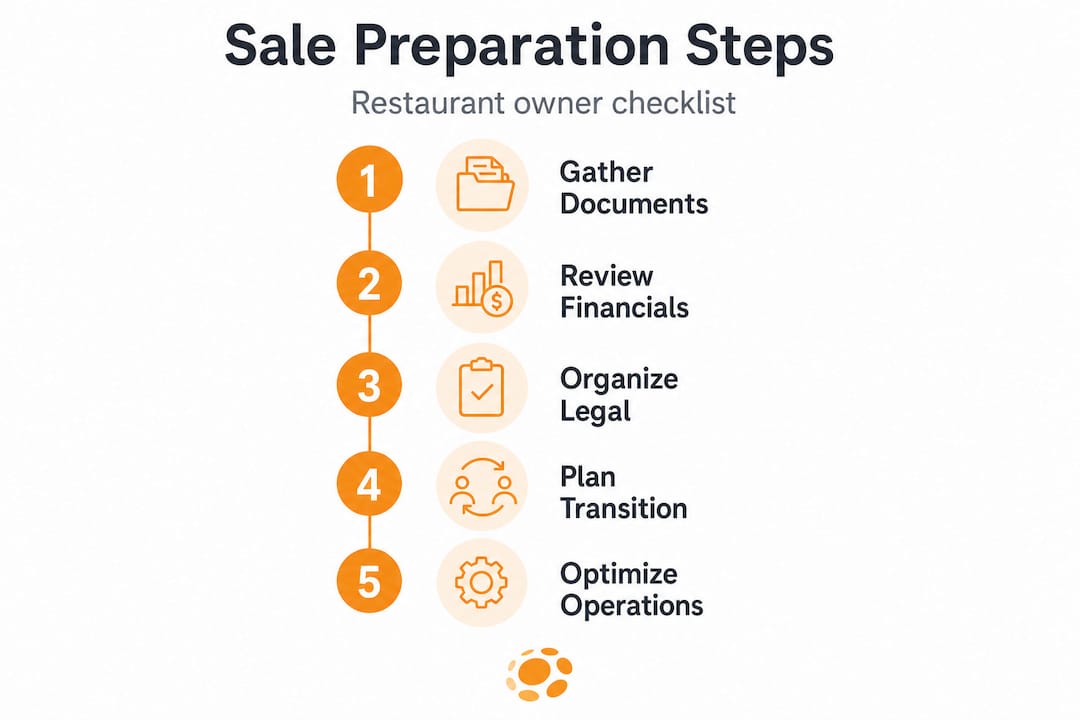
    Infographic summarizing restaurant sale preparation steps

    Your data room should be organized, clearly labeled, and accessible to authorized parties only. If you’re selling a restaurant in California or any competitive market, buyers expect professional presentation from day one.

    Here’s a foundational document checklist to start with:

    • Three years of profit and loss statements (P&Ls)
    • Three years of federal and state tax returns
    • Monthly POS (point of sale) sales reports by category
    • Merchant processing statements (credit card sales reconciliation)
    • Payroll records and employee census
    • Equipment list and maintenance logs
    • Current lease and all amendments
    • Business licenses and permits

    Understanding what buyers look for in a restaurant goes beyond just good revenue numbers. Buyers want to see that your records are consistent, complete, and trustworthy. A mismatch between your tax returns and P&Ls, for example, raises a red flag that’s very hard to erase.

    Document category Recommended lookback period Common gaps
    P&Ls 3 years minimum Missing months, cash adjustments
    Tax returns 3 years minimum Discrepancy with P&L income
    POS reports 2 to 3 years Voided transactions, category gaps
    Merchant processing 2 to 3 years Mismatch with reported sales
    Payroll records 2 years Unreported staff, contractor mix-ups

    Pro Tip: Create a master checklist with checkboxes and assign a status (complete, in progress, missing) to each item. This keeps your team accountable and shows buyers that you take the sale seriously.

    Build a buyer-ready financial stack

    Having organized documents sets you up for the next crucial component: demonstrating the restaurant’s true earnings through bulletproof financials. This is where most sellers either win or lose their deal.

    Restaurant owner reviewing financial documents

    A buyer-ready financial stack means more than just handing over PDFs. It means providing reconciled, clearly annotated financials that walk the buyer from your P&L revenue line straight to your tax return, with every variance explained. Add-backs, also called normalizations, are adjustments that remove owner-specific or one-time expenses to show what the business truly earns for a new operator.

    Common add-backs include owner salary above market, personal vehicle expenses run through the business, a one-time renovation cost, or a non-recurring legal fee. Each one needs documentation. Buyers and their lenders will not take your word for it.

    Here’s the difference between a strong and weak financial package at a glance:

    Element Strong package Weak package
    P&L to tax reconciliation Fully tied, variances explained Gaps unexplained
    Add-back documentation Receipts and memos attached Verbal explanation only
    Year-over-year trends Narrative explaining changes Numbers without context
    Merchant processing Matches reported card sales Statements missing or partial
    EBITDA/SDE normalization Clearly computed, footnoted Not addressed

    EBITDA stands for earnings before interest, taxes, depreciation, and amortization. SDE, or seller’s discretionary earnings, adds back the owner’s compensation and personal expenses. These are the two most common metrics buyers and lenders use to value a restaurant, and you must normalize earnings so that every line item makes sense to someone who wasn’t running your business.

    Follow this sequence to build a clean financial stack:

    1. Start with three years of finalized P&Ls from your accounting software.
    2. Pull matching federal tax returns and identify every line that differs from the P&L.
    3. Create a reconciliation memo for each year that explains each variance.
    4. List every add-back with the dollar amount, description, and supporting documentation.
    5. Calculate normalized EBITDA and SDE with a clear, single-page summary.
    6. Attach payroll records and merchant processing statements that cross-reference the P&L.

    Think about optimizing your restaurant’s presentation for sale not just physically, but financially. A clean, annotated financial package tells buyers you have nothing to hide, which directly translates to confidence and price.

    Pro Tip: If your tax returns show significantly less income than your P&Ls, have your CPA draft a brief letter explaining the legitimate accounting differences. This one document can prevent a buyer from walking during diligence.

    With your finances buttoned up, attention turns to the documents that control whether a buyer can actually operate your restaurant. You could have perfect financials and a motivated buyer, but if the lease can’t be assigned or a key license isn’t transferable, the deal dies anyway.

    Here are the critical documents to gather and verify:

    • Executed lease and all amendments or addenda
    • Landlord contact and assignment or consent clause language
    • Health department permit and expiration date
    • Liquor license status, transferability, and renewal timeline
    • Signage permit and any outdoor seating approval
    • Certificate of occupancy
    • Business license from the city or county
    • Any franchise disclosure document or franchise agreement, if applicable
    • Food handler certifications and any recent inspection reports

    Pay close attention to the lease assignment considerations in your lease. Many leases require landlord consent for any transfer of the business. Some give the landlord the right to recapture the space instead of approving an assignment. That clause alone can end a sale, and the time to discover it is before listing, not mid-deal.

    Understanding the full leasing process for restaurant owners is essential background for navigating these clauses effectively. Start your landlord relationship early. Notify them early that you intend to sell, gauge their cooperation level, and negotiate if needed.

    “The most common late-stage deal killers in restaurant sales are not financial. They are operational control issues: a landlord who won’t consent to an assignment, a liquor license that can’t transfer in time, or a permit that expired two years ago and nobody noticed. Every one of these is preventable with an extra 60 days of preparation.”

    Build the legal-transfer package early in the process so that when a buyer’s attorney asks for the lease on day one of diligence, you send it within hours, not days.

    Tax strategy and deal structuring for a smooth sale

    Once legal documentation is organized, you must prepare for negotiations by understanding what deal structure will be most advantageous and least risky for you. This is a step most sellers skip until they’re already in a signed letter of intent, and by then, your options are narrowed.

    The two primary sale structures are an asset sale and a stock or membership interest sale. In an asset sale, the buyer purchases specific assets: equipment, goodwill, lease rights, and the business name. In a stock sale, they purchase your actual legal entity. Each has very different implications.

    Key tax and deal-structure considerations to work through before you list include:

    • Whether you’re selling assets or the entity, and who benefits from each structure
    • How purchase price allocation across goodwill, equipment, and other assets affects your taxes
    • Whether depreciation recapture applies to any of your equipment or leasehold improvements
    • State-specific sales tax or transfer tax obligations on restaurant assets
    • Whether a seller note or earnout is part of your deal and how it’s taxed
    • Capital gains treatment vs. ordinary income on various asset categories
    • The impact of deal structure on buyer financing approval and loan eligibility

    Most buyers prefer asset sales because they inherit a clean slate without taking on the entity’s historical liabilities. Most sellers, depending on their entity structure, may prefer a stock sale for tax reasons. Your final answer depends on your specific setup, and getting restaurant asset sale guidance early helps you walk into negotiations with clarity rather than confusion.

    Pro Tip: Before you set your asking price or accept a letter of intent, run your deal structure by both a CPA with restaurant transaction experience and a business attorney who handles buy-sell agreements. The cost of that consultation is a fraction of what a poorly structured deal can cost you in taxes alone.

    Operational readiness: set up for a turnkey hand-off

    The best-prepared sellers go beyond documentation by focusing on what enables the new owner to step in seamlessly. Buyers, especially first-time restaurant operators, will pay a premium for a business they can run on day one. Sellers who make that easy for them win higher multiples and faster closes.

    The goal here is what industry advisors call “turnkeyability.” According to expert guidance on day-one operational readiness, the most valuable restaurants are those where buyers can step in without a chaos period.

    Here’s how to build that:

    1. Stabilize key staff. Identify your most critical employees and ensure they’re likely to stay through and after the transition. Consider retention bonuses timed to the close date.
    2. Document your standard operating procedures. Write out opening and closing checklists, food prep processes, vendor ordering schedules, and any specialized techniques unique to your concept.
    3. Document recipes and training materials. If your food is the product, the buyer needs to be able to replicate it without you standing in the kitchen.
    4. Create a complete FF&E inventory. FF&E stands for furniture, fixtures, and equipment. Every major item should be listed with its age, model, condition, and last service date.
    5. Pull maintenance and compliance records. Hood cleaning logs, grease trap service records, pest control receipts, and equipment repair history should all be compiled.
    6. Prepare a transition plan. Outline what you’ll do post-signing to transfer vendor relationships, introduce the buyer to staff, and hand over digital accounts like your POS, Google Business Profile, and reservation system.

    These steps matter for restaurant sale preparation across every market and concept type. A taco counter with clean SOPs and a retained kitchen manager is worth more to a buyer than a fine dining restaurant where all institutional knowledge lives in the owner’s head.

    Pro Tip: Build a short transition plan document, just one to two pages, outlining your first 30 days of post-close support. Offering 30 days of consulting post-sale is a powerful way to increase buyer confidence and justify a higher asking price.

    Our perspective: what most sellers overlook when preparing a restaurant for sale

    Here is the uncomfortable truth: most restaurant sellers treat preparation as a compliance checklist rather than a strategic advantage. They gather the documents because they have to, not because they see diligence as a storytelling opportunity.

    The sellers who get the highest prices and fewest renegotiations are the ones who actively manage the buyer’s narrative from day one. They know exactly which add-backs are defensible, they’ve pre-cleared the landlord’s consent, and they’ve thought through how their earnings story holds up under scrutiny. They don’t wait for a buyer’s attorney to discover gaps. They close those gaps first.

    One area that deserves more attention is confidentiality. Poor organization and early leaks can erode staff morale, spook suppliers, and alert competitors before you’re ready. Marketing a restaurant for sale requires a structured, controlled approach: non-disclosure agreements before any financials are shared, a teaser document that highlights the opportunity without identifying the business, and a serious buyer screening process.

    We’ve seen deals crater not because of bad financials, but because a seller mentioned the sale to the wrong person, which spooked the staff, which made the buyer question stability. The right buyer for your restaurant is not just the highest bidder. It’s the most credible operator who can close fast, satisfy a landlord, and carry the brand forward.

    Think like a buyer when reviewing your own package. Ask yourself: if I were putting my own money into this deal, what would make me nervous? Then fix those things before anyone else sees them.

    Looking for a seamless restaurant sale or acquisition?

    Whether you’re ready to list your restaurant or actively searching for the right acquisition, preparation alone isn’t enough. You need the right platform to connect with serious, buyers who are ready to move and operators.
    https://pepperlot.com

    Pepperlot is built exclusively for restaurant real estate built specifically for restaurant and F&B real estate transactions. Browse live opportunities like a full restaurant for sale in Inglewood or explore sub-lease opportunities in Los Angeles with all the restaurant-specific details you need: equipment included, lease terms, seating capacity, and permit status. The Pepperlot platform gives sellers targeted visibility to a network of over 500 active operators, landlords, and brokers, so your listing reaches exactly the right audience without the noise of a generic commercial real estate portal.

    Frequently asked questions

    How early should I start preparing my restaurant for sale?

    Start at least six months before your target listing date to allow time to gather documents, address financial gaps, and resolve any lease or permit issues. Starting sell-side readiness early and organizing a diligence workplan before marketing significantly reduces deal risk.

    What financial documents do buyers expect to see?

    Buyers expect three years of P&Ls, balance sheets, tax returns, POS reports, and merchant processing statements at minimum. A buyer-ready financial stack that includes reconciliations and normalized earnings signals a credible, organized seller.

    Why do lease and licenses matter so much in a sale?

    Leases and licenses are what give a buyer the legal right to operate the restaurant after closing, making them non-negotiable deal components. Building the lease and licensing package early prevents last-minute failures caused by non-transferable permits or landlord refusals.

    How does my choice of asset sale vs. stock sale affect taxes?

    An asset sale typically triggers depreciation recapture and different capital gains treatment across individual asset categories, while a stock sale may offer more favorable tax outcomes depending on your entity type. Tax and deal-structure planning before listing lets you negotiate from an informed position rather than reacting mid-deal.

    What increases the value of my restaurant in a sale?

    Stable staff, documented SOPs, clean and normalized financials, and organized legal records all directly increase perceived value and buyer confidence. Investing in day-one operational readiness signals to buyers that the business runs on systems, not just the owner’s personal involvement.

    Browse sell a restaurant on PepperLot.

  • What a restaurant broker does and why it matters

    What a restaurant broker does and why it matters


    TL;DR:

    • Hiring a specialized restaurant broker reduces transaction friction by leveraging industry-specific knowledge, network access, and deal management expertise.
    • They add value by handling valuation, marketing to buyers who are ready to move, negotiating terms, and addressing permit and lease issues early, ensuring smoother closings.
    • Choosing the right advisor depends on deal complexity and size, with restaurant brokers ideal for single-unit sales and M&A advisors suited for multi-unit or franchise transactions.

    Buying or selling a restaurant property without the right guidance is one of the most expensive mistakes you can make in the hospitality business. Unlike standard commercial real estate, restaurant transactions involve layers of complexity: equipment valuations, health department permits, grease trap inspections, lease assignment clauses, and liquor license transfers, all stacked on top of typical property negotiations. Many operators and investors walk into these deals thinking a general real estate agent will be enough. They’re usually wrong. This guide breaks down exactly what a restaurant broker does, how they create measurable value, and how to choose the right advisor for your specific transaction.

    Table of Contents

    Key Takeaways

    Point Details
    Specialized expertise Restaurant brokers possess unique experience and connections that general agents lack.
    Increased deal success Brokers manage every stage for faster, less risky closings and fewer failed deals.
    Advisor fit matters Pick the right advisor, restaurant broker, business broker, or M&A advisor, based on your deal’s scale and complexity.
    Step-by-step process A clear brokerage process helps owners and buyers move from listing to closing with fewer surprises.
    Leverage early and often Involve your broker early for best results and ongoing market intelligence.

    Defining the role: What is a restaurant broker?

    After outlining the purpose of this guide, it’s crucial to answer the basic and most misunderstood question: what exactly does a restaurant broker do?

    A restaurant broker is a specialized intermediary who facilitates the buying, selling, and leasing of restaurant properties and food and beverage businesses. They are not generic real estate agents who occasionally list a diner. They are industry insiders who understand the specific mechanics of restaurant transactions from the ground up. As the Pepperlot Blog notes, restaurant brokers specialize in food and beverage business transactions, offering industry-specific connections and insights that general agents simply can’t match.

    So what separates them from a typical real estate agent or even a general business broker?

    • Industry-specific knowledge: A restaurant broker understands local health codes, zoning classifications, commercial kitchen requirements, and the often complex world of lease assignments. They know whether a space’s hood ventilation system meets fire code or whether the grease interceptor needs replacement before a sale closes.
    • Property valuation expertise: They can assess a restaurant’s value based on real metrics like adjusted EBITDA (earnings before interest, taxes, depreciation, and amortization), equipment condition, and transferability of permits, not just square footage and location.
    • Marketing to the right audience: They reach buyers who are actually serious and interested in food service businesses, not general investors browsing commercial listings.
    • Deal management: From listing to closing, they coordinate negotiations, legal steps, lease transfer approvals, and licensing transitions.
    • Network access: Their professional network spans potential buyers, operators, equipment vendors, attorneys, and landlords, all critical in a niche where relationships close deals.

    “A restaurant broker isn’t just a middleman. They’re an industry translator who helps both sides speak the same language and avoid the costly misunderstandings that kill restaurant deals.”

    Understanding the different restaurant real estate listing types is also essential context, since the broker’s role shifts depending on whether the deal involves a full asset sale, a lease assignment, or a ground-up buildout.

    How restaurant brokers create value for buyers and sellers

    Now that you know what a restaurant broker is, let’s explore how they deliver real-world value to both buyers and sellers.

    Broker and owner meeting in casual restaurant office

    The clearest way to think about broker value is this: they reduce friction. Every step of a restaurant transaction has friction points, documentation gaps, pricing disputes, unqualified buyers, lease complications, and permit roadblocks. A skilled broker systematically addresses each one.

    Here’s how the process typically unfolds for both sides:

    1. Pre-listing preparation: For sellers, a broker conducts an initial valuation review, identifies gaps in documentation, and advises on presentation strategy to attract serious buyers. They’ll tell you if your asking price is realistic or if a specific equipment upgrade would increase your sale value before going to market.
    2. Targeted marketing: Rather than broadcasting to the general public, brokers leverage their networks and restaurant-only listing platforms to surface pre-serious candidates. This is especially valuable in confidential sales where you don’t want staff or competitors to know the business is on the market.
    3. Candidate screening: Brokers vet buyers for financial capacity, industry experience, and intent before anyone gets near your financials. This protects sellers from wasting time with tire-kickers and protects buyers from being taken seriously only to lose a deal at due diligence.
    4. Negotiation management: This is where significant value gets created or destroyed. A specialized broker’s connections and expertise can lead to faster closings and fewer deal failures, because they know which terms are negotiable and which are deal-breakers in restaurant-specific contexts.
    5. Due diligence and closing coordination: Restaurant transactions often hit snags during due diligence because buyers discover unresolved permit issues or equipment liabilities. Brokers who see these issues coming early can structure deals to address them before they become reasons to walk away.

    Pro Tip: In competitive urban markets, experienced restaurant brokers often have access to “off-market” deals that never appear on any public listing. These opportunities exist because sellers want discretion and brokers with active networks are the first call. If you’re a buyer and you’re only searching public platforms, you’re seeing a fraction of what’s actually available.

    The financial stakes justify the investment in expertise. Restaurant transaction timelines vary widely, but those managed by a specialist broker consistently close with fewer contingencies and more predictable outcomes than those handled by general agents or attempted without representation.

    Choosing the right advisor: Restaurant broker vs. business broker vs. M&A advisor

    Not all transactions, or advisors, are created equal. Let’s break down how to choose the right representation for your restaurant deal.

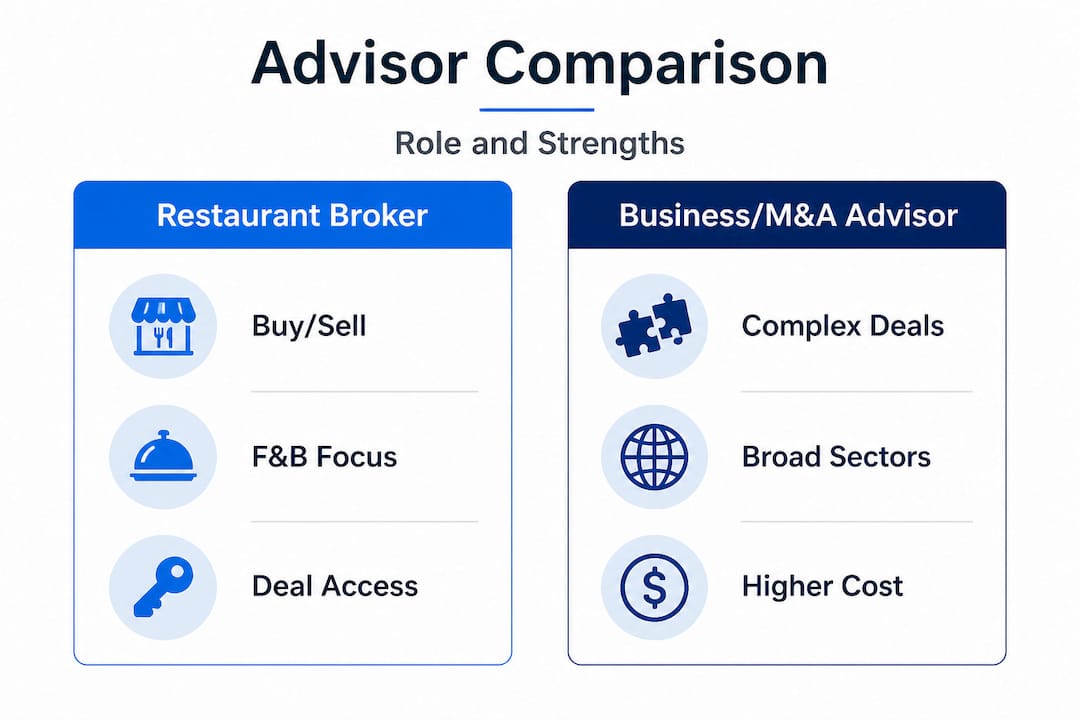
    One of the most common and expensive mistakes restaurant operators make is hiring the wrong type of advisor for their deal size and complexity. Here’s a clear breakdown of the three main categories.

    Advisor type Best for Core strengths Typical cost structure Deal complexity
    Restaurant broker Single-unit sales, leases, asset transfers Industry network, local market knowledge, niche expertise Commission on sale price (typically 8-12%) Low to medium
    Business broker Small single-location businesses with limited F&B focus General business valuation, buyer sourcing Commission on sale price (typically 10-12%) Low
    M&A advisor Multi-unit groups, chains, franchise portfolios Process rigor, competitive buyer process, institutional relationships Retainer plus success fee High

    Smaller, single-unit transactions fit the business broker model, while more complex, multi-unit or group transactions benefit from an M&A advisor with process-driven capabilities. Choosing the wrong tier is costly in both directions. Hiring an M&A firm for a two-location taco spot will mean high fees and a process designed for institutional buyers who aren’t interested in small deals. Hiring a general business broker to sell a 12-location casual dining group will mean an under-resourced process that undervalues the business and misses the right buyer pool.

    When evaluating your options, consider these key factors:

    • Number of locations: One to three units usually fits the restaurant broker or business broker model. Four or more locations, especially with a brand or franchise element, typically calls for an M&A advisor.
    • Buyer type: Operators looking for individual units are best reached by restaurant brokers. Private equity firms or strategic acquirers require the institutional presentation an M&A advisor provides.
    • Timeline and confidentiality needs: Restaurant brokers often manage tighter timelines with a focused, discreet approach suited to owner-operated businesses.
    • Complexity of assets: If the deal involves real estate ownership (not just a lease), significant equipment, multiple licenses, or franchise rights, you need an advisor with specific experience in all of those layers.

    Spending time understanding the full range of restaurant listing types before selecting an advisor helps you align expectations and ensures you’re not paying for a process that doesn’t fit your transaction.

    Infographic comparing restaurant and MA advisors

    What to expect: The restaurant brokerage process from start to finish

    Once you’ve chosen the right broker, understanding the typical process helps set realistic expectations and reduces surprises.

    A successful restaurant transaction follows a defined sequence of stages, each with its own deliverables, risks, and timelines. Here’s what a complete brokerage engagement looks like.

    1. Initial consultation (Week 1 to 2): The broker meets with you to understand the asset, your goals, your timeline, and any deal-breaker terms. This is the foundation. Owners who are vague at this stage often create costly confusion later.
    2. Valuation and pricing (Week 2 to 4): The broker conducts a thorough valuation using industry-standard methods, including EBITDA multiples, asset appraisals, and comparable sales. Restaurant businesses typically sell for 2 to 3 times adjusted EBITDA, though location and brand strength affect this significantly.
    3. Marketing and listing (Week 4 to 8): The broker creates a confidential information memorandum (CIM), a professional document summarizing the business without revealing its identity publicly. They then market to their network and on relevant platforms.
    4. Candidate screening and NDAs (Weeks 6 to 10): Interested buyers sign a non-disclosure agreement before accessing financials. The broker screens them for suitability and financial capacity.
    5. Negotiation and letter of intent (Weeks 8 to 14): buyers who are ready to move submit offers. The broker negotiates key terms including price, asset inclusions, lease assignment, training period, and transition support.
    6. Due diligence (Weeks 12 to 18): The buyer reviews financials, inspections, permits, and operational records. Most deals that fall apart do so here, usually because of surprises that could have been identified earlier.
    7. Closing (Weeks 16 to 24): Final legal documents are signed, funds are transferred, licenses and leases are formally assigned, and ownership changes hands.
    Stage Typical duration Common sticking points
    Consultation and valuation 2 to 4 weeks Unrealistic price expectations
    Marketing 4 to 8 weeks Insufficient documentation
    Screening and NDAs 2 to 4 weeks Unqualified buyer pool
    Negotiation 2 to 6 weeks Lease assignment landlord approval
    Due diligence 4 to 6 weeks Permit gaps, undisclosed liabilities
    Closing 2 to 4 weeks Licensing transfer delays

    The most critical preparation tip: gather your financial statements, lease documents, equipment lists, and permit copies before the first meeting with your broker. Sellers who show up ready move through the process in weeks, not months.

    Our take: What most experts miss about restaurant brokerage

    Beyond the process and definitions, here’s a candid inside look at what makes or breaks these transactions.

    Most articles about restaurant brokers focus on the mechanics: the steps, the fees, the timelines. What gets far less attention is the relational and strategic dimension of brokerage, and frankly, that’s where the real value lives.

    The best restaurant brokers we’ve observed in the market function less like transactional agents and more like trusted advisors. They’re the ones who get called first when an operator is thinking about expanding, not just when they’re ready to sell. That distinction matters enormously. When a broker is brought in early, they can shape the strategy around the transaction instead of just executing it. They might advise you to hold off on selling for six months until a lease renewal is secured, which could add significant value. They might identify that a competitor location is coming to market and help you acquire it before it’s listed publicly.

    There’s also an uncomfortable truth that most articles gloss over: a one-time transactional relationship with a broker almost always produces worse outcomes than an ongoing advisory relationship. Clients who treat their broker as a single-use service get a single-use result. Those who maintain relationships get access to intelligence, deal flow, and strategic insight that no fee structure officially covers.

    The impact of niche platforms in the restaurant space reinforces this point. Brokers who operate within focused industry ecosystems, not generic real estate marketplaces, develop deeper knowledge and better networks precisely because they stay close to their niche. The best client outcomes happen when operators engage brokers who live and breathe the restaurant space, and when they treat that relationship as an ongoing partnership rather than a one-time transaction.

    Find your next opportunity with expert restaurant brokerage

    Ready to put this knowledge to use? Here’s where expert support meets real-world opportunities.

    Pepperlot is built specifically for restaurant and F&B real estate, which means every listing, every tool, and every feature is designed with operators, buyers, and brokers in mind. Whether you’re searching for restaurants for sale or using location intelligence tools to evaluate a new site’s demographic fit, you’re working in a platform that speaks your language.

    https://pepperlot.com

    Pepperlot’s network of more than 500 active operators, landlords, and brokers means your listing reaches genuinely serious eyes, not a general audience browsing commercial properties. Listings include restaurant-specific details like seating capacity, grease trap status, permit history, and kitchen equipment, so serious buyers get the information they need without back-and-forth delays. If you’re ready to move forward, Pepperlot is the focused, industry-specific starting point your transaction deserves.

    Frequently asked questions

    Do I need a restaurant broker to sell my eatery?

    While you can sell without a broker, most owners benefit from a broker’s network, negotiation skill, and process management, especially for competitive or confidential sales. Brokers provide key connections and expertise for a smoother sale that general agents often can’t replicate.

    How are restaurant brokers paid?

    Brokers usually earn a commission based on the closing price, paid when the deal closes, and the exact rate is negotiated up front, typically ranging from 8 to 12 percent of the sale price.

    What’s the difference between a restaurant broker and a real estate agent?

    Restaurant brokers have specialized knowledge in food and beverage business deals, while general agents usually lack the industry expertise needed for complex transactions. Restaurant brokers offer industry-specific insights and network benefits that directly affect deal outcomes.

    When should I consider an M&A advisor instead of a restaurant broker?

    For multi-unit groups or chain-level transactions, an M&A advisor’s process-driven, competitive approach is better suited than a broker’s. Larger, more complex deals require the institutional buyer relationships and structured processes that M&A advisors are specifically built to manage.

    Can a broker help with leasing a new restaurant space?

    Yes, restaurant brokers frequently guide operators through lease negotiations and site selection, saving time and avoiding costly missteps. Brokers can assist with everything from evaluating lease terms to identifying spaces that match your operational requirements.

    Browse restaurants for sale and sell a restaurant on PepperLot.
  • Restaurant property marketing ideas that attract serious buyers

    Restaurant property marketing ideas that attract serious buyers


    TL;DR:

    • Specify infrastructure details and supporting documentation to appeal to experienced restaurant operators.
    • Use a coordinated digital approach maximizing local SEO, review platforms, and targeted email campaigns.
    • Transparency and proven readiness information build credibility, attracting serious and serious prospects.

    Marketing a restaurant property is nothing like filling seats on a Friday night. The audience is completely different, their questions are harder, and one vague listing description can cost you months of vacancy. Operators and investors evaluating your space want to know whether they can open quickly, how much infrastructure is already in place, and whether the numbers actually work. To win in this market, you need a strategy built around credibility, data, and the specific concerns of people who think in terms of lease terms, build-out costs, and return on investment.

    Table of Contents

    Key Takeaways

    Point Details
    Lead with readiness Highlight kitchen infrastructure, permitting, and operational features in your listings to attract serious buyers.
    Systematize digital marketing Use coordinated online channels and consistent messaging to boost property visibility and leads.
    Repurpose proven tactics Adapt traditional restaurant marketing strategies for property lead generation and due diligence support.
    Focus on buyer economics Showcase the speed and cost advantages of your property, even if it’s not turnkey.
    Transparency wins deals Clear, fact-based listings attract serious, motivated buyers and tenants faster.

    Set the stage with property readiness and credibility

    The single biggest mistake restaurant property owners make is leading with adjectives. “Prime location.” “High-traffic area.” “Great opportunity.” Those phrases say nothing to an experienced operator who has toured dozens of spaces and needs to justify a capital commitment to their partners.

    What actually moves the needle is specificity. As the restaurant leasing industry has learned the hard way, you need to “lead with turnkey readiness” but support that claim with documented infrastructure details rather than marketing language. That means showing exactly what is in place:

    • Hood and venting system specifications (CFM rating, last inspection date)
    • Grease trap size and compliance status
    • Gas line capacity and electrical panel amperage
    • Walk-in cooler and freezer dimensions
    • Number of sinks and their classifications
    • Active restaurant permits and health department history
    • Seating capacity for both dining room and any outdoor patio

    This is not a checklist to drop in the back of a brochure. It belongs front and center in your listing, because operators use it to estimate their build-out gap from day one. When you understand how second-generation spaces are evaluated, you realize that the technical details are the marketing. Everything else is window dressing.

    “A listing that shows the hood is in place, the grease trap is compliant, and the space is restaurant-permitted does more persuasion work in three lines than five paragraphs of narrative copy ever could.”

    Beyond the checklist, support your listing with trade-area analysis. Demographics, nearby competition density, average household income, and traffic counts give operators a business context for their investment. Think of it as framing your property not just as a space but as a viable business location. When you’re focused on listing ready-to-open restaurants, that framing is what separates a serious inquiry from a casual browse.

    Broker analyzing restaurant trade area on laptop

    Pro Tip: Include a to-scale layout diagram and at least one test-fit concept showing a potential kitchen configuration. Operators often struggle to visualize a blank space, and a test-fit removes that mental friction immediately.

    Craft a consistent digital presence and leverage high-ROI channels

    Once your listing communicates the right facts, the next job is making sure the right people actually see it. And that requires a coordinated approach, not a scattered one.

    The most effective property marketers treat their efforts like a system rather than a series of one-off promotions. Research from the restaurant industry confirms that a strong marketing motion aligns messaging across owned and digital channels including local SEO, review sites, and email to drive both visibility and conversion. The same logic applies directly to restaurant property marketing.

    Here is a practical workflow for boosting your listing’s digital reach:

    1. Optimize for local search. Make sure your listing appears when operators search phrases like “restaurant space for lease in [city]” or “second-gen restaurant available.” Use location-specific terms in your listing title, description, and metadata.
    2. Claim and update your Google Business Profile. Even for a vacant property, a Google Business Profile can capture search traffic and direct inquirers to your listing.
    3. Distribute to review and aggregator platforms. Sites where operators research markets (including broker networks and commercial real estate databases) should carry your listing with consistent details.
    4. Build an email sequence for your broker network. A single email to your contact list is forgettable. A three-email sequence that covers property overview, infrastructure highlights, and economics creates a fuller picture and stays top of mind.
    5. Retarget engaged visitors. If you have a property website or landing page, retargeting ads on social media platforms keep the listing visible to people who showed initial interest.
    6. Document and publicize your property readiness checklist. This content works double duty: it attracts search traffic and qualifies leads because only serious operators take the time to read it.

    Using restaurant listing platforms that are built for F&B real estate also amplifies your reach significantly. Generic commercial real estate databases lump your restaurant space alongside office suites and retail storefronts. Specialized platforms reach an audience that is already thinking in terms of hood vents and grease traps, which means your infrastructure details actually land with someone who understands their value.

    Pro Tip: Pair your digital listing with a downloadable property readiness checklist in PDF format. Leads who download it are signaling genuine intent, making them much easier to qualify and prioritize for follow-up.

    Adapt classic restaurant marketing tactics for lead generation

    Traditional restaurant marketing targets diners. But many of its core mechanisms, social proof, event-based visibility, and content that answers real questions, translate well when you redirect them toward operators and investors.

    Social proof for property marketing looks different than a five-star Yelp review. What moves buyers and tenants is evidence that other operators succeeded in this space or with your management. That means:

    • Testimonials from previous tenants about build-out ease or landlord responsiveness
    • Before-and-after case studies showing how a past operator transformed the space
    • Revenue or occupancy data from the previous concept (where permissible to share)
    • References from brokers who have worked deals with you before

    Event-based visibility is another underused tactic. Broker open houses create urgency and allow your infrastructure to speak for itself in person. Virtual tours with live Q&A sessions are increasingly popular with out-of-market operators who are expanding regionally. A well-run virtual tour that walks through every major infrastructure element builds credibility faster than most written descriptions.

    On the content side, consider publishing investment analysis posts that break down the economics of operating from your specific space. What does a comparable rent in your market look like? What is the realistic revenue potential given foot traffic and seating capacity? Operators compare listings as investment-risk tradeoffs, and content that helps them run those numbers positions you as a credible, transparent partner rather than just a seller.

    “The landlords who move properties fastest are usually the ones who have done part of the operator’s homework for them. That is not generosity. It is strategy.”

    One more angle worth developing is a structured FAQ for the property itself. What zoning allows, what permits transfer, what the build-out timeline looks like, whether the equipment conveys with the lease. When you answer these questions proactively, you eliminate the most common friction points that stall deals. Understanding the differences between a sale and a lease also helps you frame your listing correctly from the start, since the due diligence needs of a buyer and a tenant are meaningfully different.

    Highlight economics and risk-reduction to convert non-turnkey opportunities

    Not every listing is a plug-and-play turnkey space. Sometimes the kitchen is partially equipped, the permits have lapsed, or the ventilation needs upgrading. That is not automatically a disadvantage. It just requires a different marketing approach.

    The key insight here is that operators do not evaluate properties in isolation. They compare them. And when your space is not fully restaurant-ready, your competitive advantage comes from translating the technical readiness into buyer economics, specifically speed to open, reduced build-out risk, and a clearer capital plan.

    Here is a comparison that illustrates the difference in marketing framing:

    Factor Turnkey listing Partial build-out listing
    Time to open 30 to 60 days 90 to 150 days
    Estimated build-out cost $0 to $50K $100K to $300K
    Infrastructure documentation Full Partial, with gap analysis
    Permit status Active and transferable Requires renewal (timeline provided)
    Capital risk for operator Low Moderate, with clear ceiling
    Marketing emphasis Speed and certainty Cost control and customization

    When your space falls in the partial build-out category, the goal is to give operators a ceiling, not just a floor. Provide a realistic cost range for completing the build-out, cite local contractor estimates if you have them, and show the timeline to opening day. Operators can work with uncertainty if you quantify it honestly. What they cannot work with is a listing that forces them to guess at every line item.

    Reviewing expert restaurant real estate tips consistently shows that landlords who provide sample capital plans, even rough ones, attract more serious offers and spend less time in diligence than those who leave operators to figure it out alone.

    Pro Tip: Commission a simple capital planning document from a restaurant build-out contractor before listing. Even a two-page cost estimate broken down by category (electrical, plumbing, equipment, finishes) dramatically reduces how many back-and-forth calls your listing generates.

    Side-by-side comparison of marketing tactics

    To make the right choices for your specific property and timeline, use this comparison to weigh your options:

    Marketing tactic Best for Setup speed Lead quality Cost level
    Infrastructure-first listing All property types Fast Very high Low
    Local SEO and digital presence Lease-focused landlords Medium High Low to medium
    Broker open house High-value or complex spaces Medium Very high Medium
    Virtual tour with Q&A Out-of-market buyers Fast High Low
    Trade-area analysis content Investment-ready buyers Slow Very high Medium
    Capital plan documentation Non-turnkey listings Slow High Low to medium
    Specialized listing platform All property types Fast Very high Low

    For landlords with a property that checks most of the turnkey boxes, the fastest path to serious inquiries is a specialized listing with full infrastructure documentation paired with a focused digital presence. For more complex or non-turnkey properties, the investment in capital planning documentation and trade-area content pays back quickly in reduced time on market and fewer low-quality inquiries.

    When you’re evaluating expansion locations from an operator’s perspective, the same logic applies. The best listings answer the questions operators are already asking, and the table above helps you match your tactics to the answers they need most.

    Why most restaurant property marketing misses the mark, and what actually attracts buyers who are ready to move

    Here is the uncomfortable truth about restaurant property marketing: most of it is built for the wrong audience. Landlords and sellers often default to the same promotional instincts they use when marketing their own restaurants, colorful descriptions, lifestyle photos, and vague claims about potential. But sophisticated operators are not moved by potential. They are moved by proof.

    The listings that move fastest share three traits. First, they lead with numbers. Not estimates or ranges, but documented figures: utility averages, equipment replacement values, prior sales volume if available. Second, they open faster, spend less by removing ambiguity from the capital planning process. Third, they communicate transparently about what is there and what is not, without burying the gaps in footnotes.

    Generic buzzwords actively hurt your listing with experienced operators. When someone who has opened four locations reads “turnkey opportunity in a high-traffic corridor,” they immediately discount it because they have been burned by that language before. Replacing those phrases with a grease trap compliance date, a ventilation CFM rating, and a permit transfer timeline builds the kind of credibility that actually generates offers.

    The deeper lesson is that transparency is not a risk in restaurant property marketing. It is a conversion tool. The operators you want to attract are running their own due diligence regardless of what your listing says. When your listing answers their questions before they ask them, you are not just saving time. You are signaling that you are the kind of landlord or seller they can work with, and that matters as much as the square footage.

    Next steps: List, optimize, and close with PepperLot

    Ready to put these ideas into action? PepperLot was built specifically for moments like this.

    https://pepperlot.com

    Unlike general commercial real estate platforms, PepperLot focuses exclusively on restaurant and food and beverage properties. Every listing field is designed around the details operators actually care about: grease traps, seating capacity, permit status, and kitchen configuration. When you list here, you are not competing for attention alongside office suites. You are front and center in front of an audience of over 500 active operators, landlords, and brokers who are already looking for exactly what you have. Browse current lease opportunities to see how top listings are structured, or explore the location intelligence tools to back your listing with the demographic and market data that serious buyers demand.

    Frequently asked questions

    What details do operators care about most when researching a restaurant property listing?

    Operators prioritize infrastructure readiness above everything else, specifically kitchen configuration, venting, grease trap compliance, and permit status. As industry research confirms, “infrastructure and lease-ready details” outperform any amount of descriptive language in driving serious inquiries.

    How can I make my restaurant property stand out online?

    Lead with documented readiness details, include high-quality photos alongside layout diagrams, and distribute your listing through local SEO and specialized platforms. A coordinated digital channel approach consistently outperforms single-channel promotion in generating serious inquiries.

    Are property marketing strategies different from marketing a restaurant to diners?

    Completely different. Property marketing must support investment decisions and due diligence, not brand affinity. As noted across the industry, adapting diner-focused tactics for tenant and buyer lead generation requires shifting the focus from experience to economics.

    What’s the main benefit of marketing a second-generation restaurant space?

    Second-generation spaces let operators open faster and with significantly lower upfront capital than a raw build-out. Leading your listing with proof that the “hood, venting, grease trap, and restaurant-permitted use” are already in place is the fastest path to attracting a serious offer.

    Browse restaurants for sale and sell a restaurant on PepperLot.
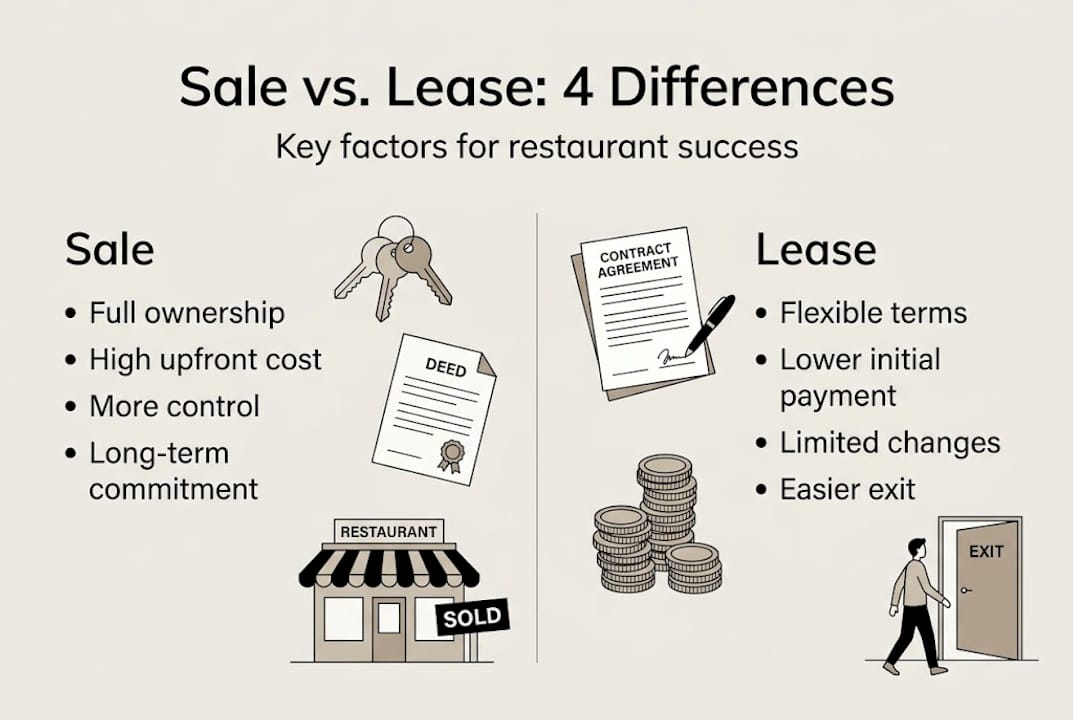
  • Restaurant sale vs. lease: 4 key differences for success

    Restaurant sale vs. lease: 4 key differences for success

    Choosing between buying and leasing a restaurant space is one of the most consequential decisions you will make as an operator or investor. Many people assume ownership is always the smarter play, but a surprising number of well-funded restaurant groups have stumbled precisely because they locked capital into real estate instead of operations. The real question is not which option sounds better on paper. It is which option fits your concept, your cash position, and your market. This guide walks you through the financial, operational, and strategic differences between sale and lease arrangements so you can make a decision grounded in facts, not assumptions.

    Table of Contents

    Key Takeaways

    Point Details
    Ownership vs. flexibility Owning gives control but ties up capital; leasing offers flexibility with less long-term risk.
    Financial impacts vary Buying costs more up front, while leasing may impact cash flow longer term.
    Operational constraints Leases restrict renovations and usage changes more than ownership does.
    Decision should fit strategy The best choice depends on business goals, stage, and market risks.

    Understanding sale vs. lease: Definitions and fundamentals

    Before you can weigh the pros and cons, you need a clear picture of what each option actually means in the context of restaurant real estate.

    Buying a restaurant property means you are purchasing full ownership of the physical space. You hold the deed, you are responsible for the building, and you have the right to use, modify, or sell the asset as you see fit. Ownership is a long-term commitment that ties your business finances directly to the real estate market.

    Leasing a restaurant property means you are paying a landlord for the right to use the space for a defined period, typically three to ten years with renewal options. You do not own the building. You operate within the terms of a lease agreement, which governs everything from permitted use to alteration rights.

    Both sale and lease are common paths for entering the restaurant business, each with a distinct set of trade-offs that depend heavily on your goals.

    Here is a quick breakdown of when each option tends to show up most in the industry:

    • Buying is more common when an operator has strong capital reserves, plans to stay in one location for ten or more years, or wants to generate rental income from adjacent spaces.
    • Leasing is more common when an operator is launching a first location, testing a new market, or prioritizing capital efficiency over asset accumulation.
    • Sale-leaseback arrangements are a hybrid approach where an owner sells the property and immediately leases it back, freeing up capital while retaining operational control.
    • Subleasing occurs when a tenant rents out part or all of a leased space to another party, subject to the original landlord’s approval.

    Typical lease terms in the restaurant industry range from five to fifteen years, often with personal guarantees and options to renew. Sales involve mortgage financing, title transfer, and ongoing property management responsibilities. Understanding these fundamentals is the foundation for every financial and operational comparison that follows. If you are exploring restaurants for lease in California, you will quickly notice how lease structures vary significantly by market and landlord type.

    Financial comparison: Costs, commitments, and cash flow impact

    Money is where most operators start, and for good reason. The financial gap between buying and leasing a restaurant space is enormous, and it affects everything from your opening day budget to your five-year growth plan.

    Upfront costs tell the first part of the story. Purchasing a restaurant property typically requires a down payment of 10 to 30 percent of the purchase price, plus closing costs, inspections, and legal fees. On a $1.5 million property, that is $150,000 to $450,000 before you have served a single guest. Leasing, by contrast, usually requires a security deposit of one to three months’ rent, plus buildout costs that may be partially offset by a tenant improvement allowance from the landlord.

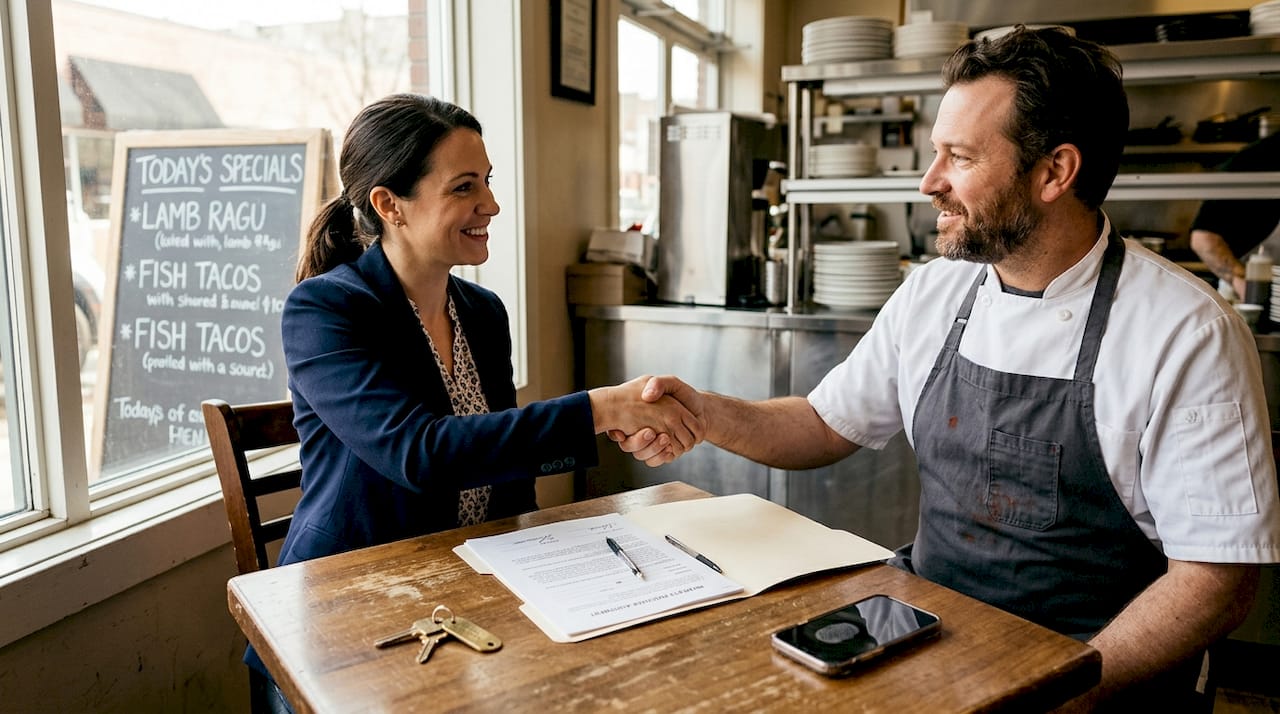
    Chef and agent closing restaurant property deal

    Cost category Buying Leasing
    Initial outlay High (10-30% down payment) Low (deposit + buildout)
    Monthly obligation Mortgage + taxes + insurance Rent (may include NNN costs)
    Equity potential Yes, builds over time None
    Capital flexibility Lower Higher
    Exit complexity High (property sale required) Moderate (lease assignment)

    Leasing typically requires less upfront capital but can result in higher cumulative payments over time, whereas buying demands more capital up front but may build equity as the property appreciates.

    Infographic comparing sale and lease differences

    Recurring costs also differ sharply. Owners pay a mortgage, property taxes, building insurance, and maintenance. Tenants pay rent and, in triple-net leases, also cover taxes, insurance, and maintenance on top of base rent. Neither model is automatically cheaper. The math depends on local market conditions, interest rates, and how long you plan to operate.

    Pro Tip: Do not evaluate this decision based on monthly payment alone. Model your cash flow over five and ten years, factoring in rent escalations, mortgage paydown, and the opportunity cost of the capital you deploy. Operators looking at leasing restaurants in San Francisco or exploring restaurant leases in Anaheim will find that local rent trends dramatically affect which model wins financially.

    Key financial considerations to keep in mind:

    • Rent escalations of 3 to 5 percent annually can significantly increase your occupancy cost over a ten-year lease.
    • Mortgage interest rates in 2026 continue to affect the true cost of ownership for buyers financing through commercial loans.
    • Tenant improvement allowances can reduce your effective buildout cost when leasing, sometimes covering $50 to $150 per square foot.
    • Owned properties can be refinanced or used as collateral, giving operators a financial lever that tenants do not have.

    Operational flexibility and control: What can you change?

    Financial fit matters, but so does your ability to run and evolve your restaurant the way you want. Sale and lease arrangements create very different operating environments.

    When you own the property, you have near-total control. You can knock down walls, add a commercial kitchen hood, expand your patio, or convert the space to a different restaurant concept without asking anyone’s permission. That autonomy is genuinely valuable, especially for operators who want to grow into a space or adapt to changing guest preferences.

    When you lease, you are working within someone else’s rules. Lease terms often restrict renovations, subletting, or changing restaurant concept, while owners have far more autonomy over their space and operations.

    Here is what operational control looks like in practice for each arrangement:

    • Renovations: Owners can proceed freely. Tenants typically need written landlord approval, and some leases require the tenant to restore the space to original condition at lease end.
    • Concept changes: Owners can pivot without restriction. Tenants may be locked into a specific permitted use clause, such as “full-service dining only,” limiting their ability to shift to fast-casual or ghost kitchen models.
    • Subleasing: Owners can lease out unused space for income. Tenants usually need landlord consent to sublease, which is not always granted.
    • Lease renewal risk: Tenants face the real possibility that a landlord will not renew, will dramatically raise rent, or will redevelop the property. Owners face no such uncertainty.
    • Exit and transfer: Selling a business that includes owned real estate is a different transaction than selling one with a leased space. Both are viable, but the complexity and buyer pool differ.

    Pro Tip: If you are negotiating a lease, push hard for explicit use and alteration clauses. A vague lease that says “tenant may not make structural changes without approval” gives the landlord enormous leverage. Specify what types of changes are pre-approved, what the approval timeline is, and whether the landlord can withhold consent unreasonably. Operators reviewing restaurant leases in Newport Beach know that lease language varies widely and that negotiation upfront saves significant headaches later.

    Risk and opportunity: Long-term growth or agility?

    Every real estate decision carries risk. The question is which risks you are better positioned to absorb, and which opportunities align with your growth strategy.

    Ownership may offer long-term value but can limit agility, while leasing supports fast pivots but grants less control over your long-term fate in a location.

    “The operators who struggle most are not those who chose wrong between buying and leasing. They are the ones who chose without fully understanding the implications of each path for their specific concept and market.”

    Factor Owning Leasing
    Market appreciation Can benefit from rising values No direct benefit
    Market downturn risk Exposed to property value drops Insulated from property value risk
    Business flexibility Lower, capital is locked in Higher, easier to relocate or exit
    Forced relocation risk None Real risk at lease expiration
    Long-term cost certainty Mortgage is fixed (if fixed-rate) Rent escalations add uncertainty

    When evaluating your own situation, work through this decision framework:

    1. Assess your capital position. Do you have enough reserves after a purchase to fund operations for at least twelve months?
    2. Define your time horizon. Are you building a single flagship location or a multi-unit brand that needs capital to scale?
    3. Analyze the local real estate market. Is the area appreciating, stable, or declining? Explore restaurant leases in Oakland to see how market dynamics shape lease terms in competitive urban markets.
    4. Evaluate your concept’s stability. A proven concept with ten years of operating history is a different buyer than a first-time operator testing a new idea.
    5. Model your exit. Whether you plan to sell the business in five years or pass it down, understand how ownership versus leasehold affects your exit value and options.
    6. Consult a restaurant-focused real estate advisor. Generic commercial real estate brokers often miss the nuances that matter most in F&B transactions.

    A fresh take: Why the ‘best’ choice depends on your business model

    Conventional wisdom says experienced operators should own and new entrants should lease. That rule of thumb is useful but dangerously oversimplified.

    We have seen well-capitalized groups buy properties in neighborhoods that shifted dramatically within five years, leaving them holding an asset that no longer matched their brand or customer base. We have also seen scrappy independent operators lock in long-term leases in high-growth corridors and build enormous goodwill equity in a location they do not own.

    The real lesson is that your real estate strategy should be a direct extension of your business model. A high-volume, low-margin fast-casual concept needs capital efficiency above all else, which often favors leasing. A destination fine-dining concept anchored to a specific neighborhood might justify ownership because the location itself is part of the brand.

    New entrants almost always benefit from starting with a lease. The flexibility to learn, pivot, and exit without a property sale is worth more than the equity upside in most early-stage scenarios. Established multi-unit operators, on the other hand, can use property ownership as a wealth-building tool that runs parallel to the restaurant business.

    The best operators we know treat real estate as a strategic input, not an afterthought. Browsing lease options in California with a clear framework in hand produces far better outcomes than reacting to whatever space happens to be available.

    Find your next restaurant space with expert support

    Now that you understand the real differences between buying and leasing, the next step is applying that knowledge to actual listings in your target market.

    https://pepperlot.com

    The PepperLot restaurant real estate marketplace is built specifically for restaurant operators, investors, and landlords who need more than a generic commercial real estate search. Every listing includes restaurant-specific details like hood systems, grease traps, seating capacity, and permit status, so you spend less time filtering and more time evaluating real opportunities. Browse current San Francisco restaurant leases to see active opportunities in one of the country’s most competitive dining markets, or explore restaurants for sale in Folsom if ownership is the right move for your next location.

    Frequently asked questions

    What is the main difference between buying and leasing a restaurant?

    Buying gives you full ownership of the property and all the rights that come with it, while leasing defines different rights that are limited to use of the space for a set period under agreed terms.

    Which option offers better flexibility for restaurant operators?

    Leasing generally allows more flexibility to pivot concepts or exit a location, while owning provides more control over the long term but makes quick strategic changes harder.

    Are up-front costs higher when buying or leasing?

    Up-front costs are significantly higher when buying, since a purchase requires a down payment, closing costs, and financing, compared to a deposit and buildout costs for a lease.

    Can I renovate a leased restaurant location?

    Renovations to a leased space typically require written landlord approval, and lease terms may restrict the scope, timeline, and permanence of any changes you want to make.

    Article generated by BabyLoveGrowth

    Browse sell a restaurant on PepperLot.