
TL;DR:
- Zoning issues often cause more restaurant deal failures than poor locations.
- Understanding local zoning codes, permits, and restrictions is critical before signing leases.
- Community opposition and overlay district rules can delay or prevent restaurant openings.
Zoning kills more restaurant deals than bad locations do. Most operators spend months negotiating lease terms, hiring architects, and pricing out equipment, only to discover that the space they signed on doesn’t legally permit a restaurant, or requires a conditional use permit that takes six months and a public hearing to obtain. That gap between “this looks like a great spot” and “this space is legally cleared for our concept” is where capital goes to waste. Understanding zoning before you tour a space, let alone sign a lease, is the single most valuable habit any serious restaurant operator or investor can build.
Table of Contents
- Restaurant property zoning basics: Understanding land use and regulations
- Navigating zoning codes: Permitted uses, bulk standards, and parking
- Conditional use permits, variances, and special restaurant features
- Zoning edge cases and real-world examples: What can go wrong
- Expert perspective: What most operators miss about restaurant zoning
- Find compliant restaurant properties faster with Pepperlot
- Frequently asked questions
Key Takeaways
| Point | Details |
|---|---|
| Zoning is highly local | Restaurant property zoning rules vary dramatically by city or county, so always check local codes before committing to a lease. |
| Parking can derail deals | Strict parking requirements for restaurants often limit capacity or render some sites infeasible unless mitigated through variances or shared arrangements. |
| Many features need extra permits | Drive-thrus, alcohol service, and outdoor seating often require conditional use permits involving public hearings and neighbor input. |
| Edge cases affect eligibility | Density limits, drive-thru bans, and proximity rules can block restaurants even in commercial zones, so double-check for unusual restrictions. |
| Early zoning analysis reduces risk | Proactive zoning verification and lease contingencies protect against last-minute compliance issues and costly project failures. |
Restaurant property zoning basics: Understanding land use and regulations
Zoning is the framework cities and counties use to control how land gets used. Every parcel of land sits inside a zone, and that zone determines what can legally happen there. Residential zones allow housing. Industrial zones allow manufacturing. And commercial or mixed-use zones, generally speaking, are where restaurants live. But that broad picture misses the details that actually matter.
Restaurant property zoning refers to local government regulations that divide land into districts specifying permitted land uses, with restaurants typically allowed in commercial or mixed-use zones but subject to specific standards including permitted use categories, bulk requirements like setbacks, height, and lot coverage, parking minimums, and operational restrictions. The key phrase there is “typically allowed.” Typical is not the same as guaranteed, and the gap between those two words is where deals fall apart.
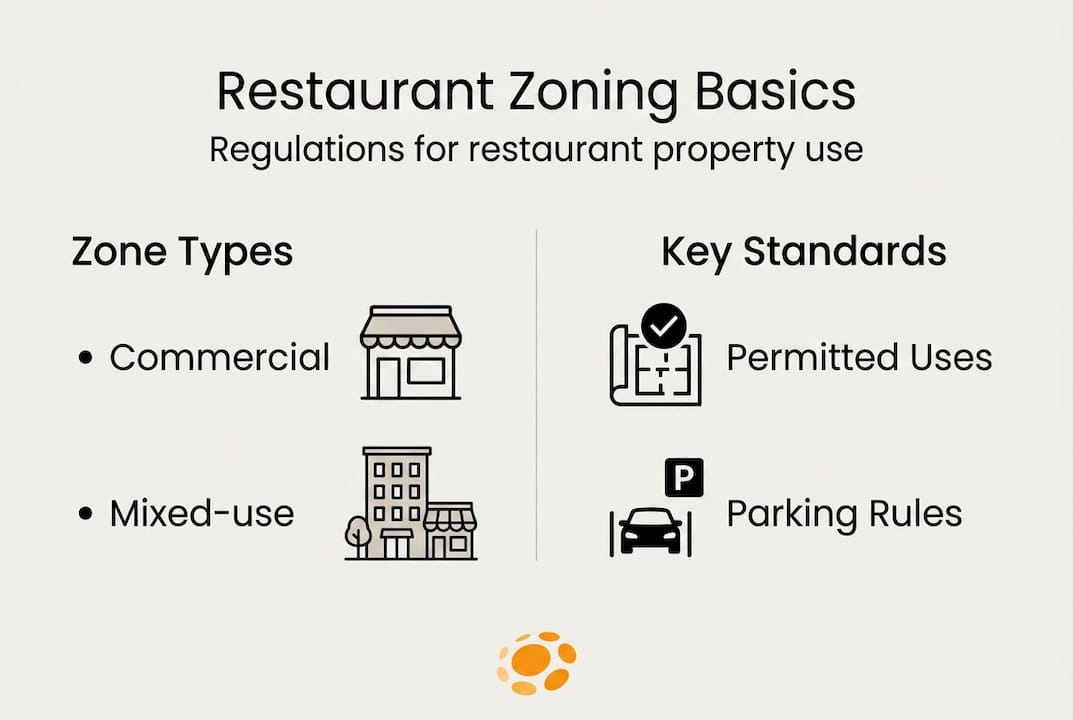
Zoning is always controlled at the city or county level. There is no national zoning code. That means a rule in Austin, Texas has zero bearing on what’s allowed in Austin, Minnesota. Every municipality writes its own code, uses its own terminology, and enforces its own processes. This is why understanding zoning requirements before lease signing is so critical, especially for operators expanding across state lines or into unfamiliar markets.
Here’s a quick breakdown of the zone types most relevant to restaurant operators:
| Zone type | Typical use | Restaurant allowed? |
|---|---|---|
| General commercial (C-2, C-3) | Retail, services, restaurants | Usually yes |
| Neighborhood commercial (C-1) | Small retail, cafes | Sometimes, with limits |
| Mixed-use (MU) | Retail, office, residential | Often yes, ground floor |
| Industrial (M-1, M-2) | Manufacturing, warehouses | Rarely, unless rezoned |
| Special overlay district | Historic, pedestrian, transit | Varies widely |
Beyond zone type, you also need to understand three core concepts:
- Permitted use: Your exact restaurant concept must match a listed or conditional use in that zone.
- Bulk standards: These are physical rules like building setbacks from property lines, maximum height, and lot coverage percentages that affect what you can build or modify.
- Occupancy classification: Fire codes and building departments assign occupancy types that determine how many people can legally be in the space, which affects seating and revenue projections.
Operators often treat zoning as a formality. It’s not. It’s a governing legal document, and skipping it early almost always creates expensive delays later.
Navigating zoning codes: Permitted uses, bulk standards, and parking
Once you know which zone a property sits in, the next step is pulling the actual zoning code and reading the use table. Most municipalities post their codes online, and many have interactive zoning maps. You search the address, identify the zone designation, and then look up what’s permitted in that zone. The use table will tell you whether a standard restaurant is permitted by right, conditional (requiring a permit), or prohibited outright.
Key mechanics include verifying permitted uses via zoning maps and codes, obtaining zoning verification before leasing, and complying with bulk standards such as parking, loading zones, setbacks, signage limits, and lighting restrictions. Parking requirements are often the most painful of these. The formula sounds simple but causes enormous headaches in practice.
Parking requirements in many cities demand roughly 1 space per 75 square feet of gross floor area for restaurants, with national retail and restaurant averages running 4 to 5 spaces per 1,000 square feet, and restaurants sitting at the higher end due to customer turnover. Drive-thru stacking lanes often require 150 to 200 feet of minimum stacking distance, and outdoor dining areas typically count toward gross floor area calculations. A 3,000 square foot restaurant could require 40 dedicated parking spaces under strict local codes, which is physically impossible on many urban parcels.
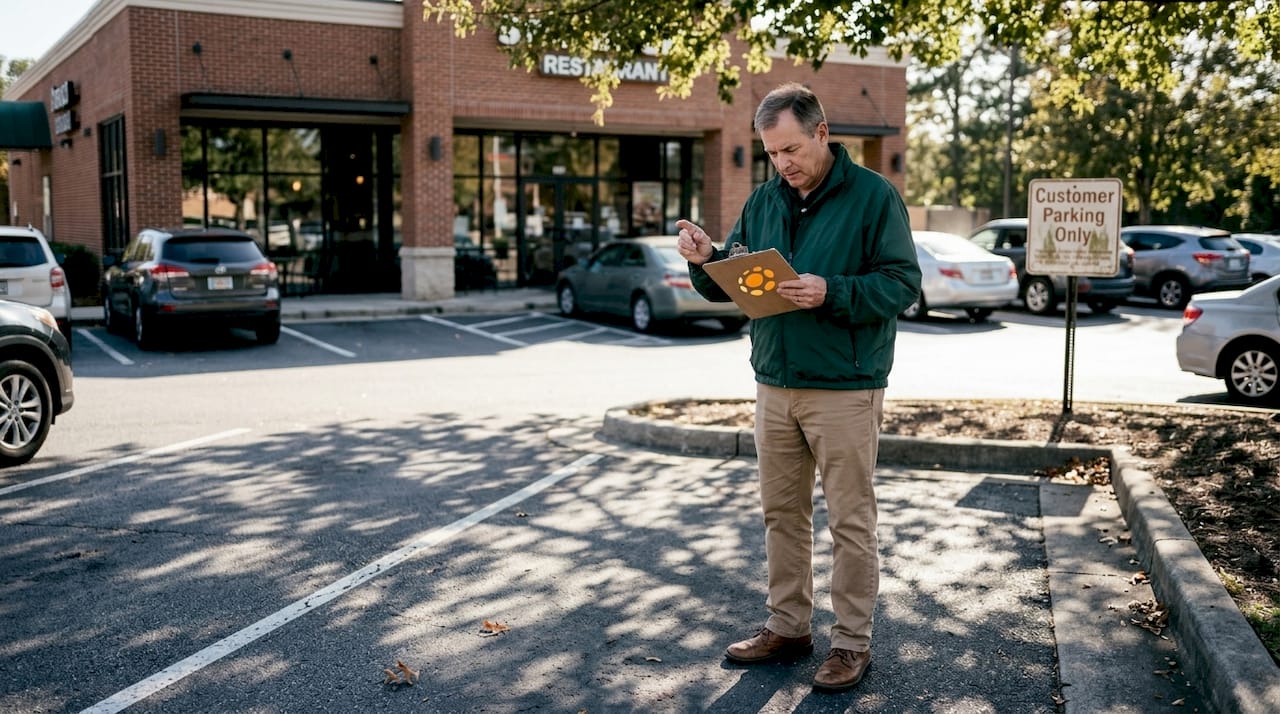
Pro Tip: Before you even walk through a space, count the parking spots on and adjacent to the property. Then pull the zoning code and calculate the required spaces for your intended square footage. If the numbers don’t match and there’s no shared parking agreement in place, you may already have a problem.
Here’s a practical research checklist every operator should run before signing anything:
- Confirm the zone designation at the county assessor or city planning portal
- Pull the use table and verify your specific concept type (fast casual, full-service, drive-thru) is permitted
- Check parking ratios for your estimated gross floor area
- Review setback requirements, especially if you plan exterior renovations or a patio
- Look for signage restrictions that could affect your branding visibility
- Identify any overlay districts that add a second layer of rules on top of the base zone
Review your restaurant expansion checklist alongside the zoning code so nothing slips through. And remember that bulk standards can affect construction budgets significantly. A required loading zone on a tight urban lot might consume space you planned to use for seating. A setback requirement might prevent you from installing the entrance you designed. Always factor hidden build-out costs that stem directly from zoning constraints into your pro forma before committing.
Conditional use permits, variances, and special restaurant features
Some restaurant features aren’t automatically allowed even in commercial zones. They require a separate approval layer. This is where conditional use permits, commonly called CUPs, and variances come into play. Understanding the difference between them is not just academic. It determines how long your timeline stretches, how much money you spend on applications and legal fees, and whether neighbor opposition can actually kill your project.
Many features like alcohol service, outdoor seating, drive-thrus, and late-night operations require conditional use permits involving public hearings, neighbor input, and potential conditions attached to approval. CUPs authorize uses listed as conditional in the zone based on their compatibility with surrounding properties. The logic is that these features have potential negative effects on neighbors, and the community should have a say before they’re approved.
The CUP process typically follows this sequence:
- Submit a formal application with site plans, hours of operation, and concept details
- Staff review and environmental analysis (if required by state law)
- Public notice mailed to neighboring property owners within a defined radius
- Planning commission hearing where the public can speak in favor or opposition
- Commission vote with conditions attached, such as restricted hours, sound barriers, or limited occupancy for outdoor areas
- Appeal period where neighbors can challenge the decision
“The neighbor who objects loudest at a planning hearing often has more power than the operator thinks. A single vocal opposition rarely kills a well-prepared application, but it can trigger procedural delays of three to six months and add conditions that fundamentally change your concept’s viability.”
Variances provide exceptions to dimensional standards such as reduced parking or setbacks upon proving property-specific hardship, and are distinct from CUPs which address use compatibility. Both require hearings, but variances are harder to obtain because you must demonstrate that the hardship is unique to your parcel, not just inconvenient for your business plan.
Think of it this way: a CUP asks “does this use belong here?” while a variance asks “can this property physically comply with the standard?” If your site has an unusually irregular lot that makes standard parking ratios impossible, a variance might be appropriate. If you want to serve alcohol and stay open until 2 a.m., you need a CUP. Both take time. Neither is guaranteed. Planning for restaurant real estate 101 means knowing which approval path applies to your concept before you’re under contract.
Pro Tip: If a property’s previous tenant held a CUP for alcohol service or outdoor dining, check whether that permit is transferable or attached to the property rather than the operator. Inherited CUPs can save months of process time, making second-generation spaces especially valuable from a permitting standpoint.
Zoning edge cases and real-world examples: What can go wrong
Standard zoning code research covers most situations, but the cases that actually destroy well-funded projects are the edge cases. These are the rules buried in overlay districts, density caps hidden in neighborhood-specific plans, and procedural invalidities that send permits back to square one.
New Orleans imposes density limits that cap standard restaurants at five per block in certain districts and as few as one per 100 linear feet on Harrison Avenue. That rule is invisible unless you read the neighborhood overlay standards, not just the base zone. Operators have signed leases in New Orleans commercial corridors only to discover the density cap was already maxed out by neighboring restaurants.
“Drive-thru bans in pedestrian overlay districts are becoming more common in cities prioritizing walkability. A national QSR brand can build out a full prototype site, only to be told that the drive-thru lane, a core revenue driver for the concept, is not permitted in that specific overlay zone.”
Real-world denials illustrate this clearly:
- Little Rock, Arkansas: A Little Caesars location near the Governor’s Mansion was rejected by zoning panel due to neighborhood character concerns, despite meeting base zone standards.
- Penfield, New York: A proposed Chick-fil-A faced opposition in an overlay district, with residents citing traffic and incompatibility with the neighborhood design standards.
- San Jose, California: A Chick-fil-A permit was initially conditioned in a procedurally invalid manner, requiring the operator to restart the hearing process entirely.
These aren’t obscure situations. They happen to well-resourced operators with experienced legal teams. The pattern is consistent: a site looks clean at the base zone level, but an overlay district, a density limit, or a procedural error creates a months-long delay or an outright denial.
| Risk factor | Common cause | Mitigation strategy |
|---|---|---|
| Density cap exceeded | Too many restaurants on block | Check neighborhood overlay plans |
| Drive-thru ban | Pedestrian or transit overlay | Confirm overlay rules before design |
| Neighbor opposition | CUP hearing | Community outreach before filing |
| Nonconforming use | Prior tenant’s certificate of occupancy | Review COO before lease |
| Procedural invalidity | Flawed hearing process | Hire land use attorney early |
If you’re evaluating a restaurant drive-thru site, the overlay district and stacking requirements deserve as much attention as the lease rate. A site that fails zoning approval after design work begins is one of the most expensive mistakes in restaurant real estate.
Expert perspective: What most operators miss about restaurant zoning
Most operators we talk to treat zoning as a checkbox. Something to confirm after the deal is essentially done. That’s backwards, and it’s an expensive way to learn the lesson.
The real insight isn’t just “check zoning early.” It’s that zoning is site-specific in ways that brokers and landlords often don’t fully understand either. A broker may tell you a space is “zoned commercial” with complete confidence, and still be missing an overlay district rule that changes everything. We’ve seen that exact scenario stall projects by six months in markets across the country.
The move that protects you is simple: include a zoning contingency in every letter of intent. Give yourself 30 to 60 days to verify the zoning is clean for your specific concept, including any CUPs you’ll need, before your deposit goes hard. Review the full California zoning checklist as a model, even if you’re operating in another state, because it covers the categories most codes share.
Neighbor opposition is also underestimated as a risk factor. A single well-organized neighborhood group can stall a CUP for months, add costly operating conditions, or force design changes that gut your concept’s economics. Savvy operators do informal community outreach before filing, not after. That one conversation with the adjacent property owner can be the difference between a smooth hearing and a six-month procedural fight. Zoning is not just a legal process. It’s a community process, and the operators who treat it that way move faster.
Find compliant restaurant properties faster with Pepperlot
Knowing the rules is one thing. Finding a property that already clears them is another.
Pepperlot is built specifically for restaurant operators who don’t want to waste time on properties that won’t work for their concept. Every listing on the platform includes restaurant-specific details: grease traps, existing permits, seating capacity, outdoor patio information, and drive-thru configurations. You can filter for turnkey spaces that already hold relevant permits, reducing the CUP timeline before you’ve even picked up the phone. Browse a live example like this restaurant for sale in Inglewood to see how detailed listings remove guesswork. Pair that with Pepperlot’s restaurant location intelligence tools to verify parking ratios, density data, and local competition before you commit to a site.
Frequently asked questions
Can I open a restaurant in any commercial zone?
No. While restaurants are typically permitted in commercial or mixed-use zones, each zone has its own standards, and many require conditional use permits for specific features like alcohol service, outdoor dining, or late-night hours.
How do parking requirements affect restaurant property viability?
Parking minimums such as 1 space per 75 sq ft can force capacity reductions or kill deals entirely unless variances or shared parking agreements are negotiated with neighboring property owners.
What steps are required to get a conditional use permit (CUP) for a restaurant?
You must submit an application, pass through a public hearing, collect neighbor input, and satisfy conditions set by the local planning authority for features like alcohol service, drive-thrus, or extended operating hours.
What is the difference between a variance and a conditional use permit?
A variance grants an exception to a physical or dimensional standard due to property-specific hardship, while a conditional use permit addresses whether a particular use is compatible with the surrounding zone and requires public hearing approval.
Are there any unusual zoning restrictions for restaurants?
Yes. Jurisdictions can impose density caps, drive-thru bans, minimum distance rules from schools or residences, and overlay district requirements that apply on top of base zone standards.
Recommended
- What Zoning Requirements Should You Check Before Signing a Restaurant Lease in California? | PepperLot Blog
- Restaurant Real Estate 101: How to Find, Lease, or Buy the Right Space for Your Concept | PepperLot Blog
- A Practical Checklist for Evaluating a Restaurant Expansion Location | PepperLot Blog
- Restaurant Lease Terms Explained: Secure Your Ideal Space
Leave a Reply