
TL;DR:
- Defining whether to buy real estate, an asset, or lease shapes your entire acquisition strategy.
- Proper due diligence and understanding lease terms are critical to avoid costly mistakes.
- Most restaurant operators prefer leasing over ownership, valuing flexibility and lower initial costs.
Buying restaurant property is one of the highest-stakes decisions you will make as an operator or investor. One wrong move, whether it is a bad lease structure, skipped due diligence, or an inflated purchase price, can wipe out years of profits before you even open your doors. Most first-time buyers feel overwhelmed because there are so many moving parts: financing, legal review, equipment audits, permits, and negotiation all happening at once. This guide walks you through every phase of the process, from building your acquisition strategy to closing the deal, so you can move forward with clarity and confidence instead of guesswork.
Table of Contents
- Define your acquisition strategy
- Requirements, deal sourcing, and preparation
- Screening and due diligence
- Making offers, financing, and closing the deal
- What most guides get wrong about buying restaurant property
- Find your ideal restaurant property on Pepperlot
- Frequently asked questions
Key Takeaways
| Point | Details |
|---|---|
| Choose your strategy | Decide if buying or leasing restaurant property fits your goals, resources, and growth plans. |
| Get prepared | Line up financing, advisors, and deal criteria before starting your property search. |
| Do thorough due diligence | Check the lease, financials, assets, and risks before making an offer to avoid costly mistakes. |
| Understand costs and value | Know industry benchmarks for valuation, buildout, and occupancy so you don’t overpay. |
| Leases often drive success | For most first-timers, securing the right lease matters more than owning the real estate itself. |
Define your acquisition strategy
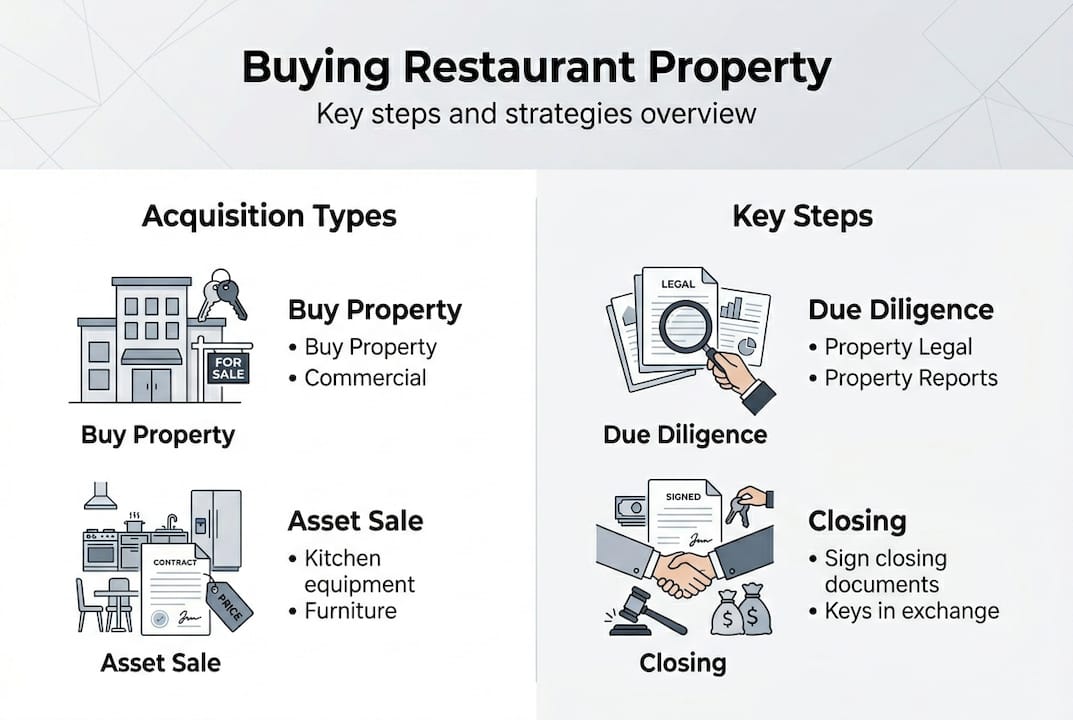
The first decision you make shapes every step that follows. Most restaurant property acquisitions start by defining whether you are buying the real estate itself, buying an existing restaurant business as an asset sale, or leasing space for a new concept. These three paths are very different, and mixing them up early causes confusion later.
An asset sale means you are buying the equipment, permits, brand, and sometimes the lease, but not the physical building. A real estate purchase means you own the land and structure. A lease means you occupy and operate without ownership. Each path has real tradeoffs you need to weigh before you talk to a single broker.
| Factor | Buying real estate | Asset sale | Leasing |
|---|---|---|---|
| Upfront cost | High | Medium | Low |
| Equity building | Yes | Limited | No |
| Flexibility | Low | Medium | High |
| Control | Full | Operational | Tenant-level |
| Cash flow impact | Capital-heavy | Moderate | Lower fixed cost |
Owning versus leasing impacts cash flow, flexibility, risk, and long-term wealth in ways that vary widely depending on your concept, market, and timeline. An operator planning to scale to five locations in three years needs flexibility. An operator building a flagship concept they plan to hold for twenty years may benefit from ownership.
Here is something worth knowing: the vast majority of restaurant operators lease rather than own their real estate. Independent operators and even large chains often choose leasing vs owning to protect capital and stay nimble. Ownership tends to make more sense when real estate is the actual investment thesis, not just a means to run a restaurant.
Some experienced operators use hybrid models, owning a flagship location while leasing expansion sites. This balances wealth building with operational flexibility. Understanding the differences between a buying vs leasing situation is foundational before you ever tour a property.
Key strategic questions to answer before you search:
- Are you investing in real estate or in the restaurant business?
- Do you need flexibility to grow or relocate in the next five years?
- Can you absorb the capital required for a property purchase?
- Are you acquiring an existing concept or building from scratch?
Understanding the restaurant sale or lease differences at this stage will save you from pursuing the wrong deals entirely. Once your strategy is locked in, every subsequent decision becomes sharper.
Pro Tip: Write down your acquisition strategy as a one-page brief before approaching any broker. It saves weeks of misdirected touring and signals to sellers that you are serious.
Requirements, deal sourcing, and preparation
Once your overall strategy is clear, it is time to get prepared and start sourcing actual opportunities. This phase separates buyers who close deals from those who spend months spinning their wheels.
Upfront requirements include equity, credit, professional advisors, and knowing your deal parameters. Most lenders want to see 20-30% down for a commercial purchase. Your credit score, business plan, and operating history all affect financing options. Get pre-approved or at least pre-serious before you start serious property tours.
| Requirement | Details |
|---|---|
| Down payment | 20-30% of purchase price typical |
| Credit score | 680+ preferred for SBA loans |
| Professional team | Broker, attorney, CPA at minimum |
| Site criteria | Size, hood/grease trap, seating, zoning |
| Deal benchmarks | 2-4x SDE for business; under 10% occupancy cost |
Your professional team is not optional. A commercial real estate broker who specializes in restaurant properties understands what a grease trap, Type I hood, and occupancy permit actually mean for a deal. A restaurant attorney reads lease clauses that a general attorney might miss. An accountant familiar with hospitality helps you evaluate true profitability numbers.
Where to find quality restaurant deals:
- Specialized platforms like Pepperlot with restaurant-specific listings
- Local commercial brokers with F&B specialization
- Business brokers listing restaurant assets
- Industry networks, trade associations, and local operator communities
- Off-market introductions through your attorney or accountant
Knowing your restaurant deal benchmarks before you look protects you from overpaying. Businesses typically sell at 2-4x seller’s discretionary earnings. Buildout costs commonly run $150k to $500k or more depending on condition. Equipment packages add $100k to $400k. Occupancy cost (rent as a percent of revenue) should stay under 10% for most concepts.
A common prep-stage mistake is touring properties without a clear site criteria list. You need to know minimum square footage, required equipment (hood systems, grease trap size, walk-in coolers), parking, zoning, and neighborhood demographics before you visit. Use a restaurant expansion location checklist to stay organized and consistent across every property you evaluate.
Pro Tip: Run a quick occupancy cost test on any listing before you visit. Take the annual rent, divide by projected revenue, and if the number is above 10-12%, your margins will be under serious pressure from day one.
Screening and due diligence
You are ready to evaluate real opportunities. Here is how to dig deeper and avoid costly mistakes before you commit a dollar.
Screening includes in-depth financial review, lease evaluation, equipment and asset checks, and due diligence on permits and property condition. This is the phase where deals look very different on paper than they do in reality.
Step-by-step screening process:
- Request three years of P&L statements, tax returns, and sales data
- Review the lease terms including base rent, CAM charges, term length, and renewal options
- Inspect all equipment for age, condition, and ownership status (owned vs leased)
- Verify all permits: health, fire, certificate of occupancy, and liquor license if applicable
- Assess physical condition of the space including hood systems, grease trap, and HVAC
- Check for any unpermitted work, outstanding violations, or pending litigation
Understanding restaurant lease terms is critical during this phase. Look for personal guarantee requirements, radius restrictions, exclusivity clauses, and options to renew. A lease with no renewal option is a serious risk: your landlord can decline to renew and you lose your entire investment in the business.
Red flags to walk away from: Occupancy costs above 12-15% of current revenue. Equipment that is past useful life with no replacement plan. Permits tied to the current owner personally rather than the business or space. Significant deferred maintenance on kitchen infrastructure.
Quick due diligence checklist:
- Verified P&L and tax returns (not just projections)
- Lease reviewed by your attorney (especially assignment and sublease rights)
- Equipment list with ages and service records
- Permit and license status confirmed with local authorities
- Health department inspection history
- Structural and mechanical inspection of the physical space
Knowing the difference between a lease assignment vs sublease matters here too. If you are buying the business, you need to understand whether the existing lease can be assigned to you or whether you will need a new lease negotiated from scratch.
Review everything through the lens of your site visit checklist so nothing gets missed in the excitement of a promising deal.
Making offers, financing, and closing the deal
Once you have identified the right property and completed due diligence, the offer and closing stage is your path to ownership.

Key steps include a Letter of Intent, financing, final negotiations, closing, and the transition period. Each step has real timelines and paperwork you need to plan for.
The offer and closing process:
- Submit a Letter of Intent (LOI) outlining price, terms, contingencies, and timeline
- Negotiate key terms: price, included assets, training period, non-compete clause
- Secure financing: SBA 7(a) loans, SBA 504 for real estate, seller financing, or conventional commercial loans
- Complete final due diligence and satisfy all contingencies
- Review and execute purchase agreement, lease assignment, or new lease
- Close and receive all keys, permits, and transfer of accounts
Financing options vary widely. SBA loans are popular for first-time buyers because they require less down and offer longer repayment terms. Seller financing, where the seller carries a portion of the price, is common in restaurant deals and signals seller confidence in the business. For first-time buyer steps, understanding which loan type matches your deal structure saves weeks.
Industry benchmarks to anchor your offer:
Restaurants typically sell for 2-4x SDE or EBITDA. Buildout and equipment are separate from the business valuation. Occupancy costs should stay under 10% of revenue. Use these benchmarks to test whether the asking price is grounded in reality or wishful thinking.
Post-closing transition is often overlooked. Plan for a seller training period of two to four weeks minimum. Transfer all vendor relationships, supplier accounts, and staff information. Update permits and licenses to your name promptly. Ignoring these steps leads to operational disruptions right when you need momentum. Review the restaurant real estate FAQ for common closing questions.
Pro Tip: Always include a training and transition clause in your purchase agreement. A seller who disappears the day after closing leaves you without critical operational knowledge that no document can fully replace.
What most guides get wrong about buying restaurant property
Here is the truth that most buyer guides skip: obsessing over whether you own the building is the wrong priority for most restaurant operators. The lease is the real asset. A well-structured lease with strong renewal options, below-market rent, and favorable assignment rights creates more business value than owning a building ever will for most concepts.
The majority of restaurant transactions are asset sales with lease assignments, not real estate purchases. Yet buyers regularly fixate on ownership and overpay for property, then wonder why margins are thin. The biggest mistake we see is paying a premium for real estate while accepting a weak lease structure on the operating business.
Operators who understand why leases drive value approach acquisitions differently. They negotiate hard on rent escalation caps, renewal options, and permitted use clauses. They treat the lease as a core asset, not a line item. That mindset is what separates operators who build long-term value from those who are always one lease renewal away from losing everything they built. The benefits of owning restaurant property are real, but only when ownership fits your actual strategy.
Find your ideal restaurant property on Pepperlot
If you are ready to take the next steps, finding the right listings and expert tools will make your property search significantly more focused.
Pepperlot is built exclusively for restaurant and F&B real estate, so every listing includes the details that actually matter to operators: grease trap size, hood systems, seating capacity, permits, and outdoor space. You can explore a restaurant business for sale with full infrastructure already in place, or browse available restaurant spaces for lease tailored to your concept. Use Pepperlot’s location intelligence tools to analyze competition, demographics, and site potential before committing. With over 500 active users including operators, landlords, and brokers, Pepperlot connects serious buyers with serious sellers, cutting out the noise of generic commercial real estate platforms.
Frequently asked questions
Is it better to buy or lease restaurant property?
Leasing is preferred for flexibility and lower upfront costs, making it the typical starting point for most operators, while buying builds equity and long-term control for those with the capital and commitment to own.
What are typical costs when buying a restaurant?
Businesses sell at 2-4x SDE/EBITDA for the operating business, with buildout costs commonly ranging from $150k to $500k or more and equipment packages adding $100k to $400k on top.
What is due diligence when buying a restaurant property?
Due diligence means checking the property’s financials, lease terms, equipment condition, permit status, and any legal or operational risks before you sign anything or commit funds.
How long does it take to buy a restaurant property?
The full acquisition process typically takes two to six months from initial search to closing, depending on deal complexity, financing approval timelines, and how smoothly negotiations proceed.
Recommended
- How to Buy a Restaurant: A Step-by-Step Guide for First-Time Buyers | PepperLot Blog
- Restaurant Real Estate 101: How to Find, Lease, or Buy the Right Space for Your Concept | PepperLot Blog
- How to Sell a Restaurant Space in California, The Complete Guide for Owners and Investors | PepperLot Blog
- How to Attract Serious Restaurant Tenants for Your Property in California | PepperLot Blog
- Restaurant Reputation Management: A Complete How-To Guide | Sorbey Blog | Sorbey
Browse restaurants for sale on PepperLot.
Browse sell a restaurant on PepperLot.
Leave a Reply