
TL;DR:
- Choosing the right location involves evaluating physical fit, visibility, parking, demand, and competition.
- Keep occupancy costs under 10% of projected gross sales and request detailed lease breakdowns.
- Match your restaurant concept to the location and use data-driven analysis to prevent mismatched failures.
Your restaurant’s location can generate a packed dining room every Friday night, or it can quietly drain your savings until you close your doors. The difference often comes down to two decisions most operators underestimate: choosing the right space and negotiating the right lease. Unlike other business costs, your real estate commitment locks you in for years, sometimes decades. A miscalculation at the start creates a burden that clever marketing or great food cannot fix. This guide walks you through the critical criteria, cost frameworks, negotiation tactics, and specialist considerations you need to secure a restaurant space that actually supports your concept and your bottom line.
Table of Contents
- Essential criteria for choosing a restaurant location
- How to analyze occupancy costs and set your lease budget
- Lease negotiation strategies: what to ask for (and avoid)
- Special considerations: QSRs, NNN leases, and when the math changes
- The overlooked art of matching restaurant concept and location
- Find your next restaurant space with Pepperlot
- Frequently asked questions
Key Takeaways
| Point | Details |
|---|---|
| Right-sizing your space | Match your location’s layout and size to your menu, service style, and projected guest count for operational success. |
| Occupancy costs matter | Cap rent and occupancy costs at no more than 10% of projected sales for long-term profitability. |
| Negotiate smart | Always seek key lease terms like kick-out and co-tenancy clauses to protect your investment. |
| Team up for deals | Use experienced restaurant brokers and legal experts to avoid costly mistakes during negotiations. |
| Adapt for your segment | QSR and fast casual restaurants may face different lease terms but can thrive with the right strategy. |
Essential criteria for choosing a restaurant location
Site selection is not just about picking a busy street. It is a structured evaluation of how a space will serve your concept, your staff, and your customers every single day.
Start with the physical fit. Your kitchen needs to accommodate your equipment layout, your storage requirements, your hood ventilation system, and your service flow. A beautiful dining room means nothing if your back-of-house is cramped and inefficient. As Bank of America outlines, the space must match your concept in terms of kitchen operations, storage, and seating capacity before any other factor gets considered.
Beyond the building itself, assess these external factors:
- Visibility and signage: Can drivers and foot traffic see your restaurant clearly? Poor visibility kills awareness before you even open.
- Parking and access: Is there dedicated parking, nearby lots, or strong public transit? Barriers to entry reduce covers.
- Local demand: Are your target customers actually living, working, or passing through this area in meaningful numbers?
- Zoning and permits: Does the space have the right municipal classification for food service? Are permits transferable from a previous tenant?
- Competition density: How many similar restaurants operate within a half-mile radius? Use a restaurant site checklist to score each factor systematically.
On competition, the nuance matters. Some competition confirms demand, which is a healthy signal. But too many similar concepts fighting over the same customer pool creates a race to the bottom on pricing and marketing spend. The smarter play is either to enter an area with clear unmet demand or to position your concept as genuinely complementary to what already exists.
Pro Tip: Visit any shortlisted location at least three different times during peak hours. Lunch, dinner, and weekend service will each reveal different traffic patterns, parking realities, and neighborhood energy that a cold Tuesday morning visit will completely hide.
Do not rush this stage. Every hour you spend evaluating locations before signing saves months of operational pain after opening.
How to analyze occupancy costs and set your lease budget
Once you have a feel for your target location, the numbers need to work. This is where many operators make emotionally driven decisions they later regret.

The core benchmark you need to know: keep occupancy costs under 10% of your projected gross sales. Under 6% is excellent, 6 to 8% is healthy, 8 to 10% is acceptable, and anything over 10% puts your operation in a risky position from day one. Occupancy costs include your base rent plus all additional fees.
Here is how a typical lease cost structure breaks down:
| Cost component | What it means |
|---|---|
| Base rent | The fixed monthly amount per square foot |
| NNN (triple net) fees | Property taxes, building insurance, and maintenance passed to tenant |
| CAM charges | Common area maintenance fees for shared spaces like lobbies or parking lots |
| Percentage rent | Additional rent tied to a portion of your gross sales above a threshold |
To put this into practice, here is a sample budget table based on projected annual gross sales:
| Annual gross sales | Max safe occupancy cost (10%) | Target cost (7%) |
|---|---|---|
| $800,000 | $80,000/year | $56,000/year |
| $1,200,000 | $120,000/year | $84,000/year |
| $2,000,000 | $200,000/year | $140,000/year |
To set your maximum safe lease commitment, follow these steps:
- Build a conservative revenue projection based on your concept, covers per service, and average check size.
- Multiply projected gross sales by 0.07 to 0.10 to get your occupancy cost ceiling.
- Request full NNN and CAM breakdowns from the landlord, not just the base rent headline figure.
- Factor in buildout costs amortized over your lease term.
- Leave a cash reserve for permitting delays and pre-opening expenses that often run longer than expected.
You can also explore restaurant real estate 101 for a deeper breakdown of how lease structures vary by property type and market.
Pro Tip: Buildout and permitting delays average two to four months in most urban markets. Budget at least three months of rent at zero revenue when calculating your true pre-opening cost. Many operators skip this and find themselves cash-negative before their first customer walks in.
Lease negotiation strategies: what to ask for (and avoid)
Knowing your numbers gives you power at the negotiating table. Now use that power strategically.
The clauses below are non-negotiable asks for any serious restaurant operator:
- Kick-out clause: If your sales fall below a defined threshold for a sustained period, you can exit the lease without catastrophic penalties. This is critical protection against underperforming locations.
- Co-tenancy clause: If a major anchor tenant leaves the center or building, you have the right to reduce rent or exit. Losing an anchor can decimate foot traffic overnight.
- Assignment and subletting rights: If you need to sell your business or restructure, you want the right to transfer the lease without landlord approval blocking the deal.
- Renewal options with fixed terms: Lock in your right to renew at a predetermined rate, not a vague “market rent” figure that can spike unpredictably.
As restaurant lease experts advise, negotiating kick-out clauses for low performance and co-tenancy protection for anchor tenant dependency are two of the most overlooked but highest-impact lease protections available.
Here is a quick comparison of negotiation wins versus deal-breakers:
| Negotiate to win | Watch out for |
|---|---|
| Kick-out clause | Unlimited personal guarantees |
| Co-tenancy protection | Vague “market rate” renewal language |
| Assignment rights | No cap on NNN cost escalations |
| Free rent period during buildout | Exclusivity clauses that are too narrow |
| Tenant improvement allowance | Short renewal windows with no notice period |
“Never negotiate a restaurant lease alone. Assemble a team with a restaurant-specialized broker, a commercial real estate attorney, and a CPA who understands hospitality financials before you open any discussion with a landlord.”
This advice from lease negotiation specialists reflects a reality that catches solo operators off guard repeatedly. Landlords negotiate leases every week. Most operators do it once or twice in their careers. The experience gap is real.
Review your local real estate FAQ for answers to common lease questions before your first landlord meeting.
Special considerations: QSRs, NNN leases, and when the math changes
Not every restaurant deal fits the same mold. Quick service restaurants operate under different real estate math, and understanding that math matters whether you are a franchisee or an independent operator entering fast casual.
For QSRs and franchise concepts, NNN leases are the standard, with cap rates around 5.7% in 2025 and total occupancy costs that can reach 9 to 11% of gross sales in some markets, which technically exceeds the standard benchmark. Yet these operations succeed because their sales volume and customer throughput more than compensate for the higher cost ratio.
Here is how QSR lease metrics compare to full-service restaurant benchmarks:
| Metric | Full-service restaurant | QSR or fast casual |
|---|---|---|
| Typical occupancy cost ratio | 6 to 10% of gross sales | 9 to 11% of gross sales |
| Common lease structure | Modified gross or NNN | Triple net (NNN) |
| Cap rate expectation | Varies widely | ~5.7% in 2025 |
| Lease term length | 5 to 10 years | 10 to 20 years |
Key considerations specific to QSR and fast casual deals:
- High throughput offsets high costs: Drive-through and counter service models generate more transactions per hour than sit-down restaurants, making a higher occupancy ratio sustainable.
- Brand covenant matters: Franchised locations with proven national brands receive better lease terms because landlords see lower default risk.
- Location type shifts the analysis: A standalone pad site with strong drive-through access justifies premium rents that an inline strip center location does not.
- Franchise disclosure documents define your range: Many franchise agreements cap the rent you can agree to, so read the FDD carefully before touring spaces.
For operators exploring this segment, browsing fast casual lease examples gives you a real-world sense of how these properties are structured and priced in today’s market.
The overlooked art of matching restaurant concept and location
Here is something the standard real estate playbook rarely says out loud: most restaurant location failures are not caused by bad markets. They are caused by mismatched concepts.
Operators fall in love with a deal. The space is beautiful, the rent is low, the landlord is motivated. But the neighborhood skews young and fast-paced while the concept is a sit-down tasting menu. Or the location is buried in an office park that goes quiet by 7 PM, and the concept depends on dinner revenue. The numbers looked fine on paper. The concept never had a chance.
Location intelligence is the discipline that closes this gap. Instead of relying on gut feel or walkability impressions, you layer demographic data, competition density, average check affinity, and foot traffic patterns to score how well a space actually fits your model. The buy vs. lease insights discussion adds another layer, because the right financial structure also depends on your concept’s growth trajectory.
The most durable restaurant real estate decisions we see are made by operators who start with their concept identity and work backward to location requirements, not the other way around. Find the space that fits your brand, your customers, and your operational model. A slightly higher rent in the right location will always outperform a bargain space that fights your concept every service.
Find your next restaurant space with Pepperlot
Pepperlot was built specifically for operators who take restaurant real estate seriously. Every listing on the platform includes the details that actually matter to restaurateurs: hood systems, grease traps, seating capacity, patio access, existing permits, and equipment included.
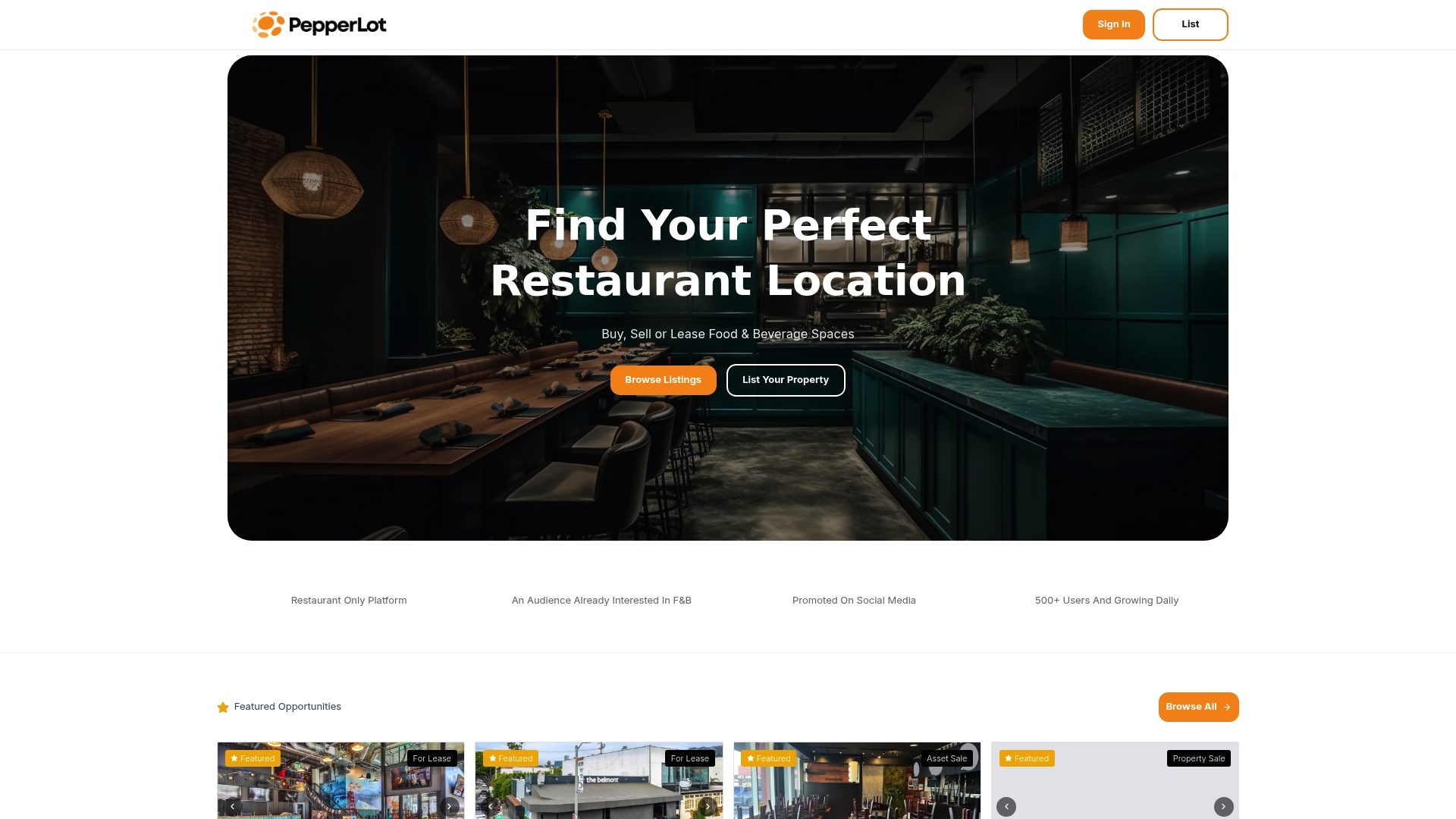
Whether you are evaluating a featured restaurant for lease, exploring a restaurant business for sale, or running location analysis before you commit, Pepperlot’s location intelligence tools give you the competitive and demographic context to make a data-driven decision. Stop guessing. Start evaluating with the right information in front of you.
Frequently asked questions
What is the ideal percentage of rent in restaurant revenue?
Aim to keep total occupancy costs under 10% of projected gross sales. Under 6% is excellent, 6 to 8% is healthy, and anything above 10% creates real financial risk.
What clauses are critical in a restaurant lease negotiation?
Prioritize kick-out clauses, co-tenancy protection, and assignment rights. Kick-out and co-tenancy clauses are among the most overlooked but highest-value protections you can negotiate.
How do QSR lease terms differ for franchisees?
QSRs commonly use triple net leases with cap rates near 5.7% and may carry occupancy costs of 9 to 11% of gross sales, supported by high transaction volumes.
Should I buy or lease restaurant space?
Leasing offers lower upfront cost and operational flexibility, while buying builds equity and long-term control but requires significantly more capital and carries greater financial exposure early on.
How can I make my restaurant stand out in a competitive area?
Differentiate your concept clearly or seek locations where your offer is complementary to existing businesses. Some competition signals healthy demand, but saturation without differentiation is a trap worth avoiding.
Recommended
- Restaurant Real Estate 101: How to Find, Lease, or Buy the Right Space for Your Concept | PepperLot Blog
- How to Attract Serious Restaurant Tenants for Your Property in California | PepperLot Blog
- Restaurant Lease Terms Explained: Secure Your Ideal Space
- Should You Buy A Restaurant Or Lease A New Space? | PepperLot Blog
- Essential restaurant tech checklist: upgrade your UK venue
Browse restaurant space for lease and restaurants for sale on PepperLot.
Leave a Reply