TL;DR:
- Successful restaurant investments rely on strong leases, creditworthy tenants, and prime locations.
- Cost segregation and bonus depreciation significantly boost after-tax returns on restaurant properties.
- Diversify investment strategies by assessing risk tolerance, location quality, and potential value-add opportunities.
Selecting the right restaurant property is one of the most consequential decisions a real estate investor can make. Get it right, and you’re looking at predictable passive income, meaningful tax advantages, and long-term appreciation backed by a corporate guarantee. Get it wrong, and you’re stuck with a vacant shell, a struggling franchisee, and a lease that doesn’t protect you. This guide breaks down the exact criteria, real-world transactions, and financial strategies that separate high-performing restaurant investments from costly mistakes, so you can move with confidence in your next deal.
Table of Contents
- What makes a restaurant property investment lucrative?
- Case study #1: $2.5M Chipotle NNN lease delivers passive cash flow
- Case study #2: Panera Bread drive-thru, triple-net lessons and opportunities
- Tax savings in action: Cost segregation and bonus depreciation
- Restaurant investment types: Side-by-side comparison
- What most investors miss, and when to break the rules
- Unlock restaurant property opportunities with Pepperlot
- Frequently asked questions
Key Takeaways
| Point | Details |
|---|---|
| NNN leases for stability | Single-tenant absolute NNN leases offer predictable, hands-off income with strong inflation protection. |
| Drive-thru demand surge | Modern drive-thru restaurant sites have become top-performing investments since 2020. |
| Tax strategies amplify returns | Cost segregation and bonus depreciation can generate major first-year tax savings for owners. |
| Comparison shapes strategy | Side-by-side analysis of investment types reveals risk and reward differences suited to your goals. |
| Fundamentals beat hype | The most successful investors prioritize real estate fundamentals and secure leases over aggressive cap rates. |
What makes a restaurant property investment lucrative?
With a clear sense of what’s at stake, let’s clarify what makes a restaurant property investment stand out before reviewing successful real-world cases.
The foundation of most successful restaurant property investments is the lease structure. The primary mechanic here is the single-tenant absolute triple-net (NNN) lease, which shifts all operating expenses, including taxes, insurance, and maintenance, directly to the tenant. This creates genuinely passive income for the landlord, with built-in rent escalations that protect against inflation. These deals are also ideal vehicles for 1031 exchanges, letting investors defer capital gains taxes by rolling proceeds into like-kind properties.
Beyond lease structure, you need to understand a few core metrics before you evaluate any deal:
- Cap rate: The ratio of net operating income to purchase price. A strong range for restaurant properties sits between 4% and 7%, depending on brand strength and location.
- Tenant credit quality: Corporate-guaranteed leases from publicly traded brands carry far less risk than franchisee-backed deals.
- Remaining lease term: More years left on the lease means more predictable income and a stronger resale position.
- Rent-to-revenue ratio: This tells you how sustainable the tenant’s rent obligation is relative to their actual sales volume.
- Site fundamentals: Traffic counts, demographics, proximity to anchors, and visibility all drive long-term occupancy.
Tax strategy is another layer that separates sophisticated investors from casual ones. Cost segregation accelerates depreciation on 5 and 15-year property components, generating immediate tax savings that can reach six figures on a single acquisition. Bonus depreciation amplifies those front-loaded benefits even further, boosting your internal rate of return (IRR) in ways that simple cap rate math doesn’t capture.
“The best restaurant investments aren’t just about yield. They’re about the intersection of a durable lease, a creditworthy tenant, and a location that makes operational sense for the brand.”
Pro Tip: Always benchmark rent as a percentage of projected revenue. Anything below 10% signals a sustainable obligation for the tenant. Above 12%, you’re looking at a stressed unit that could close before the lease expires.
Getting these fundamentals right starts with understanding restaurant real estate 101, and then sharpening your eye for evaluating restaurant locations using traffic and demographic data.
Case study #1: $2.5M Chipotle NNN lease delivers passive cash flow
Understanding key criteria, let’s see how they play out with a live market transaction involving a blue-chip tenant like Chipotle.
Marcus & Millichap recently brokered the $2.5M sale of a 5,000 SF Chipotle single-tenant net lease property in Wausau, Wisconsin. The deal featured a 15-year corporate-guaranteed lease, meaning Chipotle’s parent company, not a franchisee, is on the hook for rent payments. That distinction matters enormously.
Here’s what made this deal attractive to the buyer:
- Absolute NNN terms: The landlord has zero responsibility for taxes, insurance, or any maintenance costs. The check arrives every month, and that’s the full extent of the landlord’s involvement.
- Corporate guarantee: Chipotle Mexican Grill, Inc. is a multi-billion-dollar public company. That guarantee is about as creditworthy as you’ll find in the restaurant space.
- 15-year lease term: Long remaining term means strong resale value and predictable income for over a decade without renegotiation risk.
- Inflation protection: Rent escalations built into the lease ensure purchasing power doesn’t erode over time.
- 1031 exchange compatibility: The passive, hands-off nature of the deal makes it ideal for investors rolling out of active real estate into something more manageable.
Statistic callout: QSR cap rates averaged 5.68% in 2025, holding steady year over year. Top-tier brands like Chick-fil-A and Chipotle trade at mid-4% cap rates, reflecting the premium investors pay for credit quality and brand durability. Weaker or regional brands often price above 6%, compensating buyers for higher tenant risk.
The Wausau deal is a textbook example of what passive investors target. Low management burden, strong credit, long duration, and a location in a stable Midwestern market. If you’re exploring similar NNN lease deal examples, the structure here is the benchmark to measure against.
Case study #2: Panera Bread drive-thru, triple-net lessons and opportunities
Building on the Chipotle case, here’s how the same principles apply to another A-list brand, this time with a drive-thru advantage.
Hanley Investment Group arranged the $3.3M sale of a 4,373 SF Panera Bread drive-thru property in Plattsburgh, New York. Built in 2020, the property came with an absolute triple-net lease and approximately nine years remaining on the term. The deal illustrates a specific subset of restaurant investment that has surged in demand since 2020: the drive-thru asset.
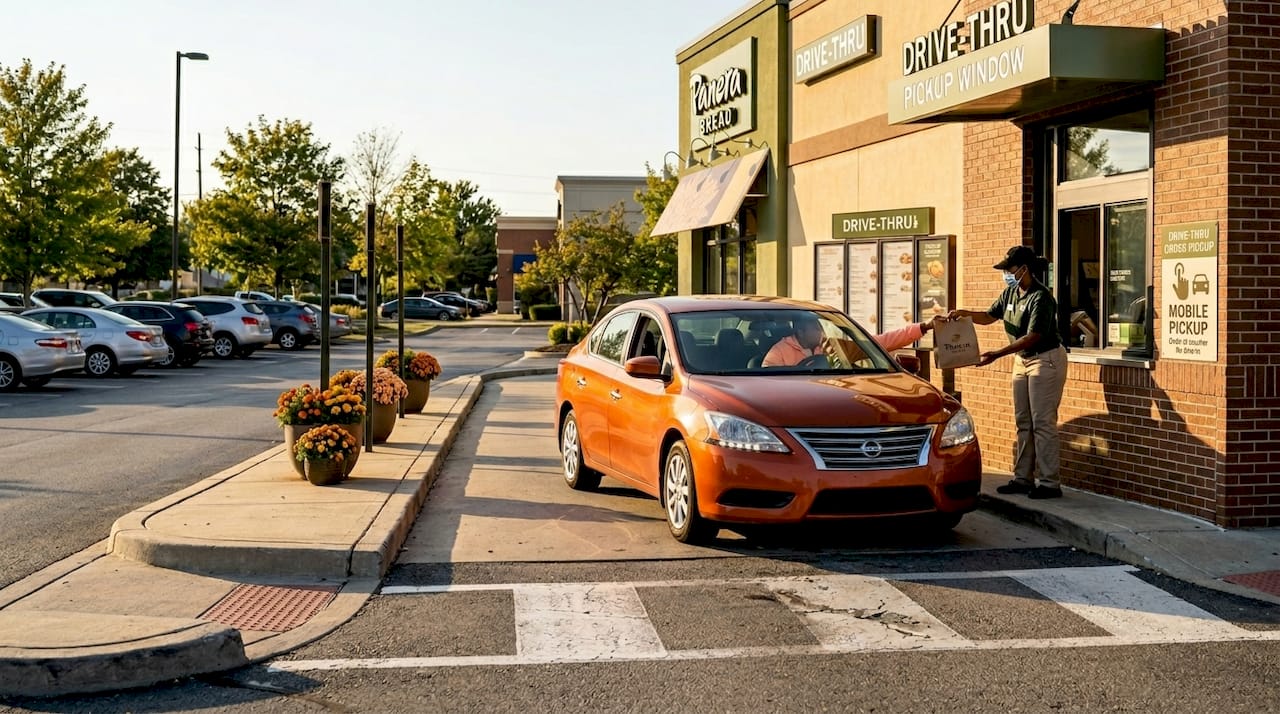
Why do drive-thru properties command premium pricing? The answer comes down to operational resilience. During periods of disruption, whether from public health events, staffing shortages, or economic downturns, drive-thru units outperform dine-in-only locations by a wide margin. Panera’s investment in digital ordering and loyalty integration makes its drive-thru units even stickier from a revenue standpoint.
Key takeaways from this transaction:
- Modern construction reduces capital risk: A 2020 build means minimal deferred maintenance and compliance issues for years to come.
- Drive-thru premium is real: Investors pay tighter cap rates for drive-thru assets because the format supports higher sales volumes and operational flexibility.
- Nine years remaining is still investable: While longer is better, nine years provides enough runway for a stable hold period and a clean exit before renegotiation pressure mounts.
- Location fundamentals matter even here: Plattsburgh sits near the Canadian border with consistent cross-border traffic, adding a geographic demand driver beyond local demographics.
- Absolute NNN means no surprises: Same as the Chipotle deal, the landlord collects rent and nothing else.
Pro Tip: When evaluating drive-thru assets, prioritize newer builds on high-traffic corridors with strong visibility from the road. Older properties with deferred maintenance can quietly erode your returns through capital calls you didn’t model. Browse current drive-thru opportunities to see how these fundamentals translate to active listings.
Tax savings in action: Cost segregation and bonus depreciation
Besides lease structure, savvy operators also maximize after-tax returns. Here’s how advanced strategies translate directly to the bottom line.
Most investors focus on cap rates and lease terms. The investors who actually outperform focus on after-tax cash flow. Cost segregation is the most powerful tool in that toolkit, and the numbers from real transactions prove it.
A fast food restaurant purchased for $1.335M generated $243,000 in first-year tax savings through cost segregation. Over a 10-year period, the net present value of those savings reached $204,000. On a sub-$1.5M acquisition, that’s a transformational boost to IRR that simple yield math completely misses.
Scale that up: a restaurant property acquired for $9.2M produced $615,000 in first-year tax savings using cost segregation combined with 60% bonus depreciation. That’s over half a million dollars in year-one tax benefit on a single deal.
Here’s a side-by-side look at how cost segregation outcomes vary by acquisition size:
| Acquisition price | First-year tax savings | Strategy used | 10-year NPV |
|---|---|---|---|
| $1.335M | $243,000 | Cost segregation | $204,000 |
| $9.2M | $615,000 | Cost seg + 60% bonus depreciation | Not disclosed |
The mechanics work by reclassifying building components (lighting, flooring, equipment hookups, site improvements) from 39-year depreciation schedules into 5 or 15-year categories. That acceleration front-loads deductions into the early years of ownership, when they have the most present-value impact.
Key points for operators and investors considering this approach:
- Works on both new acquisitions and properties you already own (through a “look-back” study)
- Applicable to single-unit deals and multi-unit portfolios
- Bonus depreciation rules have shifted over recent years, so timing your acquisition matters
- A serious cost segregation engineer, not just your CPA, should conduct the study
For a deeper look at how these strategies connect to restaurant real estate tax benefits, it’s worth reviewing the full picture before your next acquisition.
Restaurant investment types: Side-by-side comparison
Now that we’ve walked through the numbers, compare the leading investment structures head-to-head to see which fits your profile best.
Not every restaurant property investment looks like a Chipotle NNN deal. The market offers several structures, each with distinct risk profiles, yield expectations, and management demands.
| Investment type | Typical cap rate | Risk level | Landlord involvement | Key advantage |
|---|---|---|---|---|
| Corporate NNN (single-tenant) | 4% to 5.5% | Low | Minimal | Credit guarantee, passive income |
| Franchisee NNN | 5.5% to 7%+ | Medium | Minimal | Higher yield, more risk |
| Drive-thru NNN | 4.5% to 6% | Low to medium | Minimal | Format resilience, demand premium |
| Ground lease | 3.5% to 5% | Very low | None | No building ownership risk |
| Sale-leaseback | Varies | Medium | Minimal | Unlocks operator equity |
Sale-leasebacks and ground leases each carry specific trade-offs worth understanding. Sale-leasebacks let operators unlock equity from owned real estate, but they raise occupancy costs permanently. Ground leases offer the lowest risk since you own the land but not the building, though cap rates compress accordingly. Franchisee-backed deals offer higher yields but carry meaningfully more credit risk than corporate guarantees.
Here’s a practical framework for choosing the right structure:
- Define your income goal. Are you optimizing for yield, stability, or tax efficiency? Each structure serves a different priority.
- Assess your risk tolerance. Corporate NNN deals sacrifice yield for certainty. Franchisee deals flip that equation.
- Check the remaining lease term. Anything under five years requires a deep discount or a clear re-leasing strategy.
- Stress-test the location. Use location analysis tools to confirm the site makes operational sense for the brand, not just financial sense on paper.
- Model the tax impact. Run a cost segregation estimate before closing. It changes the effective yield more than most investors expect.
What most investors miss, and when to break the rules
As we’ve compared models and strategies, let’s look at some uncomfortable truths and unconventional plays from seasoned investors.
The restaurant real estate market rewards discipline, but it also punishes blind adherence to formulas. The most instructive lesson of recent years came not from a successful deal but from a catastrophic failure: Red Lobster.
Private equity’s overleveraging of Red Lobster’s real estate is a case study in what happens when financial engineering overrides operational reality. The strategy involved selling restaurant properties and leasing them back to extract equity, which looked brilliant on a spreadsheet. In practice, it permanently elevated occupancy costs, stripped the operator of location flexibility, and contributed to a bankruptcy that wiped out stakeholders across the capital stack. The lesson isn’t that sale-leasebacks are bad. It’s that structuring real estate decisions around financial optionality without stress-testing the operator’s ability to sustain the resulting rent burden is genuinely dangerous.
Here’s what that means for your due diligence process:
Don’t just model the upside. Most pro formas show you what happens if the tenant performs. The question you should be asking is what happens if same-store sales drop 15%. Can the tenant still cover rent? Does the location have enough demand to attract a replacement tenant at a comparable rent? Those answers matter far more than IRR projections built on optimistic assumptions.
Location beats brand in the long run. A Chipotle in a dying strip mall is a worse investment than a regional chain in a thriving urban corridor. Brand names attract buyers at closing, but location fundamentals determine whether the asset holds value over a 10 to 15-year hold.
Value-add plays deserve a second look. Conventional wisdom says stick to stabilized NNN assets. But some of the best returns in restaurant real estate come from acquiring distressed or vacant properties, repositioning them with a strong tenant, and capturing the spread between a value-add cap rate and a stabilized one. That requires more work and more risk tolerance, but the math can be compelling. The advanced investment strategies that experienced operators use often involve exactly this kind of repositioning play.
The investors who consistently outperform aren’t the ones chasing the tightest cap rates on the most famous brands. They’re the ones who understand location, stress-test their assumptions, and know when the conventional playbook doesn’t apply.
Unlock restaurant property opportunities with Pepperlot
Armed with case studies and comparison tools, here’s how to put your strategy into action with real, vetted opportunities.
Pepperlot is built specifically for investors and operators who take restaurant real estate seriously. Unlike generic commercial platforms, every listing on Pepperlot includes the details that actually matter for F&B investments: grease trap specs, seating capacity, existing permits, hood systems, and outdoor patio configurations.
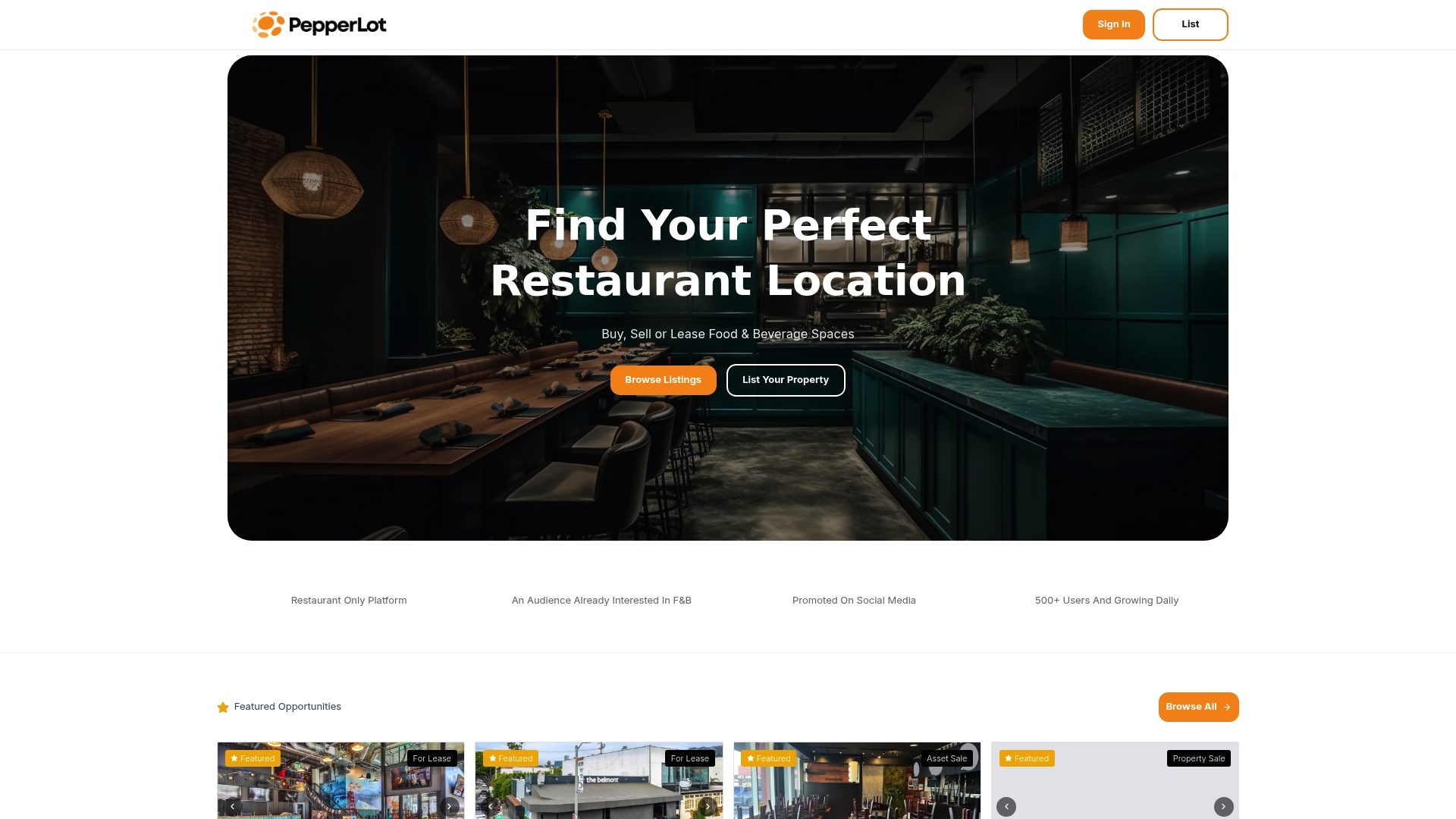
Whether you’re looking for a restaurant space for sale to anchor a passive income strategy, or you want to lease restaurant properties for your next concept, Pepperlot’s curated listings connect you with serious counterparties fast. The platform’s location intelligence tools let you analyze foot traffic, local competition, and demographic demand before you commit, so your next investment decision is grounded in data, not guesswork. With over 500 active users including operators, landlords, and brokers, Pepperlot puts you in the right room.
Frequently asked questions
What is a triple-net (NNN) lease in restaurant investing?
A triple-net lease means the tenant pays all operating expenses, including taxes, insurance, and maintenance, giving the landlord truly passive income with minimal management responsibility.
How does cost segregation benefit a restaurant property investor?
Cost segregation accelerates depreciation on building components, letting investors claim large upfront tax deductions that significantly improve first-year cash flow and overall IRR.
What cap rate should I target for a quick-service restaurant?
QSR cap rates averaged 5.68% in 2025, with top brands like Chick-fil-A and Chipotle trading in the mid-4% range and weaker operators pricing above 6%.
Are drive-thru restaurant properties better investments post-2020?
The $3.3M Panera Bread sale reflects strong investor demand for drive-thru assets, which have proven more operationally resilient and command premium pricing compared to dine-in-only formats.
What common mistakes should restaurant property investors avoid?
Overleveraging real estate without stress-testing tenant rent coverage is the most dangerous mistake, as the Red Lobster collapse demonstrated. Always prioritize location quality and lease durability over chasing yield.
Recommended
- Top benefits of buying restaurant space for growth
- Full Restaurant for Sale | PepperLot
- Full Restaurant for Sale | PepperLot
Browse restaurant space for lease and restaurants for sale on PepperLot.
Leave a Reply