TL;DR:
- A structured process helps operators select restaurant spaces aligned with their concept and budget.
- Conduct thorough inspections, market analysis, and negotiate lease terms to avoid costly mistakes.
- Second-generation spaces can save costs but require careful evaluation of hidden liabilities.
Finding the right restaurant space without a clear process is like trying to build a kitchen without a floor plan. Operators who skip the preparation phase routinely sign leases that drain their capital before they serve a single table. They overpay on buildout, discover grease trap problems after move-in, or land in a location with the wrong foot traffic pattern for their concept. A structured workflow changes all of that. This article walks you through every critical stage, from defining your requirements and running market analysis to negotiating lease terms and evaluating second-generation spaces, so you can move faster and smarter.
Table of Contents
- Define your restaurant requirements
- Conduct market and property analysis
- Financial benchmarks and risk management
- Lease negotiation and securing your space
- Second-generation space: Pros, pitfalls, and expert tips
- Our hard-won lessons: What most operators miss in restaurant space search
- Find your ideal restaurant space with Pepperlot
- Frequently asked questions
Key Takeaways
| Point | Details |
|---|---|
| Start with concept definition | Clarify your restaurant’s concept, target demographics, and space needs before beginning your search. |
| Evaluate market and property details | Check zoning, infrastructure, parking requirements, and tenant history to ensure suitability and avoid costly mistakes. |
| Follow financial benchmarks | Keep rent below 10% of projected revenue and look for favorable lease terms to protect your investment. |
| Negotiate key lease terms | Secure incentives like free rent and TI allowances, and ensure essential clauses are included in your lease. |
| Inspect second-gen spaces | Second-generation spaces can offer savings, but thorough inspections are vital to avoid hidden liabilities. |
Define your restaurant requirements
Before you tour a single property, you need a clear picture of what your concept actually demands. This step is where most operators lose time, because they start browsing listings before they know what they’re looking for.
Start with your concept and target customer. A fast-casual taco counter has entirely different space needs than a 90-seat fine dining room. Your target demographics shape everything from location to layout. Think about where your core customers live, work, and spend their evenings. That data should drive your geographic search, not just gut instinct.
Next, get specific about square footage. Defining space requirements means accounting for 1-2 square meters per cover in the dining area and 1-1.5 square meters per seat in the kitchen, along with infrastructure needs like hoods and grease traps. Those numbers shift based on your service model. A delivery-heavy ghost kitchen needs more kitchen square footage and far less front-of-house space. A full-service restaurant needs the reverse.
Infrastructure is where surprises get expensive. Identify your non-negotiables before visiting any property:
- Ventilation and hood systems: What type of cooking will you do? Heavy frying requires a Type 1 hood; lighter prep may only need a Type 2.
- Grease trap capacity: Undersized traps create compliance headaches and costly retrofits.
- Gas line capacity: High-BTU equipment needs adequate supply. Verify before you fall in love with a space.
- Electrical load: Commercial kitchens often require 200-400 amp service. Older buildings frequently fall short.
- Plumbing and floor drains: Placement matters enormously for kitchen workflow.
- ADA compliance: Restrooms, entrances, and seating configurations must meet code.
- Outdoor patio potential: If your concept benefits from al fresco dining, factor in permitting requirements early.
Use a thorough restaurant space checklist to document each requirement before you step foot in a property. This keeps site visits focused and prevents emotional decisions from overriding practical ones.
| Requirement | Minimum standard | Notes |
|---|---|---|
| Dining area | 1-2 sqm per cover | Adjust for service style |
| Kitchen area | 1-1.5 sqm per seat | Higher for complex menus |
| Electrical service | 200-400 amp | Verify with utility |
| Hood system | Type 1 for heavy cooking | Inspect condition |
| Grease trap | Sized for menu volume | Check local code |
Pro Tip: Build in 15-20% extra square footage beyond your current projection. Concepts evolve, menus grow, and adding a prep station or a second POS counter becomes nearly impossible if you’ve maxed out your footprint from day one.
Conduct market and property analysis
Having defined your requirements, the next crucial step is evaluating both the market and individual property details. This is where analyzing location data separates operators who thrive from those who struggle through their first year.

A thorough property evaluation covers a lot of ground. Restaurant analysis benchmarks tell us that good evaluation checks zoning and permits, mechanicals like gas and electrical capacity, HVAC for kitchen heat load, layout flow, parking ratios of 1 space per 150-200 square feet for casual dining, and previous tenant performance, specifically avoiding sites with two or more failures in three to five years.
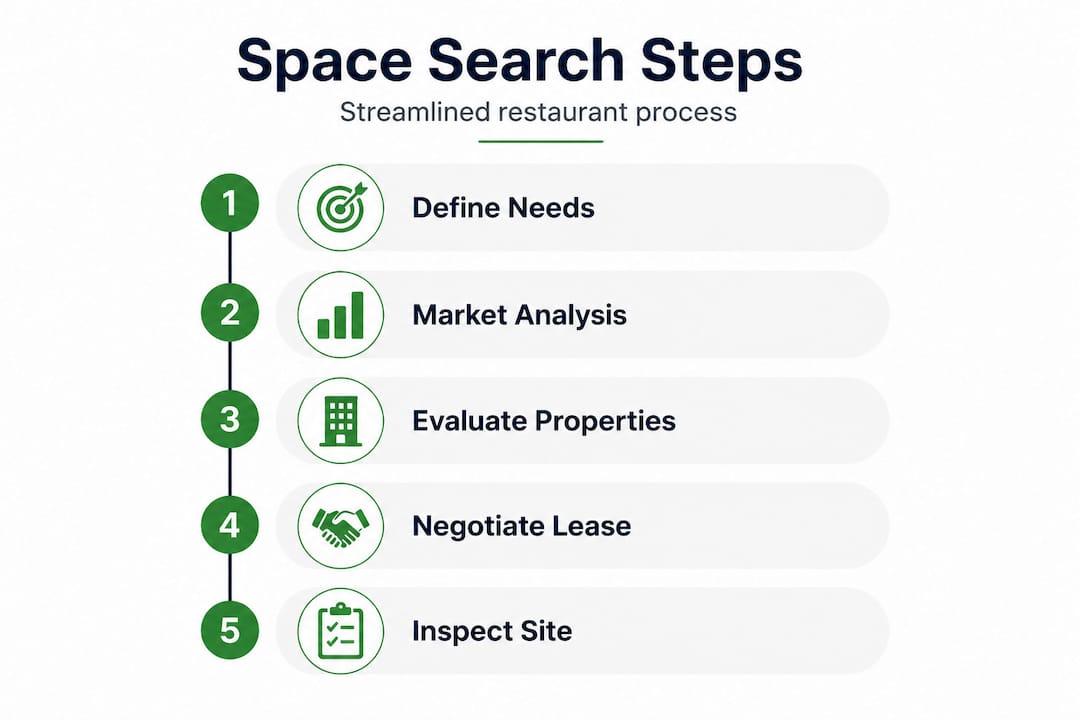
Follow this numbered workflow for every property you seriously consider:
- Verify zoning and permitted use. Confirm the address allows food service. Review zoning requirements specific to your state and municipality, especially for alcohol service, outdoor dining, or late-night hours.
- Review mechanical systems. Inspect gas lines, electrical panels, HVAC capacity, and plumbing. Hire a licensed inspector if the landlord’s disclosures are vague.
- Assess layout flow. Walk the space with your kitchen designer. Traffic patterns between the kitchen, service stations, and exits matter more than raw square footage.
- Check parking availability. Inadequate parking is a silent killer for casual and family dining concepts. Confirm whether nearby lots are shared or restricted.
- Research previous tenants. If two or more restaurants failed at a location within five years, dig into why. Sometimes it’s a bad operator. Often, it’s a structural problem with visibility, access, or demographics.
- Evaluate the competitive landscape. How many similar concepts operate within a half-mile radius? Saturation can be an opportunity or a warning sign, depending on your differentiation.
Use a detailed property evaluation checklist to score each property against your requirements. This creates an objective comparison framework instead of relying on which space felt best during the tour.
| Property type | Buildout cost | Timeline | Risk level |
|---|---|---|---|
| Second-generation restaurant | Low to medium | 2-6 months | Medium (hidden liabilities) |
| Vanilla shell (new build) | Medium to high | 6-12 months | Lower (known condition) |
| Raw space (cold dark shell) | High | 12-18 months | Higher (full buildout) |
| Existing restaurant for sale | Variable | 1-3 months | Variable (depends on deal) |
Watch out: A location that looks perfect on paper can carry invisible baggage. If the previous tenant left under financial distress, the landlord may have deferred maintenance. Always ask for the last two years of utility bills and any inspection reports before making an offer.
Financial benchmarks and risk management
Once you’ve assessed the property, it’s time to ensure your finances are on track and risks are minimized. Numbers don’t lie, and the restaurant industry’s margins are too thin to absorb avoidable financial mistakes.
Here are the key financial benchmarks every operator should know before signing anything:
- Rent as a percentage of revenue: Should not exceed 10% of projected gross revenue. Many operators stretch to 12-15% and spend years fighting to break even.
- Occupancy cost ratio: Total occupancy costs, including rent, CAM (common area maintenance), insurance, and taxes, should stay at or below 6-10% of projected revenue.
- QSR buildout budget: Quick service restaurant buildouts typically run $500,000 to $1 million.
- Casual dining buildout budget: Full-service casual concepts often exceed $2 million, especially in high-cost urban markets.
- Payback period: Target a buildout payback period of three to five years based on realistic revenue projections.
The stakes are real. Industry failure data shows that 60% of new restaurants fail within three years, and location accounts for 60-70% of that variance. Rent discipline and location quality are not separate decisions. They’re the same decision.
“Occupancy costs above 10% of revenue compress your margins to the point where even a strong concept can’t survive a slow quarter. Treat your rent ceiling as a hard limit, not a negotiating target.”
Understanding the difference between sale vs. lease structures also affects your risk profile. Purchasing a building ties up capital but eliminates rent escalation risk. Leasing preserves cash flow but exposes you to renewal uncertainty. Neither is universally better. The right answer depends on your concept’s stage and your financial runway.
Pro Tip: Negotiate a personal guarantee limitation from the start. Landlords often ask for full-term personal guarantees. Push back with a “burn-down” guarantee that reduces your personal liability as you hit revenue or tenure milestones. This protects your personal assets if the concept underperforms in its early years.
Good hospitality maintenance planning also factors into your financial model. Budget 1-3% of revenue annually for equipment maintenance, especially in second-generation spaces where aging systems can fail without warning.
Lease negotiation and securing your space
After crunching the numbers, your next task is to secure favorable lease terms to protect your business and maximize potential. This is where preparation pays off in real dollars.
The lease negotiation workflow follows a clear sequence: start with a Letter of Intent (LOI), negotiate free rent for buildout, secure a Tenant Improvement (TI) allowance of $20-150 per square foot, cap NNN/CAM increases at 3-5%, lock in exclusive use rights, negotiate assignment rights without unreasonable landlord withholding, limit your personal guarantee, and include a kick-out clause tied to a revenue threshold.
Work through these steps in order:
- Submit a Letter of Intent (LOI). This non-binding document establishes your key terms before attorneys get involved. It saves everyone time and surfaces deal-breakers early.
- Negotiate free rent for the buildout period. Request 3-6 months of rent abatement while you construct and open. Landlords who want quality tenants often agree to this.
- Secure a TI allowance. Tenant Improvement allowances typically range from $20-150 per square foot depending on market conditions and landlord motivation. Push for the higher end in slower markets.
- Cap NNN and CAM charges. Triple-net leases pass operating costs to tenants. Negotiate annual caps of 3-5% on CAM increases to prevent surprise cost spikes.
- Add an exclusive use clause. Prevent your landlord from leasing adjacent space to a direct competitor. Be specific about cuisine type and service format.
- Negotiate assignment rights. You need the ability to transfer your lease if you sell the business. Require that the landlord cannot withhold consent unreasonably.
- Limit your personal guarantee. Avoid open-ended personal liability. A burn-down guarantee or a capped dollar amount protects you without killing the deal.
- Include a kick-out clause. If revenue falls below a defined threshold for a sustained period, this clause lets you exit the lease without full penalty.
Understand every term before you sign. Review lease term explanations and the difference between assignment vs. sublease rights so you know exactly what flexibility you’re negotiating for.
Pro Tip: Hire a restaurant-specialized attorney to review the final lease, not a general commercial real estate lawyer. Restaurant leases contain use clauses, co-tenancy provisions, and exclusivity language that general practitioners routinely miss or misinterpret.
Second-generation space: Pros, pitfalls, and expert tips
Finally, consider the often-overlooked opportunities and risks in second-generation restaurant spaces. A second-gen space is any location that previously operated as a restaurant. The existing infrastructure, hoods, grease traps, plumbing, and sometimes even equipment, can dramatically reduce your buildout cost and timeline.
The savings are real, but so are the risks. Second-generation space benefits are compelling, but hidden liabilities can turn a bargain into a money pit. Common issues include:
- Faulty or undersized hood systems that fail inspection after you’ve signed the lease
- Grease traps in poor condition that require full replacement, often costing $15,000-$40,000
- Outdated electrical panels that can’t support modern kitchen equipment
- Plumbing layouts that don’t match your kitchen design, requiring expensive rerouting
- Previous tenant violations that created unresolved code issues or permit holds
- Lease restrictions inherited from prior tenants, especially in markets like New York City where use clauses can limit service hours, alcohol licensing, or even specific meal periods like brunch
Always verify infrastructure condition through independent inspection before signing. Don’t rely on the landlord’s representations or a visual walkthrough. Pull permits, check inspection records with the local health department, and have a licensed plumber and electrician assess the systems.
Pro Tip: Ask the landlord for the previous tenant’s utility bills, health inspection history, and any equipment service records. This data tells you more about the true condition of the space than any tour will.
For a broader foundation, restaurant real estate basics can help you contextualize whether a second-gen space or a fresh buildout makes more sense for your specific concept and financial position.
Our hard-won lessons: What most operators miss in restaurant space search
Here’s the uncomfortable truth that most real estate guides won’t tell you: the majority of restaurant space searches go wrong not because operators lack information, but because they rush. The excitement of a promising location overrides the discipline of due diligence. We’ve seen operators skip the mechanical inspection on a second-gen space because the landlord seemed trustworthy, only to discover a condemned grease trap after opening day.
The single most common mistake is treating the search as a linear process when it’s actually iterative. You define requirements, then the market teaches you something new, and you refine your requirements again. Operators who resist this loop end up forcing a bad fit.
Previous tenant failures deserve more attention than most guides give them. Two failed restaurants at the same address in five years is not a coincidence. It usually signals a structural problem: poor visibility from the street, a parking configuration that frustrates customers, or a demographic mismatch that no amount of marketing can fix. The lessons from second-generation space research consistently show that operators who investigate failure history before signing outperform those who don’t.
Rushing to sign is the other major trap. Landlords create urgency. “We have another offer” is a negotiating tactic as old as commercial real estate itself. Operators who hold their process, complete their inspections, and insist on legal review consistently secure better terms than those who panic-sign. The few weeks you save by skipping steps will cost you years of margin compression or an exit you can’t afford.
Find your ideal restaurant space with Pepperlot
With the workflow and expert perspectives in mind, make your search easier by leveraging dedicated tools and listings built specifically for the restaurant industry.
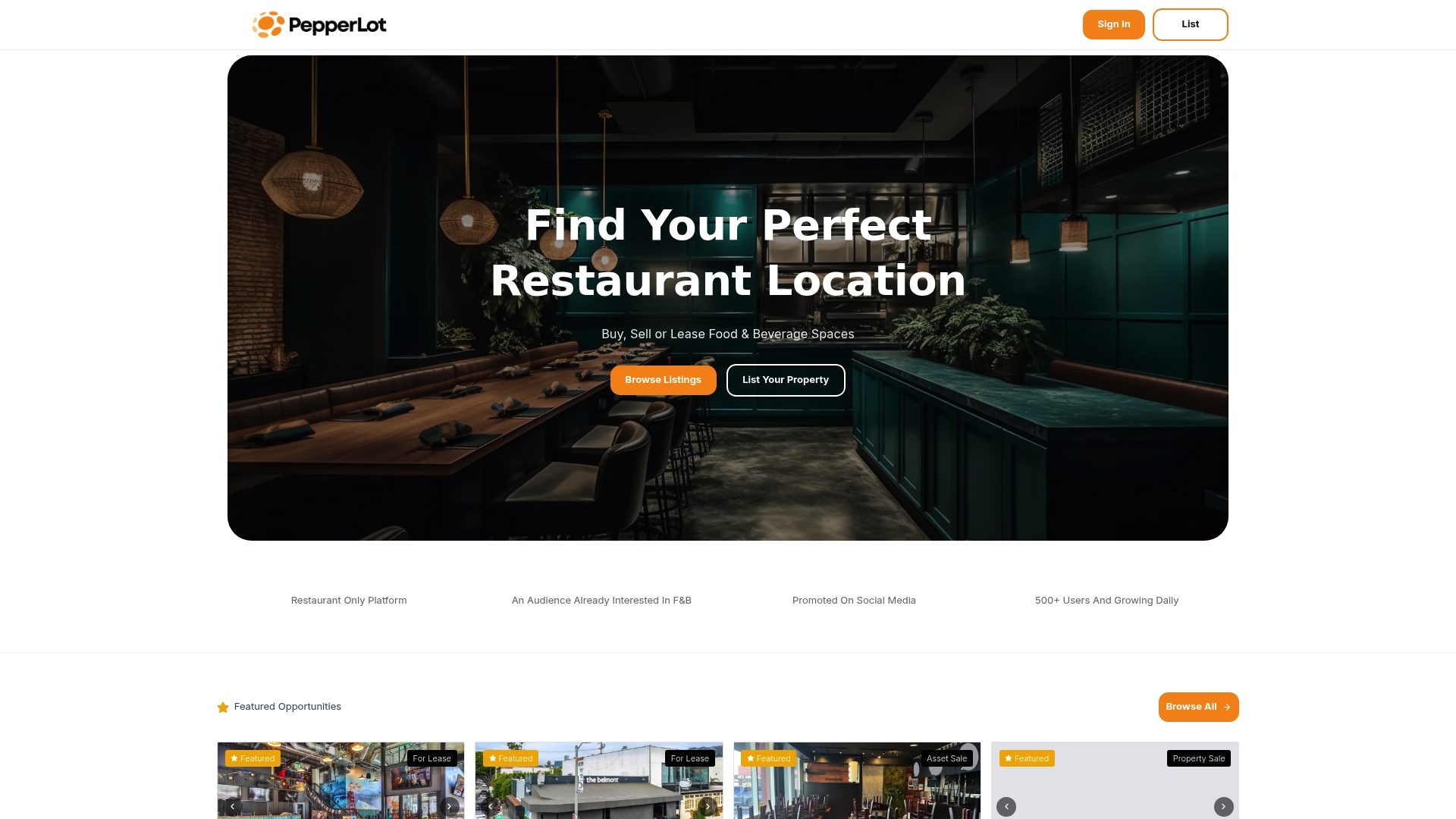
Pepperlot is the only marketplace built exclusively for restaurant and food and beverage real estate. Every listing includes the details that actually matter to operators: grease trap specs, seating capacity, permit status, hood systems, and outdoor patio availability. Browse an active restaurant lease listing or explore a turnkey restaurant for sale in Inglewood, CA to see how curated listings save you hours of back-and-forth with generic commercial brokers. Pair that with Pepperlot’s location intelligence tools to analyze foot traffic, local competition, and demographic fit before you ever schedule a tour. Your next location decision deserves better data.
Frequently asked questions
What is a second-generation restaurant space and why consider it?
A second-generation restaurant space is a location previously used for restaurant operations, and it often saves time and money on buildout. However, always inspect for hidden liabilities like faulty hoods or grease traps, and in markets like New York City, review use clauses carefully to avoid restrictions on alcohol or specific meal service.
How much space do I need per seat or cover for my restaurant?
Plan for 1-2 square meters per cover in dining areas and 1-1.5 square meters per seat in the kitchen, adjusting based on your service model and menu complexity.
What financial benchmarks should guide my lease or purchase decision?
Rent should not exceed 10% of projected revenue, occupancy costs should stay at 6-10%, and QSR buildouts run $500k-1M while casual restaurant buildouts often exceed $2 million.
What are the most critical lease negotiation terms for restaurant space?
Prioritize free rent for buildout, TI allowances of $20-150 per square foot, NNN/CAM caps at 3-5%, exclusive use clauses, reasonable assignment rights, and a limited personal guarantee with burn-down provisions.
How do I avoid hidden liabilities when acquiring restaurant space?
Always conduct independent inspections of hoods, grease traps, and electrical systems, and review previous tenant history with the local health department and permit office before signing any lease or purchase agreement.
Recommended
- The Hidden Costs of Building Out a Restaurant Space (and How to Avoid Them | PepperLot Blog
- Choosing the right restaurant space: types and key factors – Pepperlot Blog
- Second-Generation Restaurant Spaces: The Smartest Way to Launch Your Concept | PepperLot Blog
- Expert Restaurant Real Estate Tips: Secure the Ideal Space – Pepperlot Blog
Leave a Reply